How to lie using visual proofs
Based on 3Blue1Brown's video on YouTube. If you like this content, support the original creators by watching, liking and subscribing to their content.
Unwrapping curved surfaces into flat shapes can change edge geometry; Gaussian curvature means you can’t flatten without losing information.
Briefing
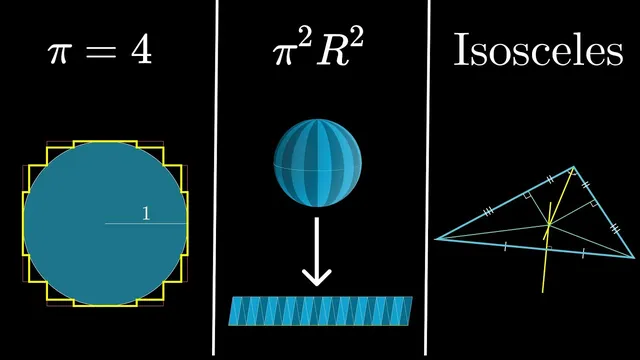
A run of “visual proofs” goes spectacularly wrong in three different ways—showing that convincing pictures can hide fatal assumptions about geometry, limits, and even where a constructed point actually lies. The most striking example starts with a sphere sliced into vertical wedges, then “unwrapped” into a shape treated like a rectangle. That setup yields an area of π²R², even though the true surface area of a sphere is 4πR². The mismatch isn’t a minor arithmetic slip; it comes from flattening curved geometry into flat space without preserving the wedge shapes’ true edge behavior.
The sphere argument begins by taking the sphere’s surface and cutting it into many orange-like slices. Unraveling the northern hemisphere wedges and the southern hemisphere wedges and then interlacing them creates a target shape whose base is taken as the unraveled equator length (2πR) and whose height is treated as a quarter of a circumference (πR/2). As the slices get thinner, the picture suggests the shape should converge to a perfect rectangle, giving area (2πR)(πR/2)=π²R². But the curvature of the sphere matters: when a wedge is unwrapped while trying to preserve its geometry, its edges don’t behave linearly. The wedge’s width changes with latitude according to a sine relationship (proportional to 2πR·sin(φ)), so the flattened edges should bulge outward rather than remain straight. Because the edges are non-linear, the northern and southern pieces overlap in a way that does not vanish under finer slicing—so the “limit” doesn’t rescue the calculation.
A second fake proof targets a different kind of subtlety: limits. A classic construction starts with a unit circle and inscribes a square whose perimeter is 8. Then a sequence of jagged curves is built so each iteration still has perimeter 8 while the curves get closer to the circle. The visual claim is that the circle’s circumference must also be 8, implying π=4. The key mathematical correction is that even if the curves converge pointwise to the circle, there’s no guarantee that the lengths of the approximating curves converge to the length of the limiting curve. Here, the approximations remain inefficient—jagged in a way that preserves perimeter at 8—so the “limit of lengths” and “length of the limit” come apart.
The third example is a Euclid-style congruence chase that tries to prove every triangle is isosceles (and even equilateral). It constructs an angle bisector and perpendicular bisector, then uses side-angle-side and related congruence arguments to conclude AB must equal AC. Every congruence step can be made valid, but the proof collapses at the end: it assumes a constructed point E lies between A and C, so that AC=AE+EC. In many triangles, the intersection point actually falls outside the segment, making that final addition invalid. The result is a reminder that hidden assumptions—about where points land, about what “straight” really means, and about what limits preserve—are where visual certainty becomes mathematical error.
Taken together, the three failures map to three lessons: curved surfaces can’t be flattened without losing geometric information (Gaussian curvature), convergence of shapes doesn’t automatically preserve length, and diagram-based constructions can smuggle in positional assumptions. Visual intuition is powerful, but it never replaces rigor and edge-case checking.
Cornell Notes
Three “visual proofs” fail for three distinct reasons: curvature, limits, and hidden positional assumptions. A sphere-slicing argument unwraps curved wedges as if they form a rectangle, but the wedge edges change nonlinearly with latitude, causing persistent overlap and the wrong area (π²R² instead of 4πR²). A second construction approximates a circle with jagged curves that all have perimeter 8, tempting a conclusion that π=4; the flaw is that the limit of curve lengths need not equal the length of the limiting curve. The final Euclid-style congruence proof claims all triangles are isosceles, but it breaks when a constructed point lies outside a segment, invalidating a final length addition (AC=AE+EC). These cases show why rigor must check geometry, limit behavior, and hidden assumptions.
Why does the sphere-slicing “rectangle” argument produce π²R² instead of 4πR²?
What is the precise mathematical trap in the “π=4” perimeter construction?
How can a Euclid-style congruence proof be logically valid in its triangle comparisons yet still end up wrong?
What role does Gaussian curvature play in the failure of the sphere visual proof?
Why does the pizza-wedge argument for the area of a circle work even though it also “unravels” wedges?
Review Questions
- In the sphere argument, what specific functional relationship (involving sin(φ)) causes the wedge edges to behave nonlinearly after unwrapping?
- Give an example of why pointwise convergence of curves does not guarantee convergence of their lengths.
- In the triangle proof, what hidden condition about the location of point E makes the final step AC=AE+EC fail?
Key Points
- 1
Unwrapping curved surfaces into flat shapes can change edge geometry; Gaussian curvature means you can’t flatten without losing information.
- 2
A sphere-slicing “rectangle” estimate fails because wedge widths vary nonlinearly with latitude (proportional to sin(φ)), creating overlap that persists under finer slicing.
- 3
Convergence of shapes does not automatically preserve length; “limit of lengths” can differ from “length of the limit.”
- 4
A perimeter-preserving sequence of jagged curves can converge to a smooth curve while still having the wrong limiting length.
- 5
Euclid-style congruence arguments can be correct while the overall proof fails due to a final step that assumes a constructed point lies between two others.
- 6
Visual proofs often smuggle in hidden assumptions about straightness, containment, or segment order; checking edge cases is essential.