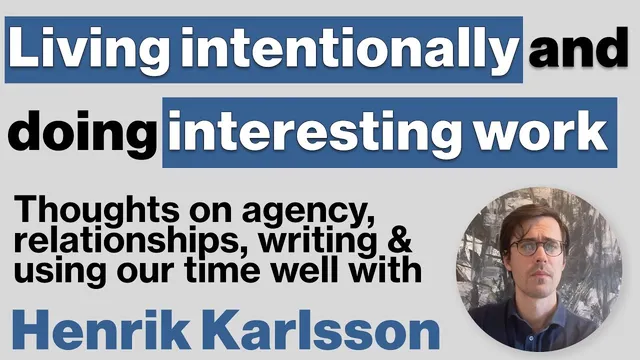
How to Live Intentionally and Do Interesting, Meaningful Work with Henrik Karlsson
Based on CombiningMinds's video on YouTube. If you like this content, support the original creators by watching, liking and subscribing to their content.
Karlsson defines “interesting work” as output that grows from intentional life constraints—especially relationships and attention—rather than from chasing productivity.
Briefing
Meaningful work, in Henrik Karlsson’s orbit, comes less from chasing productivity and more from designing a life that protects attention, relationships, and honest inquiry. He frames “interesting work” as writing and other creative efforts that unfold alongside real commitments—especially family—rather than as a career ladder. The practical implication is stark: people should treat time as a scarce resource and make deliberate tradeoffs, because the alternative is drifting into low-value consumption and constant opportunity-cost regret.
Karlsson traces his writing practice to a personal origin story: after a close friend’s suicide when he was 15, he began writing intensely as a way to process trauma. Over the next decade, he moved through Sweden’s literary world—magazines, editing, readings—yet later felt those spaces couldn’t hold the full range of his inner layers. Around the time he met his wife, he chose to stop conforming to those literary norms and kept writing privately, later returning to a public career through Substack. That shift wasn’t just about distribution; it was about incentives. Substack’s model, he says, supports long-term, “weird” bets and allows interior, relationship-centered writing that traditional publishing often dilutes.
A recurring theme is that culture is built through small, consistent experiments. Karlsson describes his own role as part of a fringe community that tests new norms—then, over time, those practices can spread. He also argues that privilege creates responsibility: with lower living costs and access to Denmark’s public healthcare, he can afford to be generous with his time and attention. Still, he insists that generosity has limits at scale; once his audience grew, he couldn’t keep up with reading and commenting on strangers’ essays. His solution includes experiments like a “wastebook” space for lower-visibility, higher-trust conversation, where he can take more risks and recreate the intimacy of early readership.
On the craft side, Karlsson emphasizes filtering. He publishes slowly because deep research and multiple drafts produce “lived-in” ideas—layers that are hard to extract when writing quickly. He contrasts his approach with faster, hook-driven writers (including Sasha, whom he reads), arguing that rapid publication can leave deeper implications unmined. For him, the cost-benefit decision is constant: finishing one piece might require more time than the next, better reframing would. He also treats writing as an upward spiral—revisiting older ideas with new context and nuance.
Technology enters as a means, not a mission. He uses Obsidian and a chaotic, agentic note system designed to support retrieval and re-entry into thinking, not to enforce rigid structure. He keeps enough structure to resurface ideas, then lets the system evolve organically as his needs change. Editing, too, is collaborative and trust-based: he and his wife use Google Docs for iterative, sometimes brutal cuts and rewrites, aiming to preserve the core insight rather than polish surface details.
Finally, Karlsson warns that social platforms can cheapen the process by rewarding visibility and instant feedback. He uses Twitter more pragmatically—reposting quotes to revive older essays and testing framings—while keeping an “arm’s length” boundary to avoid dopamine loops. The overall message is that intentional living is not effortless; it can be exhausting during transitions (language learning, homeschooling, financial strain). But once aligned, it becomes emotionally sustaining—so sustaining that he describes crying while watching his children and realizing he gets to write at all.
Cornell Notes
Henrik Karlsson links “interesting work” to intentional life design: protect attention, invest in relationships, and publish only after ideas have been metabolized through deep reading and revision. His writing practice began as trauma processing at age 15 and later evolved through literary work in Sweden, then a shift toward public, interior writing via Substack. He treats audience-building as a community problem that changes with scale—early intimacy enabled heavy feedback, but growth forced boundaries and experiments like a lower-visibility “wastebook.” On craft, he prioritizes filtering and opportunity cost: finishing a piece can require more time than the next reframing would. Tools like Obsidian matter mainly for retrieval and flexibility, not for enforcing rigid systems.
Why does Karlsson believe “interesting work” depends on life design rather than just writing habits?
How did Karlsson’s early writing practice form, and what changed later?
What does “filtering” mean in his publishing approach?
How does he handle community and feedback as his audience grows?
What role do social platforms play, and why does he keep boundaries?
How does his Obsidian workflow reflect his philosophy about tools?
Review Questions
- What tradeoffs does Karlsson make between deep revision and publishing frequency, and how does opportunity cost shape his decisions?
- How does he reconcile the need for community feedback with the limits that come at audience scale?
- In what ways does his Obsidian approach prioritize retrieval and flexibility over strict system design?
Key Points
- 1
Karlsson defines “interesting work” as output that grows from intentional life constraints—especially relationships and attention—rather than from chasing productivity.
- 2
Writing began as trauma processing at age 15, then evolved through traditional literary spaces before shifting toward more idiosyncratic, interior public work via Substack.
- 3
He publishes selectively because deep research and multi-draft revision create nuance that faster publishing often misses; opportunity cost determines what gets finished.
- 4
Community feedback is powerful early but becomes unmanageable at scale, prompting experiments like a low-visibility “wastebook” to preserve intimacy and risk-taking.
- 5
He treats social platforms as context-sensitive tools: Twitter can revive older essays and test framings, but instant validation can distort priorities.
- 6
His note-taking philosophy uses Obsidian for retrieval and flexible re-entry into thinking, keeping structure minimal and letting the system evolve with changing needs.
- 7
Intentional living can be brutal during major transitions (language learning, homeschooling, financial strain), but once aligned it becomes emotionally sustaining.