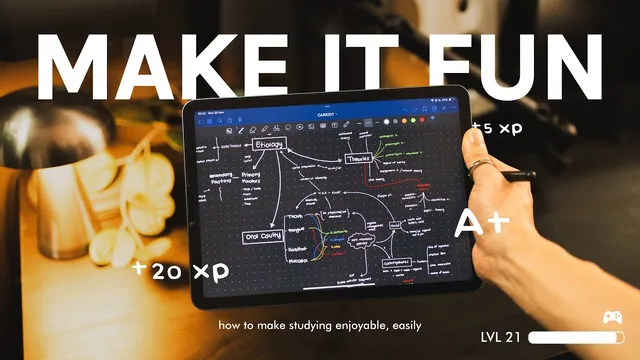
how to make studying ADDICTING, like a video game.
Based on Kai Notebook's video on YouTube. If you like this content, support the original creators by watching, liking and subscribing to their content.
Studying often feels boring because it lacks the immediate reward and clear progress cues that games provide.
Briefing
Studying often feels painful because it delivers little immediate reward—unlike social media or games that quickly trigger dopamine and clear wins. The core fix is to rebuild studying as a game: add reward progression, create an exchangeable reward system, and adopt a “leveling up” mindset so effort feels purposeful rather than punishing.
The first step is gamifying study by borrowing what makes games addictive: the reward–progress loop. Games typically require low “friction” to start, then provide frequent, visible accomplishments—finishing quests, defeating bosses, winning matches—so the brain gets direction and achievement. Just as important, games make progress easy to track: a character starts weak, then grows stronger through repeated actions. That combination of low input energy and constant feedback turns effort into momentum. Studying, by contrast, is often slow and non-intuitive when new material makes people feel lost or overwhelmed, which kills motivation before any real progress can register.
To recreate that loop, the second step is building a personal reward system. The method is simple: set an exchange rate between study work and leisure rewards. For example, studying three hours a day could earn one hour of gaming, or rewards can be tied to task counts or performance—like earning points for completing study sessions or mastering specific subjects. The point isn’t strictness; it’s fairness. Without a reward system, leisure time can feel like something you “take” even when you haven’t earned it, which can lead to procrastination or guilt. With a system, leisure becomes the payoff for completing the work.
A practical implementation uses Pomodoro timers as a measurable unit. One suggested metric: after every three Pomodoro sessions completed, reward yourself with one hour of gaming. Another option is a daily rule—finish a set number of Pomodoros (like five) and then earn the rest of the day for free time. The transcript emphasizes writing the rules down and keeping them accessible so the exchange is clear and you don’t forget.
The third step is a level mindset, essentially reframing study as growth and XP gain. Instead of viewing difficulty as proof of falling behind, it’s treated as unexplored territory or a quest. Each completed topic or assignment becomes a “level up,” and harder material yields more XP. That reframing aims to reduce demotivation by turning the unknown into a challenge rather than an obstacle.
As a final bonus, the approach recommends changing study methods when current techniques don’t support real learning. Some methods can become tedious instead of engaging, so the goal is to find strategies that align with how learning actually works—learning and mastering new concepts should feel rewarding, not mechanical. The overall message is that studying becomes sustainable when effort reliably leads to visible progress, earned rewards, and a mindset that treats academic work as personal advancement.
Cornell Notes
Studying feels boring largely because it offers weak immediate rewards and unclear progress compared with games or social media. A practical solution is to gamify study: create a reward progression loop where effort earns tangible payoffs. Build a personal exchange system (for example, Pomodoro sessions or task completion) that trades study work for leisure time like gaming. Pair that with a “level mindset” that treats each topic mastered as XP and frames difficulty as a quest rather than failure. When motivation still lags, adjust study methods so they support real learning instead of turning practice into tedious busywork.
Why does studying feel less rewarding than activities like games or social media?
What does “gamifying” studying mean in concrete terms?
How can someone set up a reward system for studying?
What are practical ways to measure study work for rewards?
How does a “level mindset” change the experience of studying difficult material?
Review Questions
- What specific game mechanics (progress tracking, frequent wins, low friction) can be mapped onto your current study routine?
- Design an exchange rate between a measurable study unit (like Pomodoros or tasks) and a leisure reward. What rule would you write down and where would you keep it?
- How would you rewrite your interpretation of “I’m struggling” into a level/XP framing for one upcoming assignment?
Key Points
- 1
Studying often feels boring because it lacks the immediate reward and clear progress cues that games provide.
- 2
Gamify study by recreating a reward–progress loop: visible wins, direction, and trackable improvement.
- 3
Set a personal exchange rate that trades study effort (hours, tasks, or Pomodoro sessions) for a specific leisure reward.
- 4
Use measurable units like Pomodoro timers to make rewards fair and predictable, and write the rules where you can access them.
- 5
Adopt a level mindset: treat each mastered topic as XP and difficulty as a quest rather than evidence of falling behind.
- 6
If motivation still drops, switch to study methods that support real learning instead of turning practice into tedious work.