How To Measure The Tiniest Forces In The Universe
Based on Veritasium's video on YouTube. If you like this content, support the original creators by watching, liking and subscribing to their content.
The kilogram was redefined in 2019 using Planck’s constant to eliminate drift associated with a physical prototype artifact.
Briefing
Measuring forces at the scale of a few femtonewtons—down to the level where a stretched DNA molecule can be used as a reference—has become practical thanks to a chain of modern mass and force metrology that ties everyday measurements to constants of nature. The core point is that today’s smallest force measurements aren’t just “tiny”; they’re traceable to the International System of Units (SI), meaning the numbers can be defended against fundamental standards rather than drifting with physical artifacts.
The story starts with mass. For decades, the kilogram was anchored to a platinum-iridium cylinder stored near Paris, with replicas distributed worldwide. That approach worked well for larger masses, but it carried a hidden weakness: the uncertainty in the standard kilogram’s mass was on the order of tens of micrograms, and the uncertainty worsened when weighing objects lighter than a kilogram. In practice, lab test weights—50 grams, 10 grams, even 1 gram—help calibrate scales, but they don’t solve the deeper problem of how to keep the unit stable when the reference itself can change.
A century of comparisons among replica kilograms revealed that the copies diverged by as much as 75 micrograms, with no way to know whether the original was gaining or losing mass. The fix was to redefine the kilogram using Planck’s constant, set in 2019. Since energy and mass relate through E = mc² and Planck’s constant links photon frequency to energy via E = hf, the kilogram becomes a derived unit tied to a constant rather than a physical object.
That redefinition enables high-precision instruments such as the Kibble balance, which replaces a direct mechanical comparison with an electromagnetic one. By balancing an object’s weight against an electromagnetic force and reading electrical quantities extremely accurately, the measurement becomes directly traceable to Planck’s constant. A related instrument, the electrostatic force balance (EFB), targets the milligram range by comparing gravitational force from a test mass to electrostatic attraction produced by a capacitor-like setup.
To push accuracy further, the lab environment matters as much as the hardware. Measurements occur deep underground to reduce vibration, at a tightly controlled 20°C to limit thermal expansion, and in vacuum to remove air currents and buoyant forces. Even local gravity is measured precisely using an absolute gravity setup.
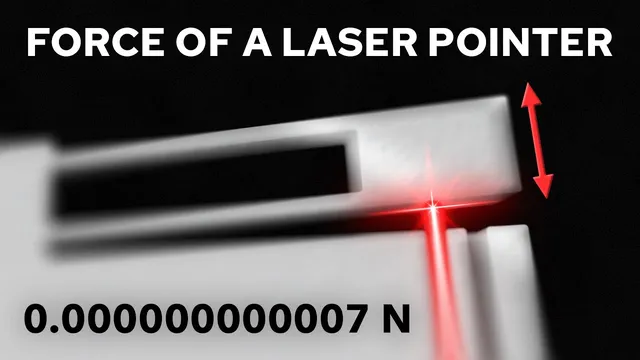
At the milligram level, the apparatus can resolve forces around 10 micro newtons. The smallest visible test weight discussed is 10 micrograms—so tiny it resembles a hair or smaller-than-an-eyelash—and the uncertainty associated with the kilogram definition sits at roughly that scale. Going below that requires different technology: atomic force microscope cantilevers act like micro-scale diving boards, where bending reveals force. With specialized sensors and optical readout (including laser interferometry and photon pressure), researchers can measure forces down to femtonewtons. The transcript gives a concrete benchmark: a piconewton corresponds to stretching a DNA molecule end-to-end.
Finally, the need for such precision is tied to real-world applications—like measuring particulate emissions in diesel systems, calibrating laser power in industrial processes, and handling microgram-to-milligram pharmaceutical doses—while also serving fundamental science, where better measurements enable new discoveries and, in turn, new measurement techniques.
Cornell Notes
The kilogram’s stability shifted from a physical platinum-iridium cylinder to a definition based on Planck’s constant, enabling traceable measurements at much smaller mass scales. Instruments like the Kibble balance and the electrostatic force balance convert weight into electromagnetic or electrostatic forces, letting labs read electrical quantities with high precision and link results directly to SI. To reach tiny forces, labs control temperature, eliminate air effects with vacuum, and even measure local gravity precisely. At the extreme end, atomic force microscope cantilevers and optical methods (including photon pressure) allow force measurements down to femtonewtons—where a piconewton is comparable to stretching a DNA molecule. Such capability matters both for industry and for pushing scientific frontiers.
Why did the kilogram’s old “prototype cylinder” approach become a problem for ultra-precise weighing?
How does redefining the kilogram using Planck’s constant improve measurement traceability?
What makes a Kibble balance different from a traditional scale?
Why do labs go to extreme lengths—underground, vacuum, and temperature control—when measuring tiny forces?
How do atomic force microscope cantilevers enable femtonewton-level force measurements?
What real-world reference is used to make piconewton forces intuitive?
Review Questions
- How does the SI redefinition of the kilogram using Planck’s constant change what “traceable mass” means in practice?
- Describe the measurement chain from a gravitational force to an electromagnetic or electrostatic force in the Kibble balance or EFB.
- What environmental factors (temperature, vacuum, gravity, vibration) most threaten accuracy when measuring forces in the micro- to femtonewton range?
Key Points
- 1
The kilogram was redefined in 2019 using Planck’s constant to eliminate drift associated with a physical prototype artifact.
- 2
Uncertainty in mass standards grows when weighing objects far below a kilogram, motivating instruments designed for small-mass traceability.
- 3
A Kibble balance measures weight by balancing it against an electromagnetic force and reading electrical quantities with high precision tied to Planck’s constant.
- 4
An electrostatic force balance (EFB) targets the milligram range by comparing gravitational force to electrostatic attraction from a capacitor-like geometry.
- 5
Ultra-small force measurements require strict environmental control: deep underground, stable temperature (~20°C), vacuum to remove buoyancy, and precise local gravity measurements.
- 6
Atomic force microscope cantilevers convert tiny forces into measurable deflections, with optical methods enabling detection down to femtonewtons.
- 7
Industrial and scientific needs—emissions testing, laser power calibration, pharmaceutical dosing, and fundamental research—drive demand for force metrology at these scales.