How to Never Lose a Customer Again
Based on Tiago Forte's video on YouTube. If you like this content, support the original creators by watching, liking and subscribing to their content.
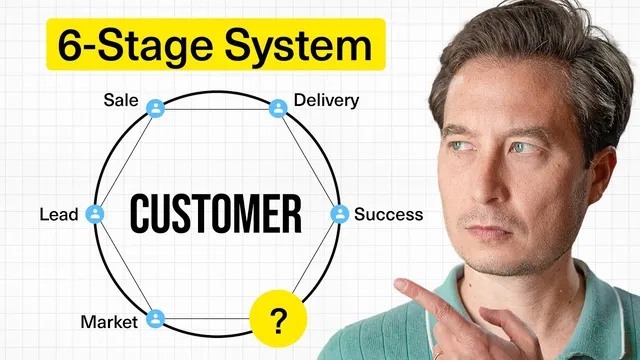
Track all six customer journey stages—market-to-lead, lead-to-sale, delivery, success, success-to-market, and success-to-sale—because measuring only the first half hides revenue leaks.
Briefing
Businesses can’t fix customer churn or inconsistent revenue without knowing where customers stall—how many people they lose, how many almost buy, and how many turn into referrals. The core prescription is a six-stage customer journey framework that tracks the full path from first contact to ongoing growth, because most companies only measure the early half and ignore the parts that create repeat value and word-of-mouth.
Instead of the common three-step view—marketing, sales, delivery—the framework breaks the journey into six stages: market-to-lead, lead-to-sale, delivery, success, success-to-market, and success-to-sale. The early stages matter because inefficiencies often hide in how lead flow is generated versus how leads are converted. Many teams also misallocate ownership: some founders over-index on marketing (especially when they have a strong organic channel like YouTube) and neglect lead-to-sale, while others are champion closers who ignore marketing. The practical fix is to assess market-to-lead and lead-to-sale separately against benchmarks, then tighten the funnel based on the real constraint—whether it’s sales capacity, no-show rates, or lead qualification.
Delivery and success are treated as distinct. Delivery is simply getting the product or service into the customer’s hands; success is the transformation the customer actually achieves. That distinction underpins the “surprise and delight” mindset associated with Apple retail training: selling commodity products still requires building an experience that helps customers get value quickly, not just completing a transaction. From there, customer success is measured using the “five Rs,” which translate outcomes into metrics that can drive improvement. The first R is results (what customers learned and applied, and what transformation occurred). The second is retention (whether the relationship lasts). The third is reviews/testimonials, which become easier once results and retention are in place. The fourth is referrals, prompted repeatedly at key moments—such as after sign-up and again during the program—often with the insight that people succeed more when they go through the journey with a friend who shares the same need. The fifth R is resale, including upsells, cross-sells, and expanding the same offer to new groups.
Once success is measurable, growth becomes a flywheel rather than a linear funnel. Success-to-market captures what customers achieved that can be shared publicly to attract future buyers, turning real customer wins into inbound momentum. Finally, success-to-sale focuses on referrals and resale, with ownership assigned—ideally to someone in sales—because asking for the sale is the hardest and most critical salesperson skill. The framework closes with an implementation timeline: use AI to complete customer journey mapping, audit delivery-to-success, assign stage ownership, then implement improvements in the weakest stage first, followed by measurement and iteration. A key barrier is documentation and training; AI is positioned as the workaround that compresses setup from months into about 30 minutes for the “master prompt” approach, with ongoing documentation and execution handled by AI thereafter.
Cornell Notes
The framework for “never losing a customer again” treats customers as moving through six predictable stages: market-to-lead, lead-to-sale, delivery, success, success-to-market, and success-to-sale. Most businesses track only the early stages, which leaves the biggest revenue leaks—failure to deliver real transformation, weak retention, and missed referrals—unmeasured. Customer success is operationalized with the “five Rs”: results, retention, reviews/testimonials, referrals, and resale (upsell/cross-sell or expanding the same offer). Growth then becomes a flywheel: customer wins fuel marketing, which brings more leads, which creates more wins. Implementation starts by mapping the customer journey, auditing delivery-to-success, assigning ownership per stage, and improving the lowest-performing stage first using metrics.
Why does separating “market-to-lead” from “lead-to-sale” matter for revenue consistency?
How do “delivery” and “success” differ, and why is that distinction a common source of churn?
What are the “five Rs” of customer success, and how do they build on each other?
What does “success-to-market” mean in practice, and how is it different from a funnel?
Why does “success-to-sale” require ownership—often in sales—and repeated referral asks?
Review Questions
- Which of the six stages is most likely to be “invisible” in a business that only tracks leads and conversions, and what metric would reveal the leak?
- How would you design a measurement plan using the five Rs to determine whether delivery is working but success is not?
- What ownership and process changes would you make if the constraint is sales talk time and no-shows are high?
Key Points
- 1
Track all six customer journey stages—market-to-lead, lead-to-sale, delivery, success, success-to-market, and success-to-sale—because measuring only the first half hides revenue leaks.
- 2
Assess market-to-lead and lead-to-sale separately against benchmarks to find whether the problem is lead flow or conversion.
- 3
Treat delivery and success as different outcomes: delivery completes the transaction, while success is the customer’s transformation.
- 4
Use the five Rs (results, retention, reviews/testimonials, referrals, resale) to convert customer experience into measurable levers.
- 5
Build referrals through repeated asks at key moments, not a single request at sign-up.
- 6
Assign stage ownership explicitly, especially for success-to-sale, since making the offer and asking for the sale is the critical sales function.
- 7
Adopt an AI-assisted implementation path: map the journey, audit delivery-to-success, assign responsibilities, then improve the weakest stage and iterate metrics.