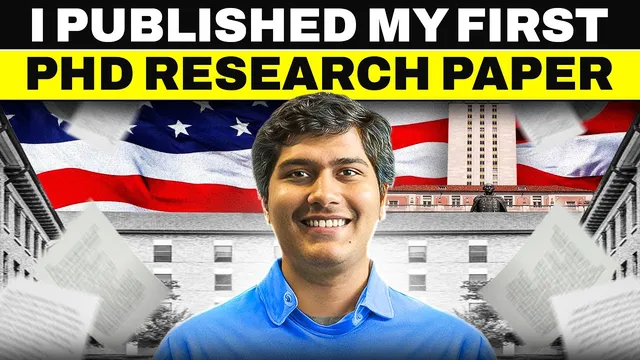
How to publish a research paper | AI tools and tips | ft @Shanthanu Katakam
Based on WiseUp Communications's video on YouTube. If you like this content, support the original creators by watching, liking and subscribing to their content.
Start with a clear problem statement, then use keyword-driven literature review (e.g., Google Scholar) to generate specific research ideas.
Briefing
Publishing a first PhD research paper comes down to three practical moves: start from a real problem statement, build a literature review that turns keywords into workable ideas, and then match the manuscript to the right journal using evidence from where similar papers were published. In this conversation, Shantanu Katakam—an engineering PhD student at the University of Texas at Austin—describes how he moved from an initial research pitch to a published paper in the desalination field, emphasizing process over mystery.
Katakam’s entry point was not a blank slate. His supervisor provided a broader problem statement tied to converting oil-field waste into green hydrogen. From there, he began with a literature review driven by keyword searches on Google Scholar, collecting a large set of relevant sources and then refining the direction through discussions with his supervisor. That cycle—keyword-driven reading, then supervisor feedback—produced “few ideas” that ultimately became his first paper. He also flags a missed opportunity: he wished he had used AI tools like Elicit during the literature review to reduce the effort of gathering and synthesizing sources, and plans to use it for the next problem statement.
For writing, the workflow was structured and iterative. He first wrote down a paper structure aligned with his supervisor’s preferences, then filled in sections one by one once the outline was agreed. He credits a WiseUp Communications course for giving him clarity on what a journal paper should contain and how the sections should flow—especially the “presentation” side of research writing. When it came to AI assistance during drafting, his use was limited: Grammarly for basic grammar correction, while the core writing remained his own and editing was handled by his supervisor.
Choosing a journal was treated as a research task, not a guess. Katakam recommends looking at journals where similar literature review papers have already been published—he cites Desalination as a strong candidate because it publishes many relevant papers in the same area. He also advises narrowing options based on the paper’s keywords and topics, then checking the journal’s website for stated scope and relevant topic categories. To streamline this, he points to journal suggestion tools (including those found on platforms like Elsevier) where entering keywords or an abstract can generate a list of journals from the publisher’s portfolio.
Finally, he addresses the human side of PhD work: the biggest challenge isn’t always technical. His main advice is time management and maintaining work-life balance to avoid burnout over a long, consistency-driven journey. For first-time authors, he closes with a writing principle that ties everything together—communicate scientific results effectively using the minimum number of sentences or words, respecting word limits while still preserving the value of the findings. The overall message is that publishing becomes achievable when research, writing, and journal targeting follow a repeatable, evidence-based process.
Cornell Notes
Shantanu Katakam describes a repeatable path to publishing a first PhD paper: start from a supervisor-provided problem statement, conduct a keyword-driven literature review (he used Google Scholar), and use supervisor discussions to convert reading into specific research ideas. For writing, he outlines the paper structure first, then drafts each section in sequence; a course helped him understand journal-paper flow and presentation. AI support was practical rather than central—Grammarly for grammar correction, with most drafting done by him and editing by his supervisor. Journal selection followed a “where similar work appears” method: check journals that publish related papers, narrow by keywords, and verify fit using the journal’s scope and topic pages, optionally aided by journal-suggestion tools.
How did Katakam turn a broad research direction into a publishable first paper?
What role did AI tools play in his literature review and writing process?
What writing workflow helped him produce a structured manuscript?
How did he choose the journal for publication?
What challenge did he highlight during the PhD, and what was his coping strategy?
What advice did he give to researchers aiming to publish their first paper?
Review Questions
- If you were starting a new PhD topic, what would you do first: keyword-based literature review, paper outlining, or journal scouting—and why?
- Which parts of Katakam’s process were most dependent on supervisor input (structure, editing, topic selection), and which parts were mostly self-directed?
- How would you apply his journal-selection method to a paper outside desalination—what evidence would you look for on journal websites?
Key Points
- 1
Start with a clear problem statement, then use keyword-driven literature review (e.g., Google Scholar) to generate specific research ideas.
- 2
Use supervisor discussions to convert broad reading into a focused, publishable direction.
- 3
Draft with a pre-agreed paper structure; outline first, then write sections in order.
- 4
Apply limited AI support strategically—Grammarly for grammar is useful, but keep core writing and analysis grounded in your work.
- 5
Choose journals by matching scope to keywords and by checking where closely related papers were already published (e.g., Desalination for desalination-focused work).
- 6
Verify fit on the journal’s website by reviewing stated topics and scope before submitting.
- 7
Manage time and maintain work-life balance to sustain consistency and avoid burnout during the long PhD timeline.