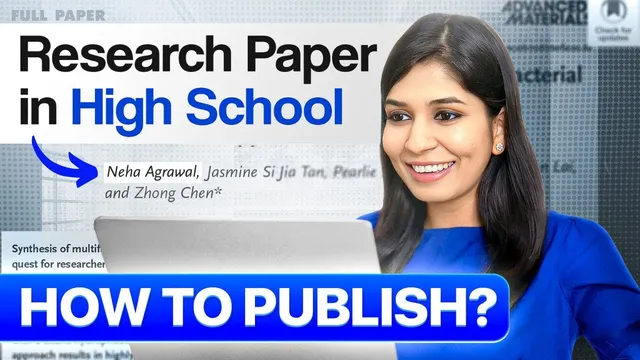
How to publish a research paper in high school (with AI tools) 🔥| Step-by-step process explained
Based on WiseUp Communications's video on YouTube. If you like this content, support the original creators by watching, liking and subscribing to their content.
Treat research as original problem-solving or exploration, not as summarizing existing articles.
Briefing
High school researchers can publish meaningful papers by treating research as solving a real problem—not by rewriting existing articles—and by using AI tools to narrow topics, read literature, draft academic sections, and format citations. The core message is practical: start with a curious question, run small experiments or data-based projects you can do with basic resources, then follow a standard paper structure and submit to journals that accept student work. Publishing matters because it turns private work into something others can evaluate, and it can strengthen credibility for college admissions and future opportunities.
The process begins by redefining “research.” Instead of browsing the internet and consolidating summaries, research means exploring something new or addressing a gap through original work. That doesn’t require a lab or advanced credentials. Meaningful projects can come from testing natural materials, building simple experiments at home, analyzing publicly available datasets (like climate change data or sports statistics), or running online surveys. For students without specialized equipment, the transcript lays out two workable paths: computer-based research (coding projects, simulations, data analysis, online surveys) and low-tech experimental research (simple measurements such as fabric heat absorption, plant growth under different light conditions, or how temperature affects battery life).
Once a field is chosen—computer science, biology, chemistry, psychology, and more—the next step is narrowing to a specific sub-area. Broad interests like “computer science” or “biology” are broken down into concrete directions such as data science, cybersecurity, web/app development, game development, artificial intelligence, or genetics, neuroscience, microbiology, plant science. From there, the hardest part for beginners is identifying a research topic with novelty. AI tools are positioned as a shortcut for topic ideation and literature navigation.
Perplexity is recommended to generate research topic ideas tailored to constraints, such as wanting eco-friendly materials research without lab facilities. Jenny AI is used to brainstorm topics as well, then to support a basic literature review by helping students understand papers. After uploading a paper, students can ask questions like the main claims, limitations, definitions of terms, or explanations of specific paragraphs—turning reading into an interactive workflow. That same paper-reading step feeds directly into methodology: students learn how experiments are designed and how data analysis is typically handled.
Writing the paper follows a familiar academic template: title, abstract (150–250 words), introduction (why the problem matters), methodology (step-by-step, “recipe-like” procedures), results (tables, charts, photos), discussion (meaning of findings, surprises, limitations), conclusion (what was learned and next steps), and references. Jenny AI is described as speeding up drafting and revision while helping maintain academic tone and reduce plagiarism risk through refinement prompts (improve fluency, paraphrase, simplify, expand, restructure, and smooth transitions). It also supports citation workflows, including generating references in multiple styles (over 17,000 options such as APA, MLA, Harvard, Chicago) and exporting to LaTeX, Word, or HTML.
Finally, publishing is treated as the step that gives the work credibility. Traditional journals can be difficult for high schoolers due to co-author requirements and long review timelines, but student-focused outlets exist. Examples named include Journal of Emerging Investigators (JEI), Journal of High School Science (JHSS), STEM Fellowship Journal, Curix Academic Journal, and The Concord Review, plus India-focused options like Iris National Fair and INSC Young Researcher. The takeaway is clear: with the right topic, feasible experiments, structured writing, and the right submission targets, high school research can reach publication.
Cornell Notes
The transcript frames high school publishing as a step-by-step workflow: start with a real problem, run original work you can actually do, then write and submit using a standard research-paper structure. Research doesn’t mean summarizing existing articles; it means testing questions through computer-based projects (coding, simulations, public datasets, online surveys) or low-tech experiments (simple measurements with home/school materials). AI tools like Perplexity and Jenny AI help students narrow topics, find research directions, and understand papers by answering questions about claims, limitations, and unclear sections. Jenny AI also supports drafting in an academic tone, refining transitions, and generating citations in many styles, with export options like LaTeX, Word, or HTML. Publishing is positioned as the credibility step that makes the work “real” for admissions and recognition.
How does the transcript redefine “research,” and why is that shift important for beginners?
What are the two practical ways high school students can conduct research without specialized equipment?
How do Perplexity and Jenny AI fit into the process of choosing a publishable topic?
What paper structure does the transcript recommend, and what does each section do?
How does Jenny AI help with writing quality and citations without making the text overly “AI-generated”?
Why does the transcript treat publishing as a separate step, and what submission options are suggested for students?
Review Questions
- What specific actions would you take to move from a broad interest (e.g., “computer science”) to a narrow, feasible research topic?
- Choose one computer-based and one low-tech research approach from the transcript. What kind of research question would each approach test?
- Walk through the recommended paper sections in order. What information belongs in the methodology versus the discussion?
Key Points
- 1
Treat research as original problem-solving or exploration, not as summarizing existing articles.
- 2
Narrow a broad field into a specific sub-area before designing experiments or analysis.
- 3
Use computer-based research (coding, simulations, public datasets, online surveys) or low-tech experiments (simple measurements with home/school materials) to match available resources.
- 4
Rely on AI tools to generate topic ideas and to interrogate papers for claims, limitations, and unclear terms, turning reading into actionable methodology.
- 5
Write the paper using a standard structure: title, 150–250 word abstract, introduction, methodology, results, discussion, conclusion, and references.
- 6
Draft in your own voice first, then use AI prompts to improve academic tone, transitions, and sentence variety without over-relying on generic output.
- 7
Submit to student-appropriate journals and platforms when traditional journals are unlikely to accept high school work.