How to Publish Fast When You Teach 40 Hours a Week
Based on Academic English Now's video on YouTube. If you like this content, support the original creators by watching, liking and subscribing to their content.
Busy teaching schedules don’t automatically prevent research output; the transcript frames the real constraint as research strategy and scheduling discipline.
Briefing
Publishing more research while teaching full time isn’t blocked by a lack of hours—it’s blocked by how academics choose research targets and how they schedule writing. The core prescription is twofold: build a “big” research agenda that can generate multiple papers on one theme, and then treat writing like a protected appointment through long-term planning and strict execution.
The first shift targets the common bottleneck of chasing small, isolated gaps. Busy faculty often spend months working a narrow question, publish, then must hunt for the next gap—an approach that collapses under heavy teaching, supervision, grading, and committee work. The alternative is to identify a research gap large enough to sustain three to five papers “on the same idea,” allowing parallel progress and reuse of core work like literature review and, in some cases, methodology. A practical example centers on professional discrimination faced by non-native speakers in English language teaching. While the topic has been examined from multiple angles, the approach described hinges on noticing something others missed: course book authors in English language teaching were overwhelmingly white native speakers from the UK or the US. That observation became an unexplored line of inquiry about how discrimination shows up in course book authorship and recruitment practices.
From that single, underexamined angle, multiple Q1 publications are framed as feasible. The example describes a first paper in a top 1% journal, followed by additional Q1 papers that stay within the same overarching theme while shifting angles—such as using different sample sizes, countries, and types of course books. The payoff is efficiency: multiple papers can be produced within a year because the work is anchored to one literature base and one research program rather than repeatedly restarting from scratch.
The second shift argues that the real problem is not time scarcity but inefficient use of available time. A claim is made that writing can be completed quickly when the process is systematized—citing an instance of writing and submitting a Q1 journal paper in just over five hours. More importantly, the transcript emphasizes planning failures. Faculty delay writing by pointing to predictable academic demands like exams, supervision, and class preparation. The response is that these are known in advance and can be planned for at the start of the academic year, then refined weekly.
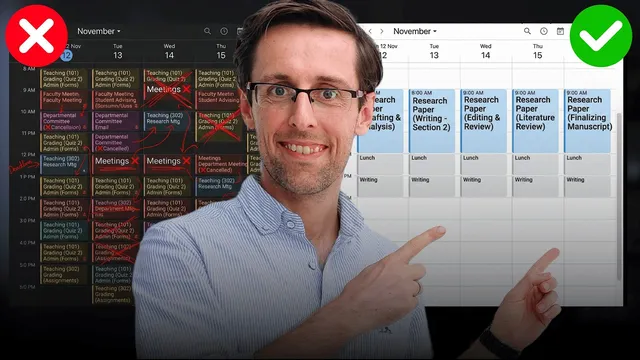
That planning includes two layers: mapping the year to place writing blocks on the calendar, and reviewing schedules weekly to decide what to write, research, and read next. Execution is treated as the final gate. Once writing time is scheduled, it should be protected with the same seriousness as teaching or student supervision—meaning declining meetings that conflict with writing. The transcript cites Lizette Britz, described as working about 50 hours a week, while also being a triathlete and mother, yet managing to publish five Q1 papers in one year by saying no and executing on scheduled writing blocks.
Overall, the message is that career stagnation comes from repeating the same approach—postponing writing or working evenings and weekends until burnout—rather than changing the research strategy and the operating system that turns writing into a reliable output. The transcript ends by promoting a free one-to-one consultation to identify bottlenecks and outline an action plan toward multiple Q1 publications.
Cornell Notes
The transcript argues that busy academics can publish more high-impact papers without relying on weekends by changing two systems: research targeting and writing execution. Instead of chasing small gaps that require starting over repeatedly, it recommends finding a large, underexplored research gap that can support three to five papers on the same theme. It also claims that time is often misused rather than truly unavailable, and that writing should be planned in long-term and short-term blocks on the calendar. Finally, scheduled writing must be protected like a non-negotiable meeting, including saying no to conflicting requests. A case example links professional discrimination against non-native speakers in English language teaching to multiple Q1 papers through different angles and study designs.
Why does the transcript treat “small research gaps” as a problem for full-time teachers?
What does “one big topic” mean in practice, and how does it speed up publication?
How does the transcript connect course book authorship to discrimination research?
What is the transcript’s argument about time—why “busy” doesn’t automatically mean “no time”?
What does “execution” mean, and why is saying no emphasized?
Review Questions
- What characteristics should a “research gap” have to support multiple Q1 papers without repeated restarting?
- How do long-term and short-term planning differ in the transcript’s scheduling system for writing?
- What rules for protecting writing time are presented, and how do they prevent postponement?
Key Points
- 1
Busy teaching schedules don’t automatically prevent research output; the transcript frames the real constraint as research strategy and scheduling discipline.
- 2
Choose a large, underexplored research gap that can generate three to five papers on one theme rather than repeatedly chasing small gaps.
- 3
Reuse core work across papers—especially literature review and, when possible, methodology—by varying angles (e.g., countries, sample sizes, and materials) within the same program.
- 4
Treat writing time as a planned block: map the year first, then review weekly to decide what to write and what to read next.
- 5
Plan for predictable teaching demands (classes, exams, supervision) at the start of the academic year instead of using them as perpetual reasons to delay.
- 6
Protect scheduled writing with strict execution: decline meetings that conflict, the same way teaching obligations are protected.
- 7
Career progress is presented as a systems problem—changing the operating system for research and writing matters more than working longer hours.