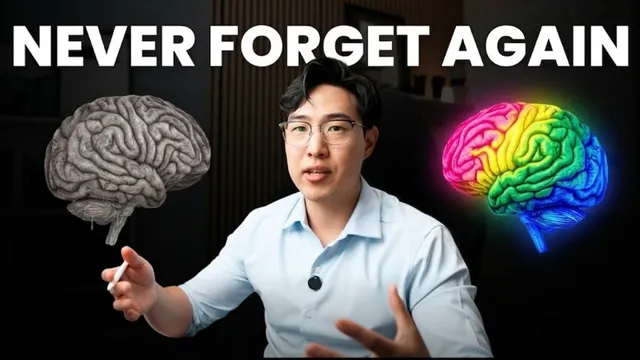
How to Read Once and Remember Forever
Based on Justin Sung's video on YouTube. If you like this content, support the original creators by watching, liking and subscribing to their content.
Durable learning depends on recall quality and transfer, not just whether information is stored.
Briefing
Learning “once and remembering forever” hinges less on raw storage capacity and more on whether the brain can later retrieve knowledge in the form you actually need. A key neuroscience finding underpins the idea: memories can be erased from conscious behavior yet still be reactivated. In a 2015 mouse study, researchers paired a new environment with a mild foot shock to create a fear memory, then tagged the specific neurons involved using light-sensitive techniques. When protein synthesis was blocked after learning—disrupting consolidation—the mice stopped freezing when re-exposed to the environment, suggesting the memory had been lost. But shining a laser on the tagged neurons later re-triggered the fear response, showing that “forgetting” can mean losing access pathways rather than destroying the memory itself.
That distinction drives a practical framework for durable learning. Memory is treated as two problems: storage and recall. Even more, recall has “levels”—the quality of what you can bring back and how flexibly you can use it. The video argues that the real target isn’t permanent memory for its own sake; it’s “transfer-ready knowledge,” meaning information you can retrieve and apply to solve problems or perform tasks. A vivid example is Kim Peek, whose condition enabled extraordinary verbatim recall of thousands of books, yet left him with major difficulties in reasoning and problem-solving. The takeaway: having lots of facts isn’t the same as having usable knowledge.
To move information toward transfer-ready status, the framework lists conditions associated with longer-lasting memories. Emotionally salient experiences tend to stick. High novelty and survival relevance also increase retention. Sleep is another major lever: sleep-dependent consolidation helps shift newly learned material into long-term stores and improves later recall. Beyond these, three more technical requirements shape whether knowledge becomes accessible and usable: retrieval (actively recalling and using what was learned), semantic encoding (learning in a way that builds meaning and context), and integration (connecting new material to one’s identity and existing mental models).
The video then acknowledges a constraint: not everyone can control emotion, novelty, or survival relevance. So it proposes a “memory ladder” that asks a simpler question when learning: how much time and effort will be paid for this memory? Lower rungs rely on repetition and volume—flash cards and rote recall—often producing fragile, narrow knowledge that requires frequent spaced retrieval. Middle rungs emphasize diverse retrieval practice, such as solving varied question types, writing summaries, or generating practice problems, because performance during retrieval is a direct readout of memory quality. The top rungs demand deep evaluation, comparison, and synthesis: asking how new ideas differ from and connect to what’s already known, judging why something matters, and building frameworks that integrate concepts. Even small acts of comparison—like linking a person’s name to similar memories—can strengthen recall.
In the end, the “once and remember forever” promise becomes more realistic: while perfect permanence may be impractical, investing effort at the right ladder level can produce knowledge that lasts much longer and transfers to real-world problem solving.
Cornell Notes
The core claim is that durable learning depends on recall quality, not just memory storage. Neuroscience evidence from fear-conditioning experiments suggests “forgetting” can reflect lost access pathways rather than destroyed memories, since tagged neurons can re-trigger behavior even after consolidation is blocked. The video reframes the goal as “transfer-ready knowledge”—information that can be retrieved and applied to solve problems—rather than literal permanent recall of everything. It lists conditions linked to longer retention (emotional salience, novelty/survival relevance, and sleep-dependent consolidation) and adds three mechanisms that shape usability: retrieval, semantic encoding, and integration. A “memory ladder” then helps learners choose how much effort to invest, from rote repetition to deep synthesis, based on how the knowledge will be used.
What does the mouse fear-memory study imply about why people “forget”?
Why does the video argue that “permanent memory” isn’t the real learning goal?
How do retrieval practice and context sensitivity affect long-term usefulness?
What are semantic encoding and integration, and how do they strengthen memory?
How does the memory ladder help decide how much effort to invest when learning?
Why does sleep matter even when someone studies hard?
Review Questions
- How does the fear-memory neuron reactivation result change the way you interpret “forgetting”?
- Where on the memory ladder would you place flash cards versus synthesis, and what kind of transfer would you expect from each?
- What role do retrieval, semantic encoding, and integration play in turning new information into transfer-ready knowledge?
Key Points
- 1
Durable learning depends on recall quality and transfer, not just whether information is stored.
- 2
Forgetting can reflect reduced access pathways; reactivating tagged neurons can restore behavior even after consolidation is blocked.
- 3
Transfer-ready knowledge is the practical goal: knowledge you can retrieve and apply to solve problems.
- 4
Emotionally salient experiences, high novelty/survival relevance, and sleep-dependent consolidation are associated with longer retention.
- 5
Retrieval practice must match how knowledge will be used later because context sensitivity can limit transfer.
- 6
Semantic encoding strengthens memory by storing meaning built during learning, not just raw facts.
- 7
The memory ladder helps choose effort level: rote repetition at the bottom, diverse retrieval in the middle, and deep comparison/synthesis at the top.