How to Read Swedish Household Examination Records | Swedish Genealogy
Based on Roam Your Roots's video on YouTube. If you like this content, support the original creators by watching, liking and subscribing to their content.
Swedish household examination records are organized by parish, so selecting the correct parish jurisdiction is the first step before searching.
Briefing
Swedish household examination records are a high-yield genealogy source because they track people by parish and household while recording precise life events—marriage, birth dates, death/widowhood timing, and even when families left for another place. For researchers, the practical payoff is clear: page references inside the books let families be traced backward across years, often leading directly to earlier household entries, birth records, and marriage documentation.
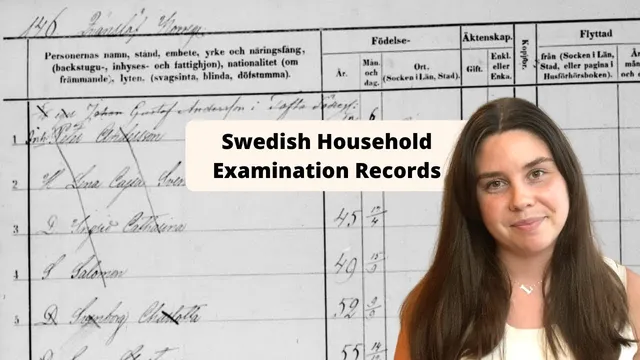
The records are organized by parish, so knowing the correct local jurisdiction matters before any searching. The tutorial uses the parish of Angelstad (in Kronoberg County) as an example, showing a clean page from the 1877–1881 examination books. Later-year pages are easier to read, while earlier volumes (late 1700s to early 1800s) can look much messier due to heavy cross-outs and denser formatting. A key navigation tool is the page number: when one household entry references another page, that pointer can be followed to find the same family in earlier years—sometimes spanning multiple moves.
A typical entry is laid out like an enumeration record, with household members listed in a names column and additional columns for dates and statuses. The names column may include abbreviations that signal relationships and roles. For example, abbreviations can indicate “wife” (Houstru) and other family relationships, helping researchers reconstruct who lived together. The household unit is not necessarily confined to a single page, so entries may be divided across the layout.
Marriage and life-status information is especially valuable. The tutorial highlights a marriage column (labeled with a term corresponding to “married”) that can include a specific marriage date. It also points to widow/widower-related indicators: if a spouse dies, the record can note the date when the person became widowed, and a separate death column provides the death date. Birth information is similarly detailed, with separate fields for place (often another parish), year, and month/day—allowing researchers to confirm identities and locate where births occurred.
Geography and migration are handled through columns that show where people came from and where they went. A “vaccinated” column (for smallpox vaccination) can appear, and a “came from” column may be blank if the family already appears in the same village in earlier volumes. When the “came from” column contains a page reference (and sometimes a parish), it becomes a roadmap for backtracking to the exact earlier entry. The tutorial also notes that leaving is recorded in a final column: it can include a departure date and destination. In the example, the family leaves for America, with an “America” abbreviation visible in the destination field, plus a note that they departed without attestation—contrasting with the usual Swedish move-in/move-out documentation.
Overall, the records function as a timeline anchored to parish geography. By reading the columns carefully—especially page references, marriage/birth/death fields, and migration notes—genealogists can connect Swedish household entries to broader civil and church records and follow families across years and continents.
Cornell Notes
Swedish household examination records are parish-based genealogical registers that list household members and track key life events with specific dates. The most useful columns include household names (often with relationship abbreviations), marriage status and marriage dates, birth place plus year and month/day, and death or widowhood timing. Page numbers referenced within entries let researchers jump backward to earlier volumes and find the same family in prior years. Migration details can also appear, including departure dates and destinations such as America, sometimes with notes about missing attestation. Because the records are organized by parish, knowing the correct local jurisdiction (e.g., Angelstad in Kronoberg County) is essential for effective searching.
Why do page numbers matter in Swedish household examination records?
How can relationship abbreviations in the names column help reconstruct a household?
What columns provide the strongest evidence for identity and family links?
How do widowhood and death information differ, and why does that matter?
How can migration columns be used to backtrack or follow a family’s movement?
What does the tutorial suggest about reading the religious/education-related sections?
Review Questions
- When you see a household entry referencing “page X,” what specific research action should you take next, and why?
- Which life-event columns (marriage, birth, death/widowhood) provide the most direct evidence for linking family members across years?
- How would you interpret a blank “came from” column compared with one that includes a page reference and parish?
Key Points
- 1
Swedish household examination records are organized by parish, so selecting the correct parish jurisdiction is the first step before searching.
- 2
Page numbers referenced inside entries function like navigation links for tracking families backward across years.
- 3
Relationship abbreviations in the names column (such as Houstru for wife) help reconstruct household structure and marriages.
- 4
Marriage and birth fields provide high-value evidence because they include specific dates and birthplaces (often other parishes).
- 5
Widowhood timing and death dates can appear in separate columns; treating them as distinct prevents timing errors.
- 6
Migration is recorded through columns that show where people came from and where they left, including departures for America and notes about attestation.
- 7
Earlier volumes can be harder to read due to messy formatting, while later-year pages (like 1877–1881) are often clearer.