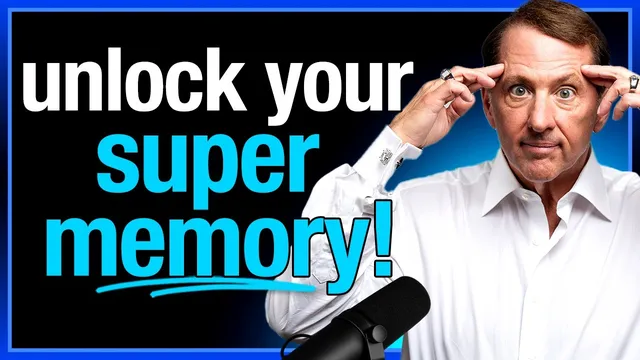
How To Remember Anything: The Story Behind The Mega Memory System
Based on The Kevin Trudeau Show: Limitless's video on YouTube. If you like this content, support the original creators by watching, liking and subscribing to their content.
Trudeau frames memory as a trainable retrieval skill rather than an innate trait, claiming information is stored but often misfiled.
Briefing
Kevin Trudeau’s Mega Memory pitch centers on a single claim: memory isn’t something people are born with—it’s a recall ability that can be “released” through mental training. Trudeau frames modern forgetfulness as misfiling rather than true loss: information is stored, but retrieval fails when it’s not organized in a usable way. The American Memory Institute, which he founded, is presented as the vehicle for teaching a “photographic or instant recall” memory system aimed at everything from remembering names to studying faster and improving performance at work and school.
The business case is built around social leverage. Trudeau argues that in sales and professional networking, the most effective way to get people to like you is to remember their names and relevant details—an idea he ties to Dale Carnegie’s “favorite subject is themselves” and the “sweetest sound” of a person’s name. He describes a Wall Street job applicant who, after meeting dozens of interviewers, used Mega Memory techniques to recall names and then memorized 1,500 New York Stock Exchange companies and symbols, leading to a job offer and later promotions. The underlying message: technology may store facts externally, but it doesn’t help during live conversations or spontaneous questions, where mental recall becomes a differentiator.
For school, Trudeau insists that learning equals recall: if students can’t remember what they learned, they haven’t truly learned it. He cites a seventh-grade class training example where, over nine hours, students reportedly improved vocabulary to college-sophomore level, saw absenteeism drop to virtually zero, and ended the school year with a grade point average around A-minus—despite being described as starting from the lowest baseline. He also recounts a personal anecdote about a daughter who failed a history exam because she couldn’t remember; after completing Mega Memory over three days, she allegedly memorized all 50 states and capitals and regained confidence after publicly reciting them.
To make the system feel tangible, Trudeau demonstrates a recall exercise: participants are given 15 words associated with numbered slots (e.g., Sunday, car, lunch, football), then asked to reproduce the sequence forwards and backwards. He later shows a second clip where, after a distraction period, he can still identify which items were called and which were not. He contrasts Mega Memory with “basic word association,” hypnosis, and subliminal methods, describing it instead as a set of mental exercises designed to stimulate neurotransmitter activity and strengthen retrieval through mental “file folders.”
The course delivery is positioned as accessible and scalable: short lessons (20–30 minutes) via audio downloads accessed through a QR code, with a claimed rapid ramp-up from dozens of recall tasks to “hundreds” after completing the program. Trudeau also claims large percentage improvements—sometimes described as thousands of percent—supported by pre- and post-course testing. He answers skepticism by arguing that memory training is like learning to ride a bike: the skill becomes an ability that persists even if practice lapses.
Finally, Trudeau extends the memory advantage beyond names and studying, claiming it can affect games of skill. He recounts a blackjack story where remembering the remaining cards allegedly led to a large win, followed by casino restrictions; later, he describes being barred because he was “too good,” referencing a “Griffin book” of non-cheaters who are still considered a threat. He closes by emphasizing that Mega Memory is meant to improve both short-term recall (like immediately forgetting a name after a handshake) and longer-term knowledge, with an additional audio product aimed at recalling details from one’s past.
Cornell Notes
Mega Memory is presented as a training system that turns weak recall into “instant recall” by teaching people to organize information into mental “file folders.” Trudeau argues that people don’t truly forget; they misfile, so retrieval fails when information is needed. He links memory to real-world outcomes—remembering names in business, studying faster in school, and performing without notes in meetings. A signature demonstration has participants encode 15 items and then reproduce them forwards and backwards, with Trudeau later recalling which items were called even after a distraction. The course is marketed as short, audio-based lessons that can be completed in a few hours, with claimed large improvements measured by tests before and after training.
What does Trudeau mean by “you don’t forget, you misfile,” and how does that idea connect to his teaching method?
Why does he argue that memory matters in business even when phones and computers exist?
What school outcomes does he claim from memory training, and what mechanism does he use to justify them?
How does the 15-item demonstration work, and what does it aim to prove?
What makes Mega Memory different from word association or hypnosis in Trudeau’s framing?
How does he respond to skepticism about needing memory training in an age of AI, apps, and notes?
Review Questions
- What evidence does Trudeau use to support the claim that people don’t forget information, they misfile it?
- How does Trudeau connect remembering names to business outcomes, and what examples does he give?
- In what ways does the 15-item demonstration attempt to show both immediate and delayed recall?
Key Points
- 1
Trudeau frames memory as a trainable retrieval skill rather than an innate trait, claiming information is stored but often misfiled.
- 2
He argues business success depends heavily on remembering names and details during live interactions, not on storing facts on devices.
- 3
He claims school performance improves when students can recall what they learned, treating learning and recall as inseparable.
- 4
Mega Memory is marketed as mental exercises that build “file folders,” contrasted with word association, hypnosis, and subliminal methods.
- 5
The course is presented as short audio lessons (20–30 minutes) accessed via QR code, with pre- and post-course testing and a money-back guarantee.
- 6
He uses a repeated 15-item recall demonstration (forwards, backwards, and after a delay) to illustrate trained instant recall.
- 7
He extends the memory advantage to games of skill, recounting stories where recalling card order allegedly led to major wins and subsequent casino restrictions.