How to Remember Everything You Read
Based on Justin Sung's video on YouTube. If you like this content, support the original creators by watching, liking and subscribing to their content.
Learning depends on pairing consumption with digestion; faster intake without digestion increases forgetting.
Briefing
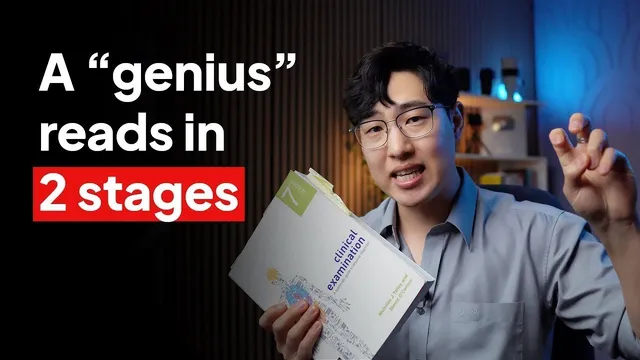
Remembering what you read isn’t mainly a speed problem—it’s a balance problem. The core idea is that learning requires two distinct stages: a “consumption” period where information enters your attention, and a “digestion” period where that information is encoded into long-term memory and becomes usable. Most people over-invest in consumption—reading faster, bingeing lectures, speeding through content—then wonder why recall fades. The system insists that digestion is the bottleneck, and that retention rises when every chunk consumed is followed by the right digestion step.
The transcript argues that trying to remember everything is a flawed goal anyway. A famous counterexample, Kim Peek—whose rare FG syndrome (including macroy/large brain and absence of the corpus callosum) enabled near-perfect recall—still struggled with reasoning and problem solving. That distinction matters: memorization-heavy exams would favor someone like Peek, but higher-level exams reward reasoning, application, and synthesis. For most learners, the practical target is not total recall, but remembering what’s necessary in a form that supports reasoning and real use.
To make digestion systematic, the system classifies information into five categories using the acronym Pacer. First is Procedural information (“P”): knowledge about how to execute tasks (e.g., clinical examination techniques like listening to a heartbeat or taking blood pressure, or coding and language skills). The digestion process is practice, and the emphasis is timing—apply and practice as early as possible rather than reading, note-taking, and postponing practice until much later.
Second is Analogous information (“A”): ideas that connect to prior knowledge, even indirectly. The digestion process is critique—actively test how strong the analogy is, where it matches, where it breaks, and whether a better or modified analogy is needed. This is presented as a way to deepen understanding by wiring new information into existing mental networks.
Third is Conceptual information (“C”): the “what” behind facts—principles, explanations, relationships, and how concepts apply. The digestion process is mapping via nonlinear note-taking (mind maps). The rationale is that expert knowledge is networked rather than strictly linear, so learners should reconstruct connections instead of memorizing word order.
Fourth is Evidence (“E”): detailed facts, statistics, dates, cases, or examples that make conceptual claims concrete. The digestion process is store and rehearse. Store happens immediately when evidence is identified; rehearsal happens later through application—solving problems, writing answers, teaching, or composing essays that use the evidence to support a broader concept.
Fifth is Reference (“R”): stable, nitty-gritty specifics that don’t drive conceptual understanding by themselves (like exact values, gene names, molecule names, or coding variable attributes). The digestion process is also store and rehearse, but rehearsal is optimized for direct recall—often via flashcards and spaced repetition (the transcript names Anki).
Across all categories, the system’s warning is consistent: if there’s no time to digest, don’t compensate by consuming more. Treat digestion as mandatory, because over-consuming without digestion leads to rapid forgetting—described as “mental vomiting”—and forces future re-learning. The transcript closes by noting that these Pacer steps are only a small slice of broader learning efficiency, and points to a free newsletter for additional methods.
Cornell Notes
Learning sticks when consumption is paired with digestion. The system splits study into two stages: consumption (taking information in) and digestion (encoding it so it can be recalled and used). It rejects the idea of remembering everything and instead targets remembering what matters for reasoning and application. Information is sorted into five categories—Procedural, Analogous, Conceptual, Evidence, and Reference (Pacer)—and each category has a specific digestion method: practice, critique, mapping, store+rehearse (application), and flashcard-style recall. The key rule is balance: if digestion can’t happen, consumption should slow down, because over-consuming without digestion leads to steep forgetting.
Why does the system treat “digestion” as the real determinant of retention rather than faster reading or more exposure?
How does Pacer decide what to do with a piece of information during study?
What’s the digestion method for Procedural information, and why does timing matter?
How does critique work for Analogous information, and what does “good analogy” mean in practice?
Why does Conceptual information call for mapping instead of linear notes?
When should Evidence and Reference information be stored and rehearsed, and how is rehearsal different for each?
Review Questions
- What are the two stages of learning in this system, and what rule keeps them from becoming unbalanced?
- Given a study topic, how would you decide whether it’s Procedural, Analogous, Conceptual, Evidence, or Reference?
- Describe one digestion method for each Pacer category and explain why using the wrong method would reduce retention.
Key Points
- 1
Learning depends on pairing consumption with digestion; faster intake without digestion increases forgetting.
- 2
Total recall isn’t the goal; the practical aim is remembering what supports reasoning and application.
- 3
Classify information using Pacer (Procedural, Analogous, Conceptual, Evidence, Reference) to choose the right digestion step.
- 4
Procedural knowledge requires early practice; postponing practice after heavy reading leads to wasted effort and loss of skill.
- 5
Analogous knowledge improves through critique—testing where an analogy holds and where it fails.
- 6
Conceptual knowledge is best digested by nonlinear mapping to rebuild the networked structure of expert understanding.
- 7
Evidence and Reference require store-and-rehearse, but rehearsal differs: apply evidence in problems/teaching, and use spaced-repetition flashcards for reference facts.