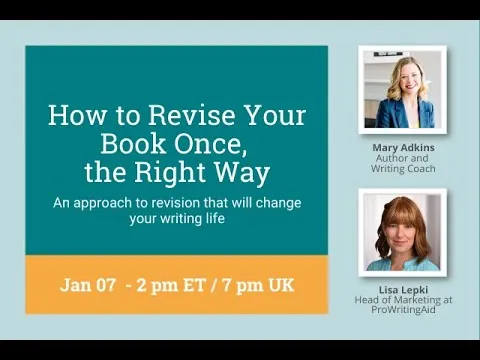
How to Revise Your Book Once, the Right Way, by Mary Adkins
Based on ProWritingAid's video on YouTube. If you like this content, support the original creators by watching, liking and subscribing to their content.
Set drafts aside for three to six weeks before revising so writer-brain fades and reader-brain can judge the work objectively.
Briefing
Revision doesn’t need to drag on for years. Mary Adkins lays out a practical system for finishing a novel by separating revision from editing, building in a deliberate pause before rereading, and using two tools—a “future book review” and a “revision pyramid”—to keep the work focused on story first and sentence-level polish last.
The biggest mistake is starting revision immediately after finishing a draft. Adkins says that when writers return too soon, they still remember writing the exact sentences, which makes them emotionally invested and less objective. She also points to two emotional tells: the draft feels either “brilliant” with nothing to fix or “the worst thing ever,” both of which usually signal the reader’s distance hasn’t arrived yet. Her recommended reset is three to six weeks, with a personal sweet spot of four to five weeks. During that break, the work “bakes” while the writer can do other life tasks without trying to reshape the manuscript in real time. She uses a birthday-cake/baking analogy: ingredients can be mixed correctly, but frosting and shaping too early ruins the result.
Once the pause is over, revision should be approached like a reader, not like a writer. Adkins argues that writer-brain tends to obsess over arc, prose beauty, and ego—whether sentences sound “good” or whether the writer feels like a “good writer.” Reader-brain, by contrast, asks what a future reader would feel: where boredom sets in, where curiosity spikes, where confusion appears, and whether the book is compelling enough to keep turning pages. She recommends printing the draft (often single-spaced to feel more like a book) and reading in a comfortable, low-pressure setting, ideally with a pen for margin notes.
To prevent revision from becoming aimless or trapped in sentence-level tinkering, Adkins introduces the “future book review”: a short (three to six sentences) aspirational review of the book the writer hopes to have written. It should include major plot points and thematic elements, and it should answer the human question at the heart of the story—what the book is really about beyond events. Examples from her own work show how this can capture essence: Palm Beach centers on a couple whose values are tested when a child becomes very sick; Privilege frames sexual assault and its aftermath through three women with competing incentives to believe different truths.
The second tool, the “revision pyramid,” enforces a big-to-small workflow. The top of the pyramid focuses on structural revision: overall story line, character development, tone, and chapter sequence. The middle level addresses scene-level and paragraph-level decisions—what belongs in each chapter and how scenes function in order. The bottom level becomes editing: sentence flow, word choice, and rhythm, where tools like ProWritingAid and reading aloud can help. Adkins warns that polishing sentences too early can be wasted effort if larger structural problems later force scenes or chapters to be cut.
In Q&A, she extends the framework to practical concerns: how to handle “dud” drafts (treat it as a sign the story needs a turn and brainstorm what could happen next), how to avoid distraction by small fixes (trust the process and only execute after structural decisions), and how to know when revision is “done” (trusted readers’ reactions like “I couldn’t put it down,” plus the reality that someone must eventually declare an endpoint). Her overall message is disciplined but humane: pause, read like a reader, set a clear thematic target, revise in layers, and save sentence-level work for the end.
Cornell Notes
Mary Adkins recommends a layered revision process that prevents endless rewrites: pause before rereading, read like a reader, and revise big-to-small. She says to set the draft aside for three to six weeks (often four to five) so the writer stops remembering the exact sentences and can judge the work more objectively. To anchor the work, she uses a “future book review”—a 3–6 sentence aspirational blurb that states major plot points and the book’s central human question. Finally, she uses a “revision pyramid” to separate structural changes (arc, character, chapter order) from scene-level adjustments and, only at the end, sentence-level editing and rhythm. The payoff is a more organized, less painful path to finishing a novel.
Why does Adkins insist on waiting three to six weeks before revising?
What exactly is a “future book review,” and what should it include?
How does “read like a reader” change what notes to make during revision?
What does the revision pyramid mean by revising big to small?
How should a writer respond when the story feels like a dud?
How does Adkins suggest deciding when revision is “done”?
Review Questions
- What are the two main reasons Adkins gives for not starting revision immediately after finishing a draft?
- Write a 3–6 sentence future book review for your current project: include major plot points, the thematic/human question, and the tone you want readers to feel.
- Using the revision pyramid, list three structural changes, two scene-level changes, and one editing task you would do last.
Key Points
- 1
Set drafts aside for three to six weeks before revising so writer-brain fades and reader-brain can judge the work objectively.
- 2
Use emotional signals—either extreme love or extreme disgust—as likely indicators the draft is being reread too soon.
- 3
Create a “future book review” (3–6 sentences) that captures major plot points and the book’s central human question as a revision target.
- 4
Revise big to small: handle arc, character, tone, and chapter order first; then refine scene order and chapter-level structure; save sentence-level editing for the end.
- 5
Read the manuscript like a reader by tracking boredom, confusion, intrigue, and pacing issues rather than rewriting sentences during the first pass.
- 6
Avoid sentence polishing before structural decisions are locked, since later cuts can make that work wasted.
- 7
Rely on trusted reader feedback to determine when revision is “done,” because endless sentence-level tweaking is always possible.