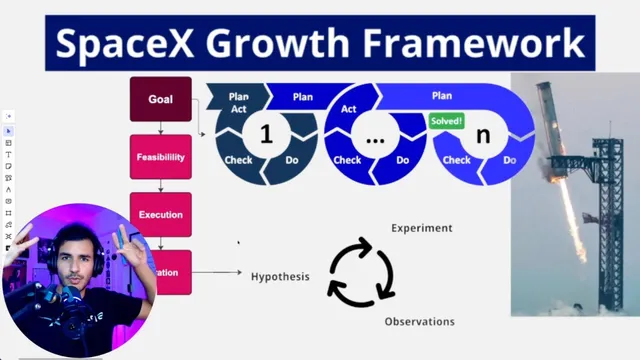
How to Run Your Business like SpaceX
Based on Ali Alqaraghuli, PhD's video on YouTube. If you like this content, support the original creators by watching, liking and subscribing to their content.
Break a grand mission into milestone goals so progress can be measured and adjusted.
Briefing
SpaceX’s speed and innovation come from a disciplined loop: set a clear, physics-driven goal; verify feasibility with first principles; execute quickly while expecting failure; then iterate based on what reality shows. The practical takeaway for entrepreneurs is that faster feedback cycles—rather than trying to perfect a plan upfront—create the conditions for rapid learning, better decisions, and compounding progress.
The framework starts with a big-picture mission. For SpaceX, that mission is landing humans on Mars and making life multiplanetary. But the method doesn’t stop at vision. The work gets broken into milestone steps—building a rocket or ship, reaching orbit, going farther, ensuring return, enabling capture with “arms,” and refurbishing hardware—so progress can be measured and managed along the way.
Where SpaceX’s approach diverges from many businesses is the way next steps are chosen. Instead of inferring actions from market trends or competitors, the decision process begins with physics: what is stopping the system from achieving the goal, and is the target even physically possible? The argument is that feasibility is non-negotiable. If an idea violates Newton’s laws of mechanics or Maxwell’s laws of electromagnetics, it can’t be done. The same logic is illustrated with everyday cause-and-effect—drop a cup and gravity predicts it will fall and likely crack—because the laws of physics have consistently held.
Once a goal passes that feasibility check, execution begins. Plans are translated into engineering work and tested through simulations and real-world trials. Failure is treated as normal rather than exceptional. The emphasis is on avoiding the “get it right the first time” mindset that leads to slow, overly perfect planning. In SpaceX’s culture, mistakes are expected early so teams can learn quickly: build, test, discover why it failed, and improve.
That learning loop—iteration—is the engine of speed. The process is likened directly to the scientific method: form a hypothesis, run an experiment, observe results, and refine. The faster an organization can cycle through hypothesis → test → feedback → revision, the more opportunities it has to learn from reality and improve the next version.
The transcript uses both SpaceX history and personal business experience to make the point. Early rockets such as Falcon 1 saw repeated failures, but each explosion produced data: teams examined components, identified what went wrong, and iterated. In the business context, the same logic applies to digital products and consulting, where experiments can be run quickly—iterating landing pages, ads, and product features, then using market response as the feedback signal. The claim is that engineering-minded entrepreneurs can compress what might take years of slow iteration into months by running many small tests, collecting data fast, and staying tightly focused on the goal.
The closing advice is to adopt speed and efficiency through scientific thinking supported by first principles and systems thinking. Even if success is possible without it, the cost is slower learning and slower progress; the proposed antidote is to build a habit of rapid experimentation and continuous iteration in business and personal decision-making.
Cornell Notes
SpaceX’s innovation is attributed to an iterative workflow built on first principles. Teams start with a clear mission (landing humans on Mars), break it into measurable milestones, and then ask whether the goal is physically feasible using laws like Newton’s mechanics and Maxwell’s electromagnetics. After feasibility is confirmed, work moves into execution and testing—often with the expectation that early attempts will fail. Those failures become inputs for the next cycle, mirroring the scientific method: hypothesis, experiment, observation, and refinement. The same approach is presented as a competitive advantage for entrepreneurs, especially in digital products, where rapid experiments can generate feedback quickly and drive faster improvement.
How does the “goal → milestones → feasibility” sequence prevent entrepreneurs from chasing random tactics?
Why does the transcript argue that “physics-first” thinking beats “market-first” thinking?
What role does failure play in the SpaceX-style process described here?
How is iteration connected to the scientific method, and why does that matter for business speed?
How can a digital business replicate the “test and iterate” loop without rocket launches?
What practical advantage does the transcript claim engineering-minded entrepreneurs have over marketer/salesman-minded ones?
Review Questions
- What does it mean to “check feasibility” using first principles, and how would you apply that to a non-technical business idea?
- Describe the iterative cycle in the transcript using the scientific method steps. How would you measure success at each step?
- Why does expecting failure early speed up learning, and what specific actions should follow a failed test?
Key Points
- 1
Break a grand mission into milestone goals so progress can be measured and adjusted.
- 2
Choose next steps by asking what prevents success and whether the goal is physically feasible using first principles.
- 3
Use simulations and real-world tests to validate feasibility before scaling effort.
- 4
Treat early failure as expected feedback, not as a reason to abandon the project.
- 5
Run rapid iteration cycles (hypothesis → test → observation → refinement) to increase learning speed.
- 6
Compress feedback time by designing experiments that can be executed quickly, especially in digital products.
- 7
Adopt systems thinking and scientific-method discipline to improve both business decisions and personal planning.