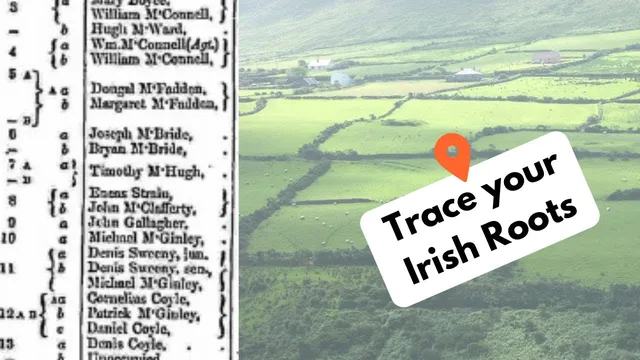
How to Search and Read Griffith's Valuation | Roam Your Roots
Based on Roam Your Roots's video on YouTube. If you like this content, support the original creators by watching, liking and subscribing to their content.
Griffith’s Valuation is a comprehensive Irish property valuation survey under Sir Richard Griffith, covering the entire island and recording taxable land to estimate annual income.
Briefing
Griffith’s Valuation is one of Ireland’s most detailed genealogical resources, and it can be searched for free online by surname or by location—then decoded using a consistent set of letters, brackets, and columns that describe who held land, who lived on it, and how rent and property value were assessed. The survey was carried out under Sir Richard Griffith and covered the entire island, recording taxable land parcel by parcel so officials could estimate the annual income each property should have produced at the time. Because the valuations were published county by county (not all at once), the county and the year a given county’s valuation was taken can determine whether the record will help track an ancestor who emigrated in a specific year.
Searching is straightforward in two main ways. A surname search pulls up all matching entries across Ireland, which can then be narrowed by adding a county—useful for names that appear in multiple places. A location-based search is better for studying family clusters and neighbors: it can start at the county level and then drill down further into barony, union, and parish. Either approach leads to valuation pages that look dense at first glance, packed with plot numbers, letters, brackets, and multiple categories of land and occupancy.
Reading a page depends on understanding what each column means. Plot numbers (like 3, 4, 5, 6, etc.) correspond to a detailed accompanying map, one of Griffith’s Valuation’s biggest genealogical advantages because it helps pinpoint where a family lived—even when place names can repeat across different parishes. Soil-type codes use uppercase letters such as A and B to show whether a plot had one or multiple soil categories. Lowercase letters such as A and B indicate houses on each plot: typically, A marks the main landholder’s house, while B marks a secondary house. That lets researchers infer how many households existed on a single land parcel and who lived where.
Brackets are the key to the financial relationships behind the land. They show when multiple people held the land “in common,” meaning both were responsible for rent to the landlord. The transcript contrasts cases where no bracket appears—suggesting a different rent arrangement—with cases where a bracket binds names together, indicating shared responsibility. Another column lists landlords and clarifies rent chains, including situations where one tenant effectively rents from another tenant rather than directly from the landlord.
Additional columns break down property details: “tenement” descriptions (such as house, land, or offices), acreage measured in acres, roots, and perches (or poles), and the “rata(b)le annual valuation” expressed in pounds, shillings, and pence. Brackets in the valuation columns indicate which entries combine into shared totals, and some people may show only land value or only building value depending on whether they held land, a house, or both. With practice, the letters and bracket patterns become a readable map of family residence, tenancy structure, and assessed value—turning a confusing table into a usable genealogical record.
Cornell Notes
Griffith’s Valuation is a county-by-county, island-wide Irish property survey carried out under Sir Richard Griffith. It records taxable land parcel details so officials could estimate annual income, and it’s searchable for free by surname or by location (county, barony, union, parish). Reading the pages requires decoding plot numbers tied to maps, soil-type letters (A/B), house indicators (lowercase A/B), and—most importantly—brackets that show when people held land “in common” and shared rent responsibility. Landlord columns also reveal rent chains, including cases where one tenant rents from another. The valuation columns then convert land/building holdings into annual assessed value in pounds, shillings, and pence.
How can a researcher decide whether Griffith’s Valuation will likely include an ancestor who emigrated in a specific year?
What are the two main ways to search Griffith’s Valuation, and when is each approach most useful?
Why are plot numbers and the accompanying maps genealogically valuable?
How do letters and house indicators help reconstruct who lived where on the same plot?
What do brackets mean, and how do they change the interpretation of rent responsibility?
How do landlord and valuation columns work together to show tenancy relationships and assessed value?
Review Questions
- When would a location-based search (county → barony → union → parish) be more informative than a surname search?
- What specific clues on a Griffith’s Valuation page indicate (1) soil types, (2) main vs secondary houses, and (3) shared rent responsibility?
- How can the landlord column reveal a rent chain where one tenant rents from another rather than directly from the landlord?
Key Points
- 1
Griffith’s Valuation is a comprehensive Irish property valuation survey under Sir Richard Griffith, covering the entire island and recording taxable land to estimate annual income.
- 2
Search the records for free by surname (optionally narrowed by county) or by location (county, barony, union, parish) depending on whether you’re tracking individuals or family clusters.
- 3
Plot numbers link to detailed maps, making it easier to locate ancestors’ land even when place names are confusing across parishes.
- 4
Uppercase A/B letters indicate soil types, while lowercase A/B letters indicate main versus secondary houses on the same plot.
- 5
Brackets are the core decoding tool: they show when occupiers held land “in common” and therefore shared rent responsibility to the landlord.
- 6
Landlord and rent-chain information comes from the landlord column, which can show tenants renting from other tenants rather than directly from the landlord.
- 7
Annual valuation is split into land and buildings and expressed in pounds, shillings, and pence; brackets in valuation totals indicate combined assessed amounts.