How To See Black Holes By Catching Neutrinos
Based on PBS Space Time's video on YouTube. If you like this content, support the original creators by watching, liking and subscribing to their content.
IceCube reported a 4.2-sigma excess of high-energy neutrinos from a sky region consistent with M77 (NGC 1068), with only about a 1-in-10,000 chance of arising from background alone.
Briefing
Neutrino astronomy is moving from speculation to targeted astrophysics: IceCube has reported a statistically significant excess of high-energy neutrinos coming from a specific patch of sky that lines up with the nearby active galaxy M77 (NGC 1068). The excess is small—about 50 more neutrinos than expected from atmospheric backgrounds—but it appears with a 1-in-10,000 chance of arising randomly, corresponding to a 4.2-sigma detection. That level of confidence matters because it turns neutrinos from a diffuse “neutrino sky” into a tool for identifying particular cosmic engines.
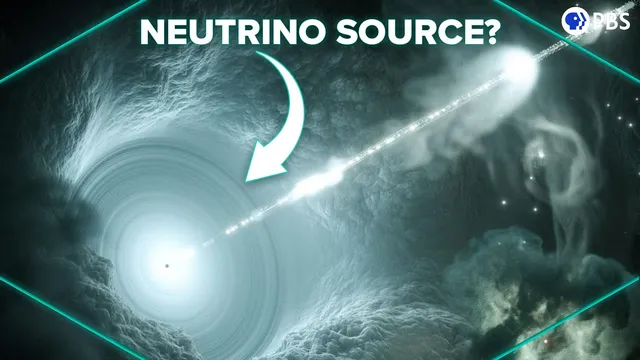
The neutrinos in question are thought to be produced in the extreme environment around M77’s central black hole, estimated at roughly 10 million solar masses. M77 is classified as an active galactic nucleus (AGN), specifically a Seyfert galaxy, where gas falling toward the black hole forms an accretion disk and is surrounded by dust and gas that can obscure the inner light. AGNs are also known for powerful magnetic fields, inferred from jets of high-energy particles launched near the black hole. Those magnetic fields can accelerate particles to energies far beyond what Earth-based accelerators achieve, and particle collisions in such magnetized regions are a key pathway for generating neutrinos.
IceCube’s ability to “see” neutrinos depends on rare interactions. Neutrinos interact only through the weak nuclear force and gravity, making them notoriously hard to detect; even a thick wall of lead would be needed to stop a low-energy neutrino with only a 50-50 chance. IceCube counters this by instrumenting a cubic kilometer of glacial ice at the South Pole with more than 5,000 photomultiplier sensors suspended in deep boreholes. When a neutrino interacts, it can produce a charged lepton (electron or muon are most useful). Those charged particles emit Cherenkov radiation—blue light—because they move faster than light travels in ice. Muons are especially valuable since they can travel kilometers, leaving long, directional light cones that trace back toward the neutrino’s origin.
Separating cosmic neutrinos from background is the other major challenge. The Sun is a bright neutrino source, but its direction makes it easier to identify. More problematic are atmospheric neutrinos and muons created when cosmic rays strike Earth’s atmosphere. IceCube reduces atmospheric muon contamination by focusing on events coming from below the horizon, but atmospheric neutrinos remain a statistical background. That is why the M77 association required about a decade of data: the signal must exceed the expected background rate from that direction by a meaningful margin.
The M77 result is framed as a step toward “real neutrino astrophysics,” joining the Sun and supernova 1987A as the only other well-established astrophysical neutrino sources. Future progress will rely on larger and more sensitive detectors, including plans to expand IceCube to about 10 cubic kilometers to boost detection rates, plus radio-Cherenkov approaches that can scan larger areas of Antarctic ice. Experiments such as ANITA already use this concept, and ideas like using the Moon as a neutrino target telescope point to a broader toolkit for mapping the high-energy universe with neutrinos.
Cornell Notes
IceCube has detected a statistically significant excess of high-energy neutrinos from a sky region that matches the nearby active galaxy M77 (NGC 1068). The signal is modest—around 50 more neutrinos than expected from atmospheric backgrounds—but it reaches a 4.2-sigma significance (about a 1-in-10,000 random chance). The likely source is M77’s supermassive black hole (~10 million solar masses), currently feeding and powering an accretion disk and strong magnetic fields that can accelerate particles and produce neutrinos. IceCube’s method relies on Cherenkov light from charged leptons created when neutrinos occasionally interact in a cubic kilometer of Antarctic ice. Background suppression and long integration time (about a decade) are essential because atmospheric neutrinos and muons can mimic signals.
Why are neutrinos so difficult to detect, and how does IceCube compensate?
How does Cherenkov radiation let IceCube reconstruct where a neutrino came from?
What background signals complicate neutrino astronomy, and how does IceCube reduce them?
What makes M77 (NGC 1068) the leading candidate for the neutrino excess?
How does this result compare with earlier IceCube neutrino associations?
What future upgrades are aimed at making neutrino astrophysics more routine?
Review Questions
- What physical process produces the light IceCube detects, and why are muons more useful than electrons for pointing back to a source?
- How do atmospheric neutrinos and atmospheric muons differ as backgrounds, and what strategy addresses each?
- Why does a small numerical excess (about 50 neutrinos) still matter when the statistical significance is high?
Key Points
- 1
IceCube reported a 4.2-sigma excess of high-energy neutrinos from a sky region consistent with M77 (NGC 1068), with only about a 1-in-10,000 chance of arising from background alone.
- 2
M77’s central black hole is estimated at around 10 million solar masses and is in an active feeding phase, producing an accretion disk and an active galactic nucleus (Seyfert galaxy).
- 3
Strong magnetic fields near AGN black holes can accelerate particles; collisions in these magnetized environments are a plausible route to neutrino production.
- 4
IceCube detects neutrinos indirectly: rare neutrino interactions create charged leptons that emit Cherenkov radiation in Antarctic ice, detected by photomultipliers.
- 5
Muons are especially valuable for source localization because they can travel kilometers and leave long, directional Cherenkov light cones.
- 6
Atmospheric backgrounds require long integration times; IceCube reduces atmospheric muon contamination by using events from below the horizon, but atmospheric neutrinos remain a statistical baseline.
- 7
Planned expansions (to ~10 cubic kilometers) and radio-Cherenkov approaches (e.g., ANITA and potential Moon-based searches) aim to increase detection rates and sky coverage.