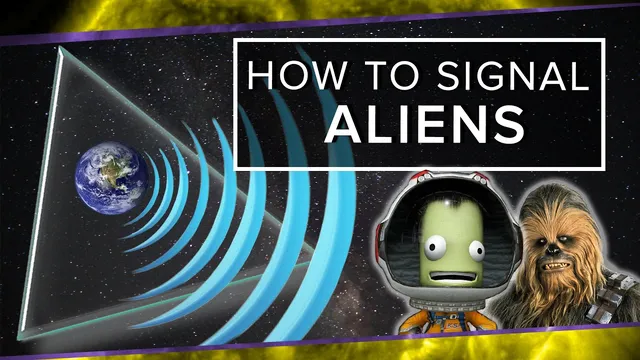
How to Signal Aliens
Based on PBS Space Time's video on YouTube. If you like this content, support the original creators by watching, liking and subscribing to their content.
Radio leakage from Earth since World War II is widely viewed as too weak and too hard to decipher for nearby aliens to detect, even with large receivers pointed at Earth continuously.
Briefing
The most practical takeaway for contacting hypothetical aliens is that “signaling” doesn’t have to mean blasting space with radio or lasers for decades. A third approach—using artificial, geometric signatures that would be visible to astronomers already hunting for exoplanets—could act like a long-lived billboard with far less ongoing energy cost.
Radio leakage from Earth since around World War II is widely considered too weak and too hard to decipher for nearby civilizations to notice, even if they had space-based receivers with large effective collecting areas pointed at Earth continuously. To make a detectable radio beacon, one analysis suggests an enormous phased array of many radio telescopes transmitting narrow, high-powered microwave pulses (10 gigahertz or higher) while sweeping the sky about once a year. Detection from a few thousand light years might be possible if power reaches gigawatt levels, but the price tag is staggering: roughly $100 billion for an omnidirectional transmitter, or about $10 billion if aimed along the galactic plane. Ongoing operating costs—personnel, power, and maintenance—would add billions more, making “going loud” a sustained, civilization-scale investment.
Lasers offer a different tradeoff. Modern lasers can generate ultra-short, high-brightness pulses—brief enough to look clearly artificial because natural sources don’t produce stellar-brightness nanosecond pulses. They’re also detectable with instruments like photomultiplier tubes, though repeated flashes are needed to rule out false positives such as cosmic rays. The downside is range: interstellar dust attenuates optical signals, limiting practical reach to roughly 1,000 light years. Still, the beam spreads slowly enough that a laser could be targeted to individual star systems, and multiple systems could be flashed per second by re-aiming a sufficiently large laser array. Like radio, however, the need to keep transmitting continuously drives high long-term energy costs.
The “billboard transit” idea sidesteps continuous transmission. Exoplanet hunters using the transit method—such as NASA’s Kepler satellite—monitor vast numbers of stars for tiny dips in brightness when an object passes in front of its host star. That same technique could reveal artificial structures if the transiting object has a distinctive shape. Work by French astronomer Luke Arnold showed that transits of non-round objects could be distinguished from those of ordinary planets, with patterns from louvered slits especially hard to mistake for natural worlds. The concept imagines an ultra-thin, lightweight, opaque material launched into solar orbit and unrolled like a sail, then periodically adjusted for solar wind and radiation pressure. If feasible, it would function as a long-lasting geometric signal visible within a few light years (or perhaps a couple thousand with very sensitive instruments).
For farther targets near the galactic center, the discussion returns to high-powered microwaves, since optical/nearby methods won’t reach. But for nearby stars, the billboard approach stands out as a relatively cheap, ongoing signal that aliens might notice simply by doing exoplanet astronomy—even if they aren’t specifically searching for alien artifacts. The segment ends with a challenge to SETI: beyond radio and laser pulses, should searches also look for geometric transit signatures consistent with orbiting alien “billboards,” using public Kepler data?
Cornell Notes
The segment compares three ways to signal hypothetical aliens: radio beacons, laser pulses, and “billboard transits.” Radio and lasers can be detectable, but both require sustained, high-power transmission—radio needs gigawatt-level microwaves and costs can reach tens to hundreds of billions of dollars, while lasers are limited to roughly 1,000 light years by dust attenuation and still demand continuous energy. Billboard transits aim to avoid transmitting at all by using the transit method already employed to find exoplanets: an artificial, non-round object orbiting a star would create a distinctive, geometric dip in starlight. If such structures can be built and deployed, they could be noticed by alien astronomers using the same instruments and data pipelines used for planet hunting. The idea is especially compelling for nearby stars, where transit signatures would be detectable without civilization-scale power budgets.
Why is Earth’s natural radio leakage unlikely to be a reliable beacon for aliens?
What would it take to make a radio beacon detectable across thousands of light years?
How do laser pulses signal artificiality, and what limits their range?
How can a “billboard transit” communicate without transmitting any signal?
Why does the billboard idea work best for nearby stars rather than the far side of the galaxy?
Review Questions
- What specific physical and economic factors make a continuous radio beacon difficult compared with other options?
- Compare the main sources of false positives and the main range limit for laser signaling.
- What light-curve feature would make a transiting object look artificial rather than planetary, according to the billboard-transit concept?
Key Points
- 1
Radio leakage from Earth since World War II is widely viewed as too weak and too hard to decipher for nearby aliens to detect, even with large receivers pointed at Earth continuously.
- 2
A detectable radio beacon would likely require a phased array transmitting narrow, high-powered microwave pulses (10 gigahertz or higher) while sweeping the sky, with gigawatt-level power and tens to hundreds of billions of dollars in build costs.
- 3
Laser signaling can look unmistakably artificial because nanosecond-scale pulses can outshine the sun for that brief duration, but interstellar dust limits practical range to roughly 1,000 light years.
- 4
Laser beacons still face a major overhead: continuous energy use over long periods to raise the odds that someone notices.
- 5
Billboard transits aim to avoid transmission by using the transit method: an artificial, non-round orbiting structure would produce a distinctive geometric dip in starlight.
- 6
Billboard transits would likely be detectable only within a few light years (or perhaps a couple thousand with very sensitive instruments), making them best for nearby targets.
- 7
SETI searches could expand beyond radio and laser pulses by mining public Kepler transit data for geometric, non-planet-like signatures consistent with orbiting artificial structures.