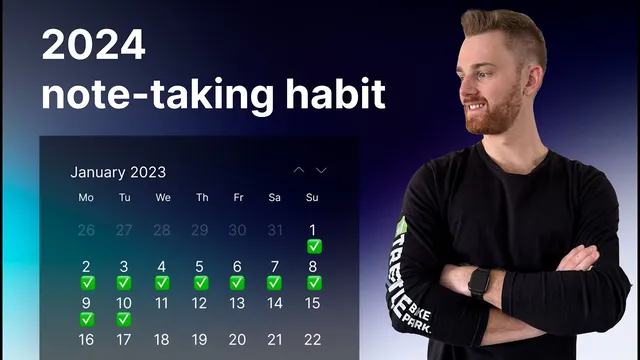
How to start a note-taking habit in 2024
Based on Reflect Notes's video on YouTube. If you like this content, support the original creators by watching, liking and subscribing to their content.
Anchor note-taking to a daily note (or a new page per day) so the next writing location is always obvious.
Briefing
Starting a daily note-taking habit in 2024 hinges on one practical idea: make it frictionless by anchoring everything to a single “daily note” that’s always ready when the day begins. Instead of hunting for where to write, the notes system should act like an infinite calendar—an ongoing note with a new section for each day—so opening the app immediately tells a person where to start and where new thoughts belong. If someone isn’t using a daily-note app, the workaround is straightforward: create a new page (or note) for each day, whether in a notebook or a digital tool. The goal is consistency of structure, not complexity.
Voice notes are positioned as the next major unlock for habit-building. With AI transcription now approaching human-level accuracy, recording spoken thoughts becomes reliable enough to trust. The workflow described is simple: start recording, speak normally (including switching languages or using unusual names), and have the transcription land directly under an audio memo section inside the day’s note. Afterward, an AI palette editor can turn raw speech into usable outputs—like generating a to-do list in a specific order via a custom prompt, or extracting key takeaways and summaries from what was recorded. The emphasis is that transcription accuracy removes a major barrier that previously made voice notes feel too messy to rely on.
Once the daily note is in place, the habit becomes more enjoyable—and more likely to stick—through a repeatable morning routine. A “daily reflection” template is recommended as the entry point: gratitude prompts, a reframing exercise for worries or stress (listing something negative and forcing a more positive reinterpretation), and a top priority for the day. Because the template is pre-written, the person can simply open the daily note and begin filling in the blanks, reducing decision fatigue. The reflection is framed as both calming and therapeutic, which helps it become something people look forward to rather than endure.
From there, the daily note should also hold the day’s operational details. A basic to-do list—labeled “to do” with action items that can be checked off—keeps tasks visible without overthinking. Meetings can be added as they arise, and future items (like publishing a video) can be captured immediately even if details are still undecided. For those who prefer a different style, a “daily log” offers a chronological record of what happened (e.g., “7 a.m. did my daily reflection,” “9 a.m. met with Alex McCaw”), trading checkboxes for a running narrative.
Finally, habit success depends on tool choice and capture discipline. The advice is to use a tool that feels fast and enjoyable—often something simple like Apple Notes—because slow, buggy, or overly complex apps kill momentum. Once the daily note is the home base, it should also become the place where everything gets saved: grocery lists, meetings, names of people met at events, new ideas, goals, and brain dumps. The underlying promise is compounding: start for a month, and after a week or two the routine can become self-reinforcing and hard to stop.
Cornell Notes
A daily note-taking habit becomes easier when it’s built around a single “daily note” that functions like an infinite calendar, giving a clear place to write every day. Voice notes with AI transcription are presented as a major upgrade because they’re accurate enough to rely on, and they can be converted into to-do lists or summaries using an AI editor. The routine is strengthened with a pre-made daily reflection template that includes gratitude, a reframing exercise for worries, and a top priority for the day. From there, the daily note can hold a simple to-do list or a chronological daily log, plus everything else worth remembering—lists, meetings, names, ideas, goals, and brain dumps. Keeping the tool simple and frictionless is treated as essential for consistency.
Why does the “daily note” structure matter more than the specific app?
How do voice notes change the practicality of note-taking?
What’s inside the recommended daily reflection template, and why is it effective?
When should someone use a to-do list versus a daily log?
What tool principle is emphasized for building the habit?
What kinds of information should be stored in the daily note?
Review Questions
- What specific features of a daily note system reduce friction compared with writing in an unstructured way?
- How can AI-transcribed voice notes be turned into both tasks and summaries, and what prompts or steps are involved?
- Would you prefer a to-do list or a daily log for your own routine—what would you gain or lose with each?
Key Points
- 1
Anchor note-taking to a daily note (or a new page per day) so the next writing location is always obvious.
- 2
Use voice notes with AI transcription to capture thoughts quickly, then convert them into to-do lists or summaries with an AI editor.
- 3
Start mornings with a pre-built daily reflection template: gratitude, reframing worries into a positive lens, and choosing a top priority.
- 4
Keep task capture simple with a to-do list (checkoffs) or a daily log (time-stamped events), depending on what feels motivating.
- 5
Choose a fast, reliable, enjoyable tool—avoid slow or buggy apps that make the habit harder to begin.
- 6
Treat the daily note as the home base for everything worth remembering: lists, meetings, names, ideas, goals, and brain dumps.
- 7
Commit to the habit for about a month; consistency should make it self-reinforcing after the first week or two.