How to Stop Overthinking (and Finally Achieve Your Goals)
Based on Ali Abdaal's video on YouTube. If you like this content, support the original creators by watching, liking and subscribing to their content.
Overthinking often comes from treating learning as a substitute for launching, not from a lack of motivation.
Briefing
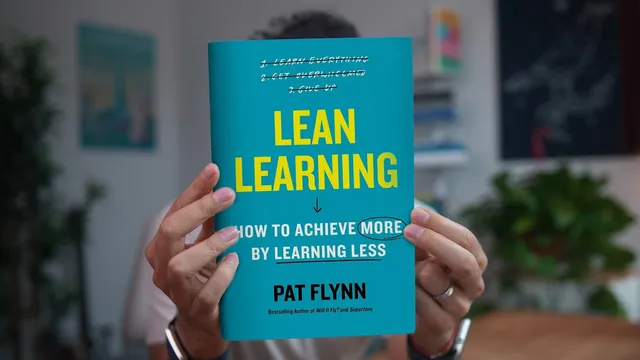
Overthinking derails progress because it substitutes information-gathering for the one thing that actually creates momentum: taking the next step with a minimum amount of knowledge. Pat Flynn’s Lean Learning—summarized through a mix of personal anecdotes and practical frameworks—argues that most people get stuck not due to laziness, but because they believe they must know everything before starting. A key visual in the book frames the idea: for any goal, there’s a vast amount of information available, yet only a small slice is truly necessary to begin. The rest becomes useful later, after action starts producing real feedback.
That distinction matters because learning often feels productive in the short term. Watching videos, reading books, and doing research can create the sensation of progress while keeping someone safely in “preparation mode.” Flynn’s subtitle, “Just Get Started,” is used to puncture that comfort. The transcript contrasts two mindsets: searching for a “Eureka moment” that will make the endeavor easier versus building skill through doing. Pat Flynn’s own early business experience is cited as a cautionary tale—years of consuming blogs, podcasts, and business books became a way to hide behind learning rather than launch. The result wasn’t just delayed action; it was a habit of waiting for certainty that never arrives.
A bicycle analogy makes the same point. It would be irrational to study Olympic-level cycling details before learning to ride at all. Beginners need training wheels, basic instruction, and repeated attempts—even if they fall over. Only after the skill exists does it make sense to research advanced techniques. The transcript emphasizes that people rarely feel “ready” for uncertain, creative work; they feel ready only after momentum builds. That’s why the “dip” described in Seth Godin’s The Dip becomes central: starting often begins with uninformed optimism, then quickly turns into difficulty. Many quit when the work gets hard, switching to new opportunities before they ever reach completion.
Fear drives the quitting cycle. Two dominant fears show up: fear of making mistakes and fear of public humiliation. The transcript notes that school conditioning rewards avoiding errors, so adults carry the same logic into business and creativity—mistakes feel like failure rather than data. A neuroscience lecture is used to reframe this: the brain is a prediction machine, and learning happens when reality surprises expectations. Mistakes create that mismatch, which means they can be treated as signals for learning instead of proof of incompetence. The alternative mental move is crucial: “I learned through this” versus “I’m a failure.”
The practical solution is Flynn’s Lean Learning method: (1) identify the next step, (2) gather the minimum viable information needed to complete it, and (3) take action to finish that step. Then repeat. The transcript argues that the real shift is from “more learning, less action” to “more action, less learning,” because progress in uncertain domains comes from iterating with real-world results—not from waiting for perfect preparation.
Cornell Notes
The core claim is that overthinking blocks progress by replacing action with excessive information gathering. Pat Flynn’s Lean Learning framework says only a small amount of knowledge is needed to start; the rest becomes valuable after you begin and learn from feedback. Fear—of mistakes and of being judged—keeps people in “research mode,” even though learning feels productive while it delays momentum. Mistakes can be reframed as learning signals because the brain learns when reality surprises expectations. The method is simple: pick the next step, collect the minimum viable information to complete it, take action, and then repeat.
Why does “endless research” feel productive but still keep people stuck?
What does the bicycle analogy add to the argument about readiness?
How does the “dip” explain why people quit when work gets hard?
How does neuroscience reframe mistakes?
What is the Lean Learning method, and why is “minimum viable information” central?
Review Questions
- What is the difference between information needed to start and information that only becomes useful after action begins?
- How do fear of mistakes and fear of public humiliation each contribute to overplanning?
- Apply Lean Learning to a goal you have: what is the next step, what is the minimum viable information, and what action would you take today?
Key Points
- 1
Overthinking often comes from treating learning as a substitute for launching, not from a lack of motivation.
- 2
Only a small amount of information is typically required to begin; the rest becomes useful after you start and get feedback.
- 3
Creative and business efforts rarely feel “ready” at the start; momentum is built through doing, not through certainty.
- 4
School-style conditioning makes mistakes feel like failure, but mistakes can be reframed as signals that enable learning.
- 5
The “dip” phase is where many people quit; sticking with the hard middle is often what separates completion from abandonment.
- 6
Lean Learning’s loop is: identify the next step, gather minimum viable information, take action, then repeat.
- 7
The mental shift is from “more learning, less action” to “more action, less learning.”