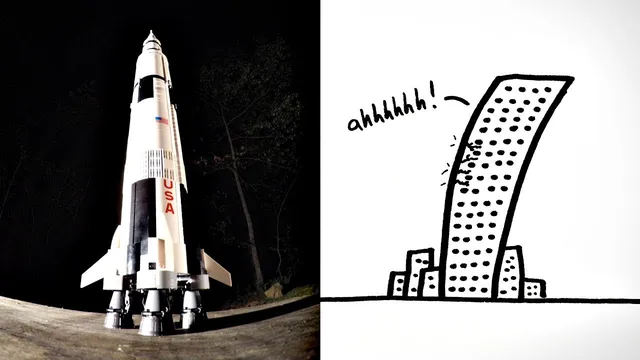
How To Stop Structures from SHAKING: LEGO Saturn V Tuned Mass Damper
Based on minutephysics's video on YouTube. If you like this content, support the original creators by watching, liking and subscribing to their content.
Tall structures act like upside-down pendulums, so their sway is driven by a natural rocking frequency determined by height, weight, and stiffness.
Briefing
Tall structures don’t just “sway”—they behave like upside-down pendulums, with a natural rocking frequency set by height, weight, and stiffness. When wind or an earthquake pushes at or near that frequency, the motion can build and become a problem for safety and comfort. A stiffer structure can reduce swaying, but it often costs more and can be less elegant than needed.
A more efficient strategy uses a tuned mass damper: a smaller, movable mass attached to the main structure so that energy transfers from the big oscillation into the smaller one—where friction and internal losses dissipate it instead of sending it back. In idealized, frictionless physics, coupled oscillators would trade energy back and forth forever. Real systems aren’t ideal: air resistance, friction, and even heating in the spring gradually drain energy, so the oscillations fade. The tuned mass damper exploits that reality by “stealing” oscillation energy from the structure at the right rate.
The key is tuning. For a given large object, the damper’s mass, spring stiffness, and friction must be matched to the structure’s natural frequency. If the smaller mass and its coupling aren’t tuned correctly, energy won’t transfer efficiently, and the damping effect weakens. When tuned properly, the large structure loses energy faster, so its rocking amplitude drops more quickly.
The demonstration uses LEGO Saturn V rocket sets as a stand-in for a tall, flexible body. One rocket includes a weighted pendulum placed where the lunar module would normally go; the other keeps the weights fixed. When the table is bumped, the rocket with the pendulum sways noticeably less, and a motion graph makes the difference clearer: the tuned system damps the oscillations that the untuned setup allows to persist.
While tuned mass dampers weren’t used in the Saturn V in this specific way, the underlying principle is widely used in real engineering. Skyscrapers often incorporate tuned mass dampers to counter wind-induced sway, and similar devices appear in non-building applications. Power lines can include small “dumbbell” dampers that reduce vibration in gusts. The same concept has also been applied to reduce unwanted vibrations in airplane engines, Formula 1 racing cars, and audio speaker cones.
In short, the approach turns a structure’s own tendency to oscillate into a liability that can be actively drained: a carefully tuned secondary mass converts the main motion into heat and frictional losses, discouraging the swaying that would otherwise grow or linger.
Cornell Notes
Tall buildings behave like upside-down pendulums: a small sideways push triggers rocking at a natural frequency determined by height, weight, and stiffness. Coupling that motion to a smaller oscillating mass via a spring creates energy swapping between the two systems. In real life, friction and air resistance dissipate energy, so the smaller mass can act as an energy sink. A tuned mass damper works best only when the damper’s mass, spring strength, and friction are tuned to the main structure’s natural frequency. LEGO’s Saturn V demo uses a pendulum in place of the lunar module to show reduced swaying compared with fixed weights, illustrating the same damping principle used in skyscrapers and other vibration-prone systems.
Why does a tall structure tend to sway, and what sets its natural rocking frequency?
How does a tuned mass damper reduce shaking instead of just adding stiffness?
What does “tuned” mean in tuned mass damper design?
What does the LEGO Saturn V pendulum experiment demonstrate?
Where else are tuned mass dampers used beyond buildings?
Review Questions
- How does energy transfer between a main oscillating system and a coupled smaller mass lead to damping in real-world conditions?
- What design parameters must be tuned for a tuned mass damper to work effectively, and why does mistuning reduce performance?
- In the LEGO Saturn V comparison, what mechanical change (pendulum vs fixed weights) produces the observed reduction in swaying?
Key Points
- 1
Tall structures act like upside-down pendulums, so their sway is driven by a natural rocking frequency determined by height, weight, and stiffness.
- 2
A tuned mass damper reduces oscillations by transferring energy from the main motion into a secondary mass where friction and losses dissipate it.
- 3
In ideal frictionless models, coupled oscillators would keep swapping energy indefinitely, but real friction and air resistance make the energy transfer lead to damping.
- 4
Tuned mass dampers must be carefully tuned—damper mass, spring stiffness, and friction need to match the structure’s natural frequency for maximum damping.
- 5
The LEGO Saturn V demo uses a pendulum in place of the lunar module to show reduced swaying compared with fixed weights.
- 6
Tuned mass dampers are used in skyscrapers and also in power lines, airplane engines, Formula 1 cars, and audio speaker systems to control unwanted vibrations.