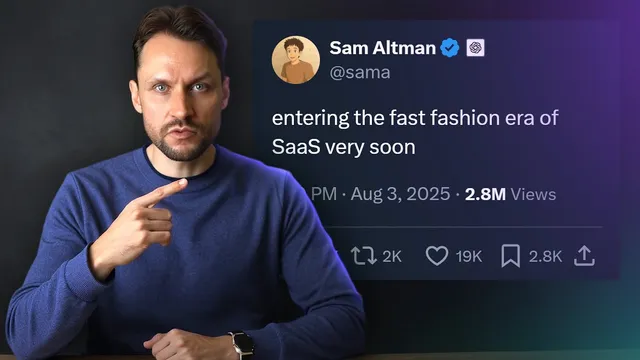
How To Survive The "Fast Fashion" Era of SaaS
Based on Simon Høiberg's video on YouTube. If you like this content, support the original creators by watching, liking and subscribing to their content.
AI is expected to automate most coding and parts of UX and debugging, increasing the number of SaaS products and making differentiation harder.
Briefing
SaaS is entering a “fast fashion” phase: AI tools can generate most code and even handle UX and debugging, which will flood the market with low-quality, interchangeable products. The practical takeaway is blunt—surviving the AI-driven commoditization race depends on uniquely positioning a product so customers don’t treat it as a cheap substitute.
The transcript frames this as the “Teemo effect,” borrowing the idea that many users settle for low-cost options even when the output isn’t exceptional. With tools like lovable, cursor, and cloud code, the barrier to launching a SaaS product drops sharply. AI is expected to write roughly 95% of code for many products, design interfaces, and perform debugging and quality checks. That combination raises the odds that many new offerings will be “AI slop” or merely adequate, not truly differentiated. As a result, the central problem becomes positioning: how to avoid a race to the bottom in a crowded market.
Eight positioning strategies are laid out, each with tradeoffs and examples. First is “low-cost alternative,” where messaging emphasizes solving a known problem for a lower price than established players. Papley is cited as a low-cost “sepier” alternative that benefits from not needing to educate the market—customers already understand the category and can instantly map the value proposition to “SaaPier and cheaper.” The risk is being perceived as a knockoff or low-quality AI substitute.
Second is “light version,” offering a simpler, more limited interface aimed at less technical users. Canvas is used as the cautionary tale: it began as a light Photoshop alternative but grew into a complex tool that some users now struggle with. Third is “enterprise,” targeting large, painful problems with heavy customer service, tailored solutions, and manual setup—described as a hybrid software-services model. Hopspot and Salesforce are offered as examples, with Hopspot’s enterprise pricing cited as over $3,000 per month.
Fourth is “unique player,” built on a genuinely distinctive approach or specialized expertise, with Grammarly and OpenAI as historical examples of early uniqueness. The downside is that uniqueness is hard to defend as competitors copy what works. Fifth is “first mover,” capturing a new market before others—Slack is the example—though first movers must educate customers and absorb early mistakes.
Sixth is “niche,” tailoring the product to a small segment (Oberlo for Shopify drop-shipping inventory management). This is presented as a particularly strong indie SaaS strategy because customization creates defensibility, but it can cap growth and may force later expansion that alienates the original user base. Seventh is “privacy first,” using data privacy and security as the core differentiator (BAM Analytics and NADN). The risk is getting trapped in a small segment if larger competitors adopt similar privacy practices. Eighth is “integrations,” positioning as the tool with the most third-party connections (Sappure with 6,000 integrations). The vulnerability here is that competitors can eventually match integration catalogs.
Overall, the transcript urges founders to identify which position their product currently occupies and whether that choice still makes sense in an AI-saturated market—while also warning that some AI SaaS categories are especially difficult to build into a defensible business.
Cornell Notes
AI-driven development is expected to generate most code and even handle UX and debugging, making many SaaS products feel interchangeable and pushing the market toward low-cost “good enough” offerings. To avoid a race to the bottom, the transcript lays out eight positioning strategies—each designed to create defensibility through pricing, scope, service model, differentiation, timing, audience focus, trust, or ecosystem fit. The most durable options tend to be those that are hard to replicate quickly, such as niche tailoring or enterprise service depth. Founders are encouraged to audit their current positioning and consider switching if it no longer creates a clear reason to choose their product.
Why does AI make SaaS positioning more urgent now?
What are the tradeoffs of positioning as a low-cost alternative?
How does “light version” create defensibility—and why can it backfire?
Why is “enterprise” described as more resilient in an AI-saturated market?
What makes “niche” a strong indie SaaS strategy, and what’s the downside?
Which positioning is hardest to protect long-term: integrations or uniqueness?
Review Questions
- Which of the eight positioning strategies best matches your product’s current value proposition, and what evidence supports that fit?
- Pick one strategy (low-cost, light version, enterprise, unique player, first mover, niche, privacy first, integrations). What is the most likely way competitors could neutralize it?
- If AI reduces development effort, what non-code advantages (service model, audience focus, trust, ecosystem, or timing) could still create defensibility for your SaaS?
Key Points
- 1
AI is expected to automate most coding and parts of UX and debugging, increasing the number of SaaS products and making differentiation harder.
- 2
Survival depends on choosing a positioning strategy that creates defensibility in a crowded market rather than competing on generic features.
- 3
Low-cost alternative works when customers already understand the category, but it risks being perceived as a knockoff or low-quality “AI slop.”
- 4
Light version can attract non-technical users, but it becomes risky if the product grows into complexity and breaks the “light” promise.
- 5
Enterprise positioning can be more durable because it relies on human-heavy service, tailored setup, and ongoing account management.
- 6
Niche positioning is often the most indie-friendly approach because deep customization for a small segment is harder to replicate, though it may cap growth.
- 7
Integrations can drive adoption quickly, but integration catalogs are relatively easy for competitors to match.