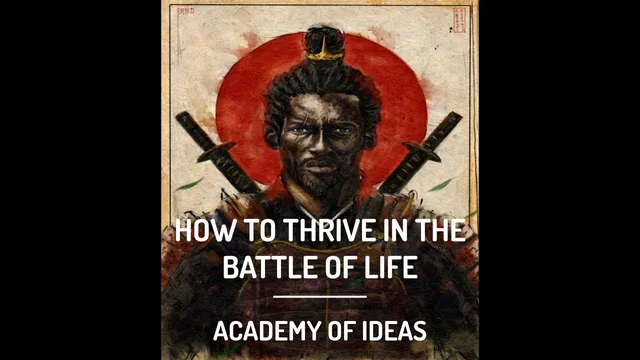
How to Thrive in the Battle of Life
Based on Academy of Ideas's video on YouTube. If you like this content, support the original creators by watching, liking and subscribing to their content.
Life is treated as an unavoidable battle, and meaning comes from engaging it rather than escaping it.
Briefing
Life is framed as a constant battle—against fear, weakness, bad habits, and the limits of time—but the central claim is that meaning and fulfillment come from full participation in that struggle. Hard conditions can’t be removed, yet how a person meets change determines whether life feels like mere endurance or genuine growth. Since life is defined by flux—aging, shifting relationships, and sudden, unpredictable events—success depends less on rigid plans and more on adaptive capacity. Psychological and behavioral rigidity is treated as a near-guarantee of failure because it narrows options when circumstances shift; avoiding challenges, denying they exist, or fleeing them may reduce discomfort temporarily, but it also shrinks lived experience. The alternative is to face battles with flexibility, adjusting tactics as new “foes” appear, an approach likened to Sun Tzu’s idea that victory comes from modifying strategy to match the opponent and conditions.
To make that adaptivity possible, the transcript argues for a reorganization of identity: replacing a “constructed self” with a “discovered self.” A constructed self is anchored in external markers—job title, income, physical attributes, age, education, home location, car, and social connections. That identity can feel stable only while the surrounding world remains stable. When the outer order breaks down—through economic, social, or personal crisis—people whose self-concept depends on external goods often collapse with it. Schopenhauer is used to underline the fragility of happiness built on property, rank, relationships, and social standing: when those supports vanish or disappoint, the “foundation” of well-being disappears because the center of gravity is outside the self.
A discovered self, by contrast, is cultivated through virtues, skills, character traits, and personal capacities—through becoming rather than acquiring. The transcript ties resilience to this inward anchoring: a discovered self emerges through individuation, a process of developing unique, inborn abilities over time. With identity rooted in personal qualities and values, change becomes less threatening; parts of the external world can dissolve without feeling like existence itself is collapsing. This discovered self is also described as more adaptive because self-development builds practical capacities for confronting life’s battles.
The most reliable path to cultivating a discovered self is presented as living with a purpose or mission—any challenging, inspiring long-term goal chosen by the individual that promotes human flourishing. Purpose functions as daily training: it supplies new tasks, forces skill-building voluntarily, and helps actualize latent potential. The transcript defends purpose as more than a cliché by invoking extreme historical evidence. Joost Meerloo, a Dutch doctor and anti-Nazi resistance member who studied concentration-camp prisoners, argues that morale boosters exist under catastrophe, and the most effective is often a guiding inner goal—love of freedom or justice, or even hate and revenge—because a guiding idea is as necessary as physical endurance. Viktor Frankl’s concentration-camp observations reinforce the same point: without a future goal, prisoners struggled to endure uncertainty and succumbed to “give-up-itis.”
With social uncertainty and intensifying tyranny described as looming threats, the argument concludes that purpose and discovered selfhood may determine whether people thrive amid turmoil or merely suffer through it. In that sense, the battle of life becomes not only unavoidable, but also potentially transformative—if identity and purpose are built to withstand change.
Cornell Notes
Life is portrayed as an unavoidable battle shaped by constant change, unpredictable events, and human fear and weakness. Because conditions shift, success depends on adaptability rather than rigidity—avoiding challenges shrinks life, while flexible engagement builds meaning. The transcript recommends replacing a “constructed self” (identity built on external status, possessions, and social markers) with a “discovered self” (identity grounded in virtues, skills, and character developed through individuation). A discovered self is more stable internally and more adaptive because self-development equips people for new challenges. The clearest route to that inner anchoring is living with a purpose or mission, which sustains morale even under extreme suffering, as shown by accounts from Joost Meerloo and Viktor Frankl.
Why does rigidity fail in the “battle of life,” and what replaces it?
What makes a “constructed self” vulnerable during crises?
How does a “discovered self” change the way people respond to change?
Why is living with a purpose treated as a practical tool, not just inspiration?
What do Meerloo and Frankl add to the argument about purpose?
Review Questions
- How does the transcript connect adaptability to success, and what specific behaviors does it treat as counterproductive?
- Compare constructed and discovered selves: what external or internal anchors define each, and why does that matter during social or personal breakdown?
- What mechanisms does the transcript attribute to purpose for building resilience, and how do Meerloo and Frankl’s accounts support those mechanisms?
Key Points
- 1
Life is treated as an unavoidable battle, and meaning comes from engaging it rather than escaping it.
- 2
Because life is defined by change and unpredictability, success depends on adaptive tactics instead of rigid routines.
- 3
Avoiding challenges may reduce discomfort, but it also reduces lived experience and weakens resilience over time.
- 4
A constructed self—built on external status and goods—becomes unstable when the surrounding world collapses.
- 5
A discovered self—built through virtues, skills, and individuation—offers greater internal stability and flexibility under change.
- 6
Living with a challenging, chosen purpose provides daily training that helps a discovered self emerge.
- 7
Accounts from concentration-camp survivors are used to argue that purpose can be a decisive morale factor between endurance and collapse.