How To Train Yourself To Have An Exceptional Memory
Based on Justin Sung's video on YouTube. If you like this content, support the original creators by watching, liking and subscribing to their content.
Treat memory as a property of how information is constructed and connected, not as a fixed personal trait.
Briefing
Memory isn’t a fixed personality trait—it’s a property of how information gets constructed and connected. The core shift is from “I have a bad memory” to “I build memories in a fragile or robust way.” Daniel Willingham’s line—memory is the residue of thought—captures the mechanism: recalling isn’t pulling a stored file from an archive; it’s reactivating the thoughts and processes that were present when the information was first engaged. If learning happens quickly and haphazardly, there’s little durable “residue.” If learning forces deeper construction—more mental work, more connections, more integration—information becomes stickier and easier to retrieve later.
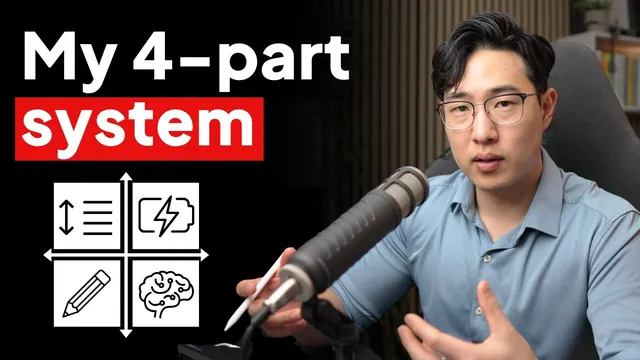
That framing leads to four learning principles that train memory by changing how study sessions are designed. First is the spacing effect: recall ability decays after initial learning, with many people forgetting roughly half of what they learned within about a week (and overestimating how much they’ll retain). Spacing—revisiting the same material after days and weeks—flattens the decay curve so forgetting slows over time. But spacing alone can become a scalability problem. Passive review methods may require many repetitions (five, six, seven, or more) and still risk forgetting again after a couple of months. The practical takeaway is to space repetitions, but also make each repetition more effective.
Second comes the generation effect: producing knowledge from one’s own effort sticks better than passively receiving it. Rereading notes is passive; rewriting from recall is generative. Listening is passive; pausing to summarize every few minutes is generative. Highlighting is passive; turning highlights into practice questions is generative. The goal isn’t endless complexity—it’s “marginal gains,” moving one step beyond comfort and stabilizing until it becomes a habit. A simple scheduling exercise pairs generation with spacing: plan review times across a week, then ask what one-step-more generative method could replace the original plan, repeating the adjustment every couple of weeks.
Third is the testing effect, but with a crucial nuance: testing improves memory only when the test matches the level and context of real use. Isolated fact regurgitation (like flashcards) may not transfer to complex decisions that require applying knowledge in context. Effective testing also works because it reveals gaps early—often immediately after first learning—so confidence should be treated cautiously. Two traps undermine testing: recognition (seeing the answer and mistaking familiarity for recall) and overconfidence (feeling unsure during recall, then becoming confident only because the answer was provided). The fix is to test at sufficiently challenging difficulty and use feedback to find and fill gaps, not to avoid mistakes.
The fourth principle—higher order thinking—ties everything together. When information is irrelevant, it can’t connect to an existing knowledge network, so it’s harder to think about and harder to retain. When information fits a network (through big-picture reasoning, implications, comparisons, and simplification), new facts can consolidate quickly, reducing how long the decay curve stays steep. Training higher order thinking means zooming out frequently, simplifying after each block of learning, and delaying relationships as little as possible—ideally forming connections almost immediately. Analogies, well-structured teaching, and nonlinear notes (like mind maps) are tools for forcing that network-building. Combined, spacing, generation, testing, and higher order thinking create a memory system that improves gradually—about 1% per day—rather than relying on brute-force repetition.
Cornell Notes
Memory improves when learners change how information is constructed and connected, not when they rely on “talent.” The residue-of-thought view frames recall as reactivating the thinking done during learning. Spacing combats rapid knowledge decay by revisiting material after days and weeks, flattening the forgetting curve. Generation makes learning stickier by requiring effortful recall and transformation (e.g., summarizing, rewriting from memory, turning highlights into questions). Testing strengthens memory most when it is level-matched to real-world use and when feedback is used to find and fill gaps while avoiding recognition and overconfidence. Higher order thinking—network-building through zooming out, simplifying, and connecting immediately—can make learning consolidate faster and reduce how often later review is needed.
Why does the transcript treat memory as something constructed rather than a fixed trait?
How does spacing work, and why isn’t spacing alone enough?
What does the generation effect mean in practice, and how can learners apply it without going overboard?
What makes the testing effect effective, and what are the two major traps?
How does higher order thinking change memory outcomes?
What are concrete techniques for training higher order thinking?
Review Questions
- How would you redesign a passive study method (like rereading notes or highlighting) into a more generative one while keeping it within your current comfort level?
- What does “level-matched testing” mean for a professional using knowledge at work, and how would you check whether your practice questions match that level?
- Describe recognition and overconfidence. How would you modify your feedback process to avoid both when you review mistakes?
Key Points
- 1
Treat memory as a property of how information is constructed and connected, not as a fixed personal trait.
- 2
Use spacing to counter knowledge decay, but don’t rely on passive repetition as the main strategy.
- 3
Increase effort during learning through generation: recall, summarization, paraphrasing, and turning notes into questions.
- 4
Make testing match real-world use by testing at the right difficulty and context, not just by drilling isolated facts.
- 5
Use testing feedback to find and fill gaps early, and avoid recognition and overconfidence when reviewing answers.
- 6
Train higher order thinking by zooming out, simplifying after each block, and forming relationships immediately to build a knowledge network.
- 7
Improve through marginal gains: move one step beyond current habits, stabilize, then take the next step rather than jumping to an extreme system.