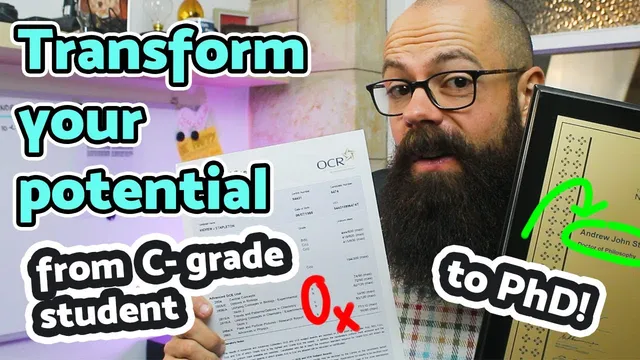
How to transform from C grade student to PhD (like me!)
Based on Andy Stapleton's video on YouTube. If you like this content, support the original creators by watching, liking and subscribing to their content.
Treat disappointing grades as diagnostic feedback about study method, not as a permanent label.
Briefing
A C-grade start in A-level chemistry and physics didn’t block a path to a PhD; the turning point was switching from passive studying and “talent-based” expectations to a repeatable active-recall revision system—and then, later, replacing exam-focused habits with PhD-focused discipline.
At A-level, Andy Stapleton earned B in biology and C in both chemistry and physics, and the disappointment came partly from outside pressure. Teachers and parents framed him as “clever,” which led him to assume he wouldn’t need to work much. That mindset collided with how he actually learned: studying alongside higher-achieving peers, he noticed they could read, write notes, and recall later with less effort. He couldn’t. The mismatch showed up again at university, where he earned a C in chemistry overall and even a D in a chemistry subject, triggering doubts about whether chemistry was the right path.
The breakthrough arrived when he treated the poor grades as feedback rather than a verdict. He concluded that his revision method didn’t fit his memory and recall style, so he rebuilt his approach around active recall. In undergraduate chemistry at the University of Wales Swansea, he went from those early setbacks to first-class results across all years, ultimately earning a first-class degree and opening the door to PhD study.
The core method was active recall using a “one-page A4” system. For each topic and subtopic, he created a single page with the key steps, mechanisms, and exam-relevant information. He then used the back of the page as a prompt: read a line or sentence, try to reproduce the full content from memory word-for-word, and write it out. After marking himself, he repeated the process until he could reach roughly 80% accuracy before moving on. He built up the number of pages gradually—about a month before exams he had the full set—adding several pages in the first week and then one per day until the final week, when he mainly double-checked recall.
He credits two habits for making this work: attending every lecture (when missing information meant losing it entirely, since lectures weren’t online) and then using the A4 pages to force retrieval practice. The result was a consistent upgrade in exam performance, from C-level outcomes to a first-class undergraduate degree.
PhD life required a second shift. At the PhD level, he warned against relying on the same active-recall exam skills. Passing exams proved a foundation, but finishing research demands different capabilities: staying agile to the process, self-discipline, and sustained motivation when progress feels slow. He frames the PhD as “compound interest”—small daily effort builds foundations early, then accelerates later—so the skills that matter most become day-to-day persistence rather than revision technique.
Overall, the message is practical: grades can be improved by matching study methods to how memory works, and PhD success depends less on being the “best student” and more on learning the new skill set of long-term research effort.
Cornell Notes
A-level disappointment (B in biology, C in chemistry and physics) led to a method change rather than self-doubt. The key fix was active recall: for each topic, he wrote a one-page A4 cheat sheet, then repeatedly tested himself from memory (writing answers, marking, and redoing until about 80% accuracy). He attended every lecture and built up roughly 20 A4 pages per exam section over the month before exams, improving from C-level chemistry to a first-class undergraduate degree at the University of Wales Swansea. That success opened the door to a PhD at the University of Newcastle in Australia, but PhD completion required different skills—self-discipline, agility, and sustained motivation—because exam-style revision habits stop being sufficient.
Why did “talent” thinking derail his early results, and what did he learn from it?
What specific active-recall system replaced his earlier revision approach?
How did he schedule the A4 pages leading up to exams?
What role did lecture attendance play in his undergraduate turnaround?
Why did the same revision skills stop working at PhD level?
Review Questions
- What evidence did he use to conclude that his original study approach didn’t match his learning style?
- Describe the steps of his one-page A4 active-recall method and the accuracy threshold he aimed for before moving on.
- How does his view of what matters most in a PhD differ from what matters most for exam success?
Key Points
- 1
Treat disappointing grades as diagnostic feedback about study method, not as a permanent label.
- 2
Match revision to your own recall process; studying alongside high performers doesn’t guarantee the same method will work.
- 3
Use active recall with retrieval practice: write from memory, mark immediately, and repeat until you reach a target accuracy (about 80% in his system).
- 4
Convert each topic into a compact, exam-focused one-page A4 so retrieval is manageable and repeatable.
- 5
Build revision gradually (roughly a month out), adding pages over time and using the final week for double-checking recall.
- 6
At undergraduate level, lecture attendance matters when missing content can’t be easily recovered later.
- 7
At PhD level, shift from exam-revision techniques to long-term research discipline: agility, self-discipline, and sustained motivation.