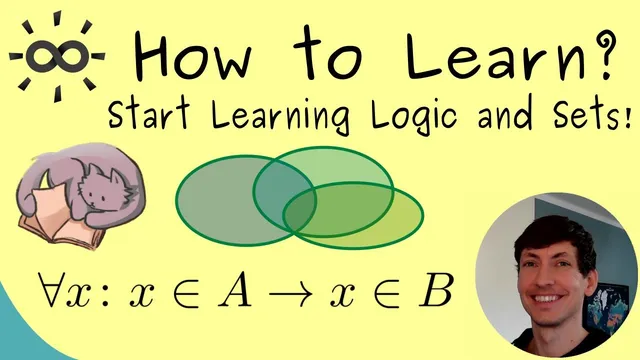
How to use my videos to start learning mathematics
Based on The Bright Side of Mathematics's video on YouTube. If you like this content, support the original creators by watching, liking and subscribing to their content.
Start with logic to learn the precise language needed for rigorous proofs, including conjunction, negation, disjunction, and logical equivalences.
Briefing
The fastest way to learn mathematics effectively is to build a correct “language foundation” first—starting with logic, then sets and maps—before moving on to courses like linear algebra or real analysis. The core message is that mathematics depends on precise symbols and rigorous ways to combine statements and objects, and those skills come from learning how logical statements work and how set-based constructions underpin much of the rest of the subject.
The learning path is organized as a connected series with a clear order. After an introductory node, the sequence begins with logical statements: learning the symbols used in mathematics and the rules for combining them. Key operations include conjunction and negation, followed by disjunction and logical equivalences. The emphasis isn’t just on intuition; the goal is to understand that proofs require a precise formal language. Even if learners can mix in everyday English during practice, mathematics ultimately relies on the ability to express ideas rigorously in formal terms so that valid proofs can be written.
From there, sets and maps become the next essential building blocks. Sets provide the vocabulary and structure used throughout mathematics, including subsets, intersections, and unions. Just as importantly, this part of the series teaches how the language of mathematics works when combining set objects “in a normal way,” rather than treating set theory as an isolated topic. Maps are introduced as special constructions of sets, which makes their notation feel less mysterious and more like a natural extension of set operations.
The most important follow-up videos focus on map-specific vocabulary that repeatedly appears across disciplines: range, image, and pre-image. Learners also encounter common categories of maps such as injective, surjective, and bijective functions, along with how these ideas show up throughout mathematics. A later video addresses composition of maps, completing the toolkit needed to work with functions systematically.
Once logic, sets, and maps are in place, the series positions linear algebra and real analysis as the next logical steps. Deeper understanding of how numbers work comes later through additional material on constructing number sets, but that construction is not required to begin the major foundational courses. For beginners, the recommendation is to treat number construction as optional at first—then return when ready, especially when complex numbers become relevant. The overall takeaway is simple: follow the intended order, prioritize the first two logic-sets-and-maps modules, and only then expand into broader courses with confidence.
Cornell Notes
A strong start in mathematics comes from mastering the subject’s language before tackling heavier topics. The recommended sequence begins with logic—learning how logical statements combine using conjunction, negation, disjunction, and equivalences—because proofs depend on precise formal expression. Next comes sets and maps: subsets, intersections, unions, and the idea that a map is a special construction of sets. The series then builds function vocabulary (range, image, pre-image) and classifications (injective, surjective, bijective), finishing with composition of maps. With these foundations, learners can move into linear algebra or real analysis, while number-set construction (including complex numbers) can be revisited later when needed.
Why does logic come first in this learning plan?
How do sets function as “building blocks” for later topics?
What map-related concepts are emphasized as repeatedly useful?
What role does composition of maps play in the sequence?
When should learners worry about constructing number sets and complex numbers?
Review Questions
- What logical operations are introduced first, and how do they connect to proof-writing?
- How does the series justify treating maps as special constructions of sets?
- Which function concepts (range/image/pre-image and injective/surjective/bijective) are singled out as recurring across mathematics?
Key Points
- 1
Start with logic to learn the precise language needed for rigorous proofs, including conjunction, negation, disjunction, and logical equivalences.
- 2
Treat sets as core building blocks by learning subsets, intersections, and unions and how set operations combine systematically.
- 3
Understand maps as special constructions built from sets, so function notation feels grounded rather than arbitrary.
- 4
Master recurring map vocabulary—range, image, and pre-image—because these concepts appear across many math topics.
- 5
Learn function classifications (injective, surjective, bijective) early since they recur whenever functions are analyzed.
- 6
Use composition of maps as the capstone for the maps foundation before moving to broader courses.
- 7
Begin linear algebra or real analysis after logic and sets/maps; revisit number-set construction later, especially when complex numbers become necessary.