How To Use Procrastination To Your Advantage (Productive Procrastination)
Based on Better Than Yesterday's video on YouTube. If you like this content, support the original creators by watching, liking and subscribing to their content.
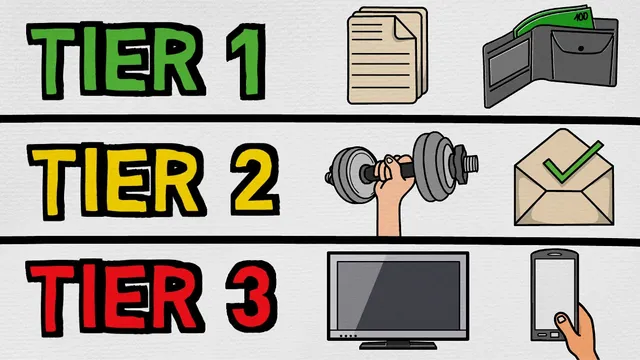
Divide tasks into Tier 1 (crucial), Tier 2 (worthwhile), and Tier 3 (unnecessary distractions) to diagnose what procrastination is actually replacing.
Briefing
Procrastination doesn’t have to mean doing nothing—or wasting the day. A more useful framing divides all activities into three tiers of importance, then treats “productive procrastination” as a way to keep time spent during resistance from sliding into the lowest-value tier.
Tier 1 is the work with the biggest life impact: the crucial tasks people most need to do sooner rather than later. Examples include writing a master’s thesis, finishing a major job project, and planning finances. Tier 2 includes important but less urgent activities—work that still counts as productivity when Tier 1 feels out of reach. Email replies, cleaning the house, and going to the gym fall here. Tier 3 is everything that doesn’t need to happen at all: scrolling Instagram, watching TV, or socializing with someone you don’t care about. These tasks feel like relief, but they’re essentially time-wasting.
The key insight is that when people procrastinate, they’re often not choosing between “Tier 1” and “doing nothing.” They’re usually choosing between Tier 1 and Tier 3—low-effort distractions that are easier than the hard mental resistance of the main task. The goal, then, is not to eliminate procrastination entirely, but to remove the easiest path to Tier 3. If TV, internet access, and phone use are unplugged or blocked, the usual escape route disappears. Staring at a wall is still possible, but boredom tends to push action back toward something else.
In practice, boredom becomes a lever: once Tier 3 is harder to start, the mind looks for the next easiest option, which is typically Tier 2. The method is straightforward—when Tier 1 work feels impossible, deliberately steer procrastination into worthwhile tasks. That can mean cleaning the desk, doing dishes, writing down goals, brainstorming an idea, going to the gym, or answering emails. The point isn’t to pretend the hard task is suddenly done; it’s to ensure the time spent avoiding it still produces real progress.
A personal example illustrates the approach. After two weeks on a work project with a strict deadline, the person hit a wall and began procrastinating—normally by browsing the internet. Instead, they unplugged internet access, removing the go-to distraction. With the usual Tier 3 option blocked, boredom set in and they shifted to Tier 2 activities: cleaning the apartment, practicing piano for hours, reading four chapters, and going to the gym. The outcome was both honest and effective: procrastination happened, but it became “productive procrastination” because Tier 3 was prevented.
The takeaway is behavioral: when facing an important task and feeling resistance, don’t jump straight to Tier 3. Make Tier 3 harder to begin, let boredom drive movement, and aim for Tier 2 work so the avoidance period still adds value. Over time, this can turn procrastination from pure loss into a structured, productive detour.
Cornell Notes
The framework splits tasks into three tiers: Tier 1 (most important, highest life impact), Tier 2 (still worthwhile but less urgent), and Tier 3 (unnecessary distractions like social media and TV). When mental resistance makes Tier 1 hard, people often procrastinate by defaulting to Tier 3 rather than doing nothing. “Productive procrastination” works by blocking or making Tier 3 difficult to start, so boredom pushes action toward Tier 2. The result is time spent avoiding the main task that still produces real progress—cleaning, exercising, reading, or planning—rather than pure waste.
How does the three-tier system change the way procrastination is understood?
What’s the practical strategy for turning procrastination into something useful?
Why does blocking Tier 3 lead to Tier 2 work instead of total inactivity?
What example shows the method in action?
What should someone do when they feel resistance toward an important task?
Review Questions
- If Tier 1 work feels mentally blocked, what specific changes could you make to reduce access to Tier 3 distractions?
- Give three examples of Tier 2 tasks and explain why they might be easier than Tier 1 during procrastination.
- In the provided framework, what would “productive procrastination” look like if your main Tier 3 habit is social media rather than internet browsing?
Key Points
- 1
Divide tasks into Tier 1 (crucial), Tier 2 (worthwhile), and Tier 3 (unnecessary distractions) to diagnose what procrastination is actually replacing.
- 2
When resistance hits, avoid defaulting straight from Tier 1 to Tier 3; treat that jump as the problem to manage.
- 3
Make Tier 3 harder to start by removing or blocking common escape routes (e.g., unplug TV, switch off internet, hide the phone).
- 4
Use boredom as a forcing function: once Tier 3 is blocked, inactivity usually doesn’t last, and Tier 2 becomes the next easiest option.
- 5
Choose Tier 2 actions during procrastination—cleaning, exercising, reading, brainstorming, goal-writing, or answering emails—to keep time productive.
- 6
Acknowledge that procrastination may still happen; the objective is to redirect it into meaningful output rather than pure time-wasting.
- 7
The approach can be replicated by identifying personal Tier 3 weaknesses and removing the fastest path to them when Tier 1 feels too hard.