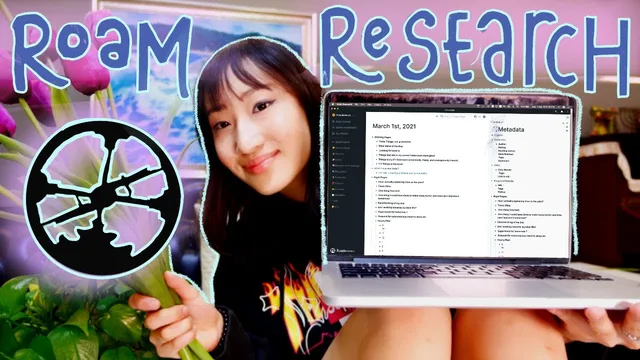
How to use Roam Research 2021 (workflow for school, creativity, mental clarity, storytelling)
Based on Priscilla Xu's video on YouTube. If you like this content, support the original creators by watching, liking and subscribing to their content.
Roam Research is used as a non-linear “digital garden,” where notes grow through connections rather than stored in a straight line.
Briefing
Roam Research is presented as a “digital garden” for building a web of linked ideas—turning reading into memory, creativity, and better storytelling. Instead of treating notes as a linear archive, the workflow centers on daily capture (morning/night pages and what’s being consumed) and then directional linking between concepts so knowledge accumulates like a living knowledge graph. The payoff is practical: more connections mean denser recall, and those connections can be shaped into narratives rather than left as isolated facts.
The core mechanism is Roam’s non-linear note system using bidirectional links (created with double brackets). When a concept sparks another idea, linking them forms an association that can be visualized as a knowledge graph—described as neuron-like connections. As the user studies a topic more, related ideas cluster more tightly, making it easier to retrieve information later and to “see” story paths emerge from the same network. The daily page also acts as a staging ground: it tracks routine reflections and logs articles or books by creating a linked page under the date, then tagging and summarizing what matters.
The workflow for turning consumption into usable knowledge follows a repeatable loop. After reading a section, the user extracts key points and writes summaries to train comprehension and summarization. Metadata and hashtags organize content by topic (for example, using a hashtag like “self improvement” to surface everything consumed under that theme). For school—especially pharmacology—the notes become more than summaries: key terms (such as “anti-cholinergic effects”) are highlighted and linked to new pages, so related drugs fall under shared references. The result is faster recall and the ability to construct explanations or mnemonics as stories.
A major motivation is the scale of information intake: the average person spends about 11 hours consuming media (around 34 gigabytes of data), so note-taking is framed as information management for “knowledge workers.” The transcript also argues that passive reading isn’t enough. It cites learning effects tied to active creation: the generation effect (remembering improves when people create hands-on notes and explain them), the drawing effect (recording improves when information is actively produced), and a “quantity over quality” claim supported by an experiment where students taking more photos produced higher satisfaction outcomes than those graded on fewer, higher-quality images.
Once the garden of linked ideas grows, reflection and storytelling become the synthesis layer. The user describes using life reflection to rehearse lessons and avoid repeating mistakes, and using concept linking to build mnemonic stories—such as connecting sympathetic and parasympathetic nervous system drugs across multiple receptors. Sharing these stories with friends is treated as reinforcement: the same narrative network helps others memorize, and the creator benefits from teaching.
Finally, storytelling is positioned as a human survival tool and a cognitive accelerator. Stories improve memorization and spread knowledge, and they’re described as triggering oxytocin release—“the cuddling hormone”—not only in parent-child bonding but also when people connect through shared narratives. In that framing, Roam Research isn’t just a productivity app; it’s a system for turning reading into connected memory, then into empathy-rich content that people can carry forward.
Cornell Notes
Roam Research is used as a non-linear “digital garden” where notes become a network of linked ideas rather than a straight timeline. The workflow starts with daily capture (morning/night pages and what’s being consumed), then turns reading into usable knowledge by writing key points and summaries and adding metadata/hashtags. Bidirectional links (double brackets) connect concepts so the knowledge graph grows denser over time, improving recall and making story paths easier to find. For school and creativity—especially pharmacology—highlighting terms and linking them to reference pages helps organize mechanisms and supports mnemonic storytelling. The transcript also argues that active note creation and teaching improve memory (generation effect) and that storytelling strengthens human connection, including via oxytocin release.
How does Roam’s linking system change the way information is stored and retrieved?
What does the note-taking loop look like after reading an article or book?
How are pharmacology notes turned into memorization and storytelling?
Why does the transcript argue that active notes beat passive reading?
What evidence is used to support “quantity over quality” in note-taking?
How does storytelling connect to memory and human bonding in the transcript?
Review Questions
- What role do bidirectional links (double brackets) play in turning reading into a recall-friendly knowledge graph?
- How does the transcript’s pharmacology example demonstrate the difference between summarizing and building linked reference pages?
- Which learning effects (e.g., generation effect, drawing effect) are cited as reasons active note creation improves memory?
Key Points
- 1
Roam Research is used as a non-linear “digital garden,” where notes grow through connections rather than stored in a straight line.
- 2
Daily capture (morning/night pages plus what’s being consumed) creates a steady intake pipeline for later linking and synthesis.
- 3
Bidirectional links (double brackets) build a knowledge graph; denser study produces denser associations and easier recall.
- 4
Reading-to-notes works best when summaries and key points are written after each section, supported by metadata and hashtags for retrieval.
- 5
For school learning, highlighting terms and linking them to reference pages organizes mechanisms and supports mnemonic storytelling.
- 6
The transcript frames note-taking as active learning: generation and drawing effects improve memory compared with passive consumption.
- 7
Storytelling is treated as both a memorization tool and a social bonding mechanism, tied to oxytocin release.