How to Write a Book Summary
Based on Tiago Forte's video on YouTube. If you like this content, support the original creators by watching, liking and subscribing to their content.
Start by converting exported highlights into a hierarchical outline, then treat that outline as scaffolding rather than the finished summary.
Briefing
A practical method for turning messy book highlights into a readable, persuasive summary hinges on one idea: build a structured outline first, then “translate” that hierarchy into paragraphs in separate passes. The payoff is less blank-page stress and a clearer logic flow—because the hard decisions about what to include and how to order it get handled during cleanup, not during drafting.
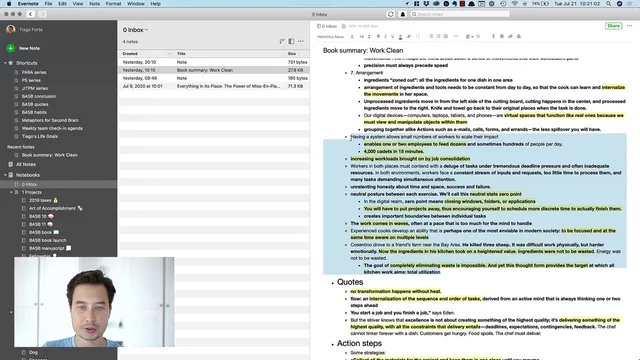
The process starts with an outline created from exported highlights. That outline is treated as scaffolding—useful for completeness, but too sparse to digest. Before writing, the outline gets cleaned up: sections get reordered, duplicated ideas get merged, and the writer re-familiarizes themselves with the material after days or weeks away. The cleanup phase also forces explicit answers to two strategic questions: what the book is about, and why it matters. In the example, the book’s subject is the cooking system of mise-en-place, and the “why” centers on the gap between existing productivity approaches and the need to manage work as a fluid, holistic process that accounts for energy, thoughts, and emotions.
As the outline is refined, the writer notices patterns that suggest a stronger structure. Specific ideas that initially appear later in the notes—like sequence, checklists as an “external brain,” immersive versus process time, finishing mentality, speed, balance, and arrangement—begin migrating upward into a coherent framework. The result is a set of “seven principles” tailored for knowledge work, even though the original book’s emphasis may differ. The writer also creates a small “miscellaneous” bucket for valuable points that don’t naturally fit, keeping it intentionally small so it doesn’t become a second full outline.
Once the structure is stable, drafting happens in a deliberate sequence using two documents side-by-side: the cleaned outline on the left and a Google Doc on the right. The writer rejects the idea of starting from a blank page because it forces too many mental tasks at once—choosing main points, supporting points, ordering logic, and rewriting in one pass. Instead, each stage isolates one kind of thinking, matching how attention works best: one decision at a time. The first draft is treated as iteration, not a final product, with the introduction revisited multiple times and polished after the rest of the post exists.
The example introduction shows how the writer uses notes for resonance while still shaping the voice. It begins with a hook about knowledge work lacking a culture of systematic improvement—contrasting it with trades where best practices spread through generations and across peers. From there, the writer defines mise-en-place for readers as more than a kitchen habit: it becomes a philosophy and set of practical techniques for organizing minds and automating repetitive work so people can focus on creative parts. The draft stays concise to maximize the odds of readers continuing.
Finally, the method generalizes beyond books: the same outline-to-paragraph pipeline can summarize conferences, courses, and personal learning. Summarization is framed as a core learning mechanism—turning knowledge into a concrete artifact that can be revisited, shared, and absorbed faster than the original source.
Cornell Notes
The core workflow turns book highlights into a structured outline, then converts that hierarchy into prose through staged passes. Cleanup comes first: reorder sections, merge overlapping ideas, and explicitly answer “what is it about?” and “why does it matter?” for the summary’s logic. In the example, mise-en-place becomes a knowledge-work framework, culminating in seven principles such as sequence, checklists as an external brain, immersive vs. process time, finishing mentality, speed, balance, and arrangement. Drafting happens with the outline on one side and a Google Doc on the other, avoiding blank-page overload by isolating decisions across steps. The first draft is intentionally iterative, especially the introduction, which is revised to improve hooks and clarity.
Why treat an outline as scaffolding rather than the final summary?
How does the cleanup phase reduce uncertainty during writing?
What’s the logic behind creating a “seven principles” framework in the example?
Why does the writer insist on staged drafting instead of writing from scratch?
How does the example introduction use notes without copying them verbatim?
What role does iteration play in the writing process?
Review Questions
- When does the method require answering “what” and “why,” and how does that timing affect later drafting?
- How does the outline-to-prose translation reduce cognitive overload compared with writing from a blank document?
- What criteria lead ideas into the main framework versus the “miscellaneous” bucket?
Key Points
- 1
Start by converting exported highlights into a hierarchical outline, then treat that outline as scaffolding rather than the finished summary.
- 2
Do a dedicated cleanup pass before drafting: reorder sections, merge overlaps, and re-familiarize with the material after time away.
- 3
Use two strategic anchors early—what the book is about and why it matters—to stabilize the summary’s logic.
- 4
Build a compact, reader-friendly framework (like seven principles) by grouping the most transferable ideas for knowledge work.
- 5
Draft in stages with two documents side-by-side to isolate decisions and avoid blank-page overload.
- 6
Write a first pass quickly and iteratively, especially the introduction, which should be revised for hook and clarity.
- 7
Generalize the same pipeline to other learning inputs (courses, conferences, personal knowledge) to turn them into reusable artifacts.