How to write a good abstract | structure, example abstract & tips
Based on Qualitative Researcher Dr Kriukow's video on YouTube. If you like this content, support the original creators by watching, liking and subscribing to their content.
An abstract must both summarize the study’s main ideas/findings and support discoverability through keywords.
Briefing
A strong abstract does two jobs at once: it gives readers a fast, accurate overview of a study’s core ideas and findings, and it helps search engines (and AI tools) locate that work through the right keywords. That dual purpose matters because most people decide whether to read further based on the abstract alone—especially when browsing databases—so the abstract needs to be both informative and discoverable.
The recommended structure breaks an abstract into four elements. First comes an introduction that states the research aims and, when useful, the research questions. This section can include brief background or rationale—such as the practical problem being addressed—but it should avoid long literature reviews, excessive references, and anything not directly tied to the study’s focus. A key writing constraint is tense: future tense should be avoided because the study has already happened. Writers can mix tenses slightly (for example, describing what was done in past tense and framing implications in present tense), but the overall rule is to keep it consistent with completed work.
Second is a brief methodology snapshot. The emphasis is on brevity: no lengthy procedural walkthroughs, no deep dives into statistical measures, and no extended discussion of validity limits. Instead, the abstract should name the study type (qualitative, quantitative, or mixed methods), the general approach, and the participant or data source at a high level—such as “20 interviews were conducted”—without bogging down in operational detail or software.
Third comes the findings section, typically placed immediately after the methodology. Even when a study has many themes or results, the abstract should highlight the single main point (or the most defining takeaway) that a reader needs to know. It should also stay faithful to what appears in the full results; including outcomes not actually reported in the paper undermines credibility.
Finally, the conclusion wraps up the “so what.” It should summarize the main lessons learned by addressing how the research questions were answered and what implications or contributions follow. Sometimes limitations are mentioned, but only in a way that naturally leads to future research directions—again, without turning the abstract into a full discussion.
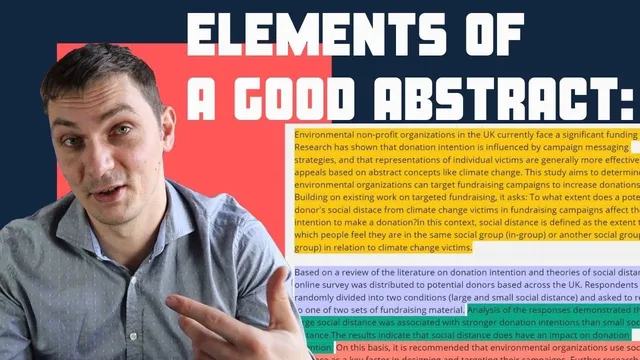
An example abstract illustrates this structure in practice: it begins with context (environmental nonprofit organizations facing a funding gap), then states the aim and research questions, follows with a high-level methodology description (literature review plus an online survey split into two groups), delivers a one-sentence main finding (large social distance linked to stronger donations), and ends with a recommendation and a note that further research is needed to identify other influencing factors. The example also demonstrates how keyword-rich phrasing can support discoverability without relying on references.
For writing effectively, the guidance is to draft the abstract at the end—after the full study’s findings and implications are clear—then learn by reading many published abstracts and thesis abstracts to see how structure and wording work in real papers. Clarity and concision are treated as non-negotiable: avoid long background sections, keep acronyms and jargon to a minimum (especially those not universally understood), and focus on the study rather than re-litigating prior debates. Formatting and referencing rules still depend on the target journal or institution, so requirements should be checked before final submission.
Cornell Notes
A good abstract serves two purposes: it summarizes the study’s main ideas and findings for human readers, and it improves search visibility through keywords. The recommended structure has four parts: (1) a brief introduction with research aims and possibly research questions, with only limited background; (2) a short methodology description (study type, approach, participants/data source) without procedural detail; (3) a focused findings section highlighting the main takeaway; and (4) a conclusion covering implications and/or directions for future research. Future tense should be avoided because the work is already completed. Writing the abstract last, and studying other strong abstracts, helps ensure the abstract stays concise, accurate, and aligned with the full paper.
Why does an abstract need to do more than summarize results?
What is the four-part structure for a strong abstract?
What should writers avoid in the background and methodology sections?
How should tense be handled in an abstract?
How can an abstract handle multiple findings without becoming cluttered?
What practical habits improve abstract quality?
Review Questions
- What four elements should appear in an abstract, and what does each element need to accomplish?
- How do tense choices (past vs present vs future) affect credibility and clarity in an abstract?
- If a study has many results, what strategy should be used to decide what to include in the abstract’s findings section?
Key Points
- 1
An abstract must both summarize the study’s main ideas/findings and support discoverability through keywords.
- 2
Use a four-part structure: aims/research questions, brief methodology, focused main findings, and a conclusion with implications or future research directions.
- 3
Keep background and references limited; avoid long literature reviews and anything not directly tied to the study’s problem.
- 4
Describe methods briefly (study type, approach, participants/data source) without detailed procedures, software, or validity debates.
- 5
Highlight only the most important finding(s) rather than listing every theme or result.
- 6
Avoid future tense when describing the study; use past tense for what was done and present tense mainly for implications.
- 7
Write the abstract last, study strong published abstracts for wording/structure, and follow the specific formatting and referencing rules of the target venue.