How to Write a Research Paper | A Beginner to Advanced Guide | Research Paper Format
Based on Dr Rizwana Mustafa's video on YouTube. If you like this content, support the original creators by watching, liking and subscribing to their content.
Start with a feasible research topic by using supervisor input when available or by reviewing recent work and lab capacity when it isn’t.
Briefing
A professional research paper starts long before drafting: it hinges on choosing a research topic that can credibly be carried out, then defining the problem, gap, and expected outcomes. If a researcher has already completed a research proposal and thesis, the topic selection step is largely done; otherwise, the process begins with narrowing a workable title and research direction. Common routes include asking a supervisor for related papers and guidance, or—when lab capacity and feasibility matter first—reviewing what other professors and teams in the same research area are doing. Recent studies are used to identify limitations and future research prospects, including by scanning popular literature platforms for gaps. The workflow also includes brainstorming research ideas and building a list of related papers using AI tools such as DeepSeek and Gemini, then reading conclusions (and sometimes “future research” sections) to pinpoint a topic that fits the unanswered questions in the field.
Once a topic is selected, the next critical step is to formalize the research problem and its structure: the research problem itself, the research questions, the methodology to address the problem, and the research gap the study will target. Researchers then set aims and objectives and define the scope—what the study will cover and what it will intentionally leave out. Only after this planning does the practical research begin. The chosen methodology is applied to generate data that directly addresses the research gap and objectives, producing the results that will later be used to justify the study’s contribution.
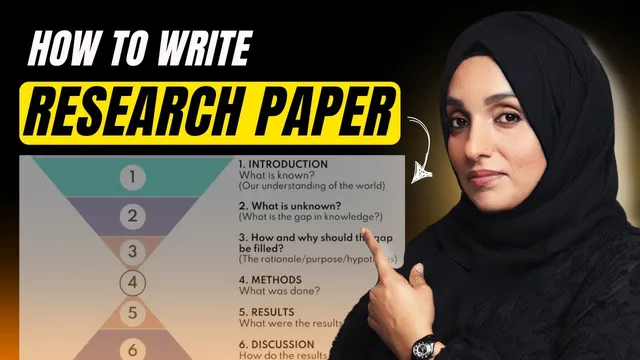
The paper’s standard outline follows a clear chapter logic. Chapter 1 is the introduction, which begins with a broad framing of the topic and builds the rationale (“hype”) for the work. It connects prior literature to the gap—highlighting what has been done and what remains missing—then states objectives and defines the study’s scope.
Chapter 2 is “material and math” (material and methods), described as comparatively easier because it lays out the step-by-step process used to conduct the study. It includes the materials, protocols, and procedures, with enough clarity that other researchers could replicate the work and obtain comparable results. If additional technical procedures were used—such as specific spectroscopy or other validation studies—those must be documented as well, emphasizing reliability and adoptability.
Chapter 3 is the results chapter, where only final, key results belong. The guidance is to avoid cluttering the paper with basic calculations or preliminary samples; instead, present the results that support the study’s conclusions.
Chapter 4 is the discussion, where results are linked back to the introduction: the research gap and the aims and objectives. This section uses technical language to show how the findings align with the study’s stated goals and how they address the gap. Chapter 5 is the references section, listing the literature and sources consulted while writing.
Finally, the paper can include acknowledgements for partners, funding agencies, or collaborators, and the conclusion can restate findings and suggest future research prospects. The overall message is that strong research writing is built on feasibility-driven topic selection, gap-focused problem definition, and a chapter structure that turns data into a technically grounded argument for why the work matters.
Cornell Notes
A research paper’s credibility depends on selecting a feasible topic, then defining the research problem, questions, methodology, and research gap before any data collection. The standard structure is five chapters: introduction (broad context, gap, objectives, scope), material and methods (step-by-step protocols and reliable procedures), results (only final key findings), discussion (technical linkage of results to the gap and objectives), and references (all consulted sources). Replicability is emphasized in the methods chapter: procedures should be clear enough that others can reproduce similar results. The discussion and conclusion sections then convert those results into an argument for how the study meets its aims and addresses what prior work left unanswered.
How should a researcher choose a research topic if supervisor guidance isn’t available?
What elements must be defined before practical research begins?
What makes the “material and methods” chapter central to research authenticity?
What belongs in the results chapter, and what should be left out?
How should the discussion chapter connect results to the paper’s original purpose?
Review Questions
- What steps help narrow a research topic from broad area to a gap-focused title, and how do feasibility and recent literature factor in?
- How do the introduction, results, and discussion chapters work together to demonstrate that a study addresses its research gap?
- Why does the methods chapter need to be written with replicability in mind, and what details should be included to support that?
Key Points
- 1
Start with a feasible research topic by using supervisor input when available or by reviewing recent work and lab capacity when it isn’t.
- 2
Define the research problem, research questions, methodology, research gap, aims, objectives, and scope before collecting data.
- 3
Use a standard chapter structure: introduction, material and methods, results, discussion, and references.
- 4
Write methods as a step-by-step, replicable protocol; include validation procedures (e.g., spectroscopy) when used.
- 5
Present only final, key results in the results chapter, avoiding basic calculations or preliminary samples.
- 6
In the discussion, connect results directly to the research gap and the aims and objectives using technical field language.
- 7
Include references for every source consulted and consider acknowledgements for collaborators, funding agencies, and partners.