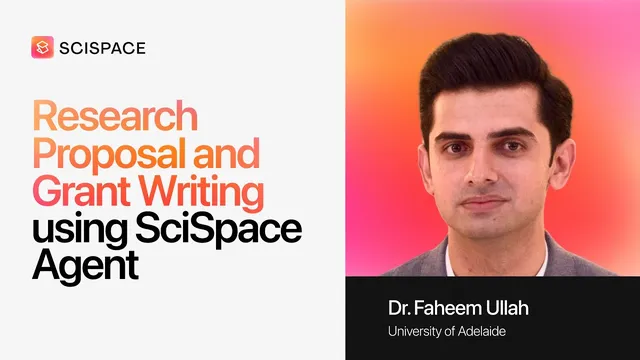
How to Write a Winning Research Proposal | Step-by-Step Guide with SciSpace | Dr. Faheem Ullah
Based on SciSpace's video on YouTube. If you like this content, support the original creators by watching, liking and subscribing to their content.
Treat the research proposal as a persuasive entry point: it must show value, feasibility, and novelty, not just an idea.
Briefing
A strong research proposal is essentially a persuasive blueprint: it convinces admissions committees, supervisors, and funders that a proposed study is worth doing—and that the work is feasible. The core job is to clearly state what research is planned, why it matters, how it will be carried out, and what novelty it brings relative to existing literature. Length and depth vary by stage and stakes: a short proposal may suffice for an undergraduate final-year project, while major funding requests demand a more comprehensive, tightly structured document.
The proposal’s importance is practical, not theoretical. For PhD applicants, it can determine admission and scholarship chances; for academics, it influences funding access and, by extension, performance and promotion metrics. Reviewers look for more than an interesting idea. They want evidence of significance (who benefits and why), clarity of understanding (the proposal should feel grounded rather than vague), and an execution plan that addresses common failure points—especially when students can describe a concept but cannot explain data access, methodology, or analysis steps. In fields like machine learning and deep learning, the availability of datasets often determines whether an idea can actually be executed.
To evaluate proposals, Dr. Faheem Ullah says he looks for four answers that must be present. First: what exactly is being studied. Second: why it is worth studying, supported by motivation and references that establish importance. Third: how it will be done, including data collection, analysis approach, and reporting—often illustrated more effectively with diagrams or flowcharts than with text alone. Fourth: what has already been done, and whether the proposed work is genuinely new. A frequent weakness in submitted proposals is a literature review that becomes purely descriptive—summarizing papers without critical analysis of strengths, weaknesses, and gaps. Novelty should be positioned by reflecting on what prior studies missed and then showing how the new research addresses those shortcomings.
Structurally, a proposal typically includes a title, abstract, introduction, literature review, research methodology, timeline (often in a Gantt chart), ethical considerations, resource requirements, and references. The title and abstract function like a “hook” and “trailer,” and typos there can create a negative first impression. The literature review should draw on roughly 10–15 related papers and can be made reviewer-friendly through tables that compare studies by dataset, algorithms, and key outcomes—making gaps and novelty visible quickly.
The second major thrust is how AI—especially SciSpace—can accelerate proposal work without replacing the researcher. AI can help identify research gaps (including knowledge, evidence, methodological, empirical, theoretical, population, and data gaps), suggest relevant papers for literature review, extract structured information from papers into tables, draft literature review text, format references consistently, generate outlines, and even convert a proposal into a poster. It can also help find potential funders based on research area.
Caution matters. AI should support, not substitute for, the researcher’s judgment. Outputs can reflect bias, vary in correctness across regions, and raise academic integrity issues if used to produce unoriginal work. Sensitive or critical information should not be uploaded to third-party systems, and researchers should stay current because AI tools and research policies change quickly. The takeaway is straightforward: treat the proposal as your entry point, answer the four core questions clearly, use figures and tables to highlight key claims, and use AI ethically to improve quality and speed.
Cornell Notes
A winning research proposal functions as a persuasive, executable plan: it convinces reviewers that the study is important, feasible, and genuinely new. Dr. Faheem Ullah emphasizes four must-answer questions—what the research is, why it matters, how it will be carried out (including data and methods), and what prior work exists to establish novelty. He warns that literature reviews often fail when they summarize papers without critical analysis of strengths and weaknesses, which makes it hard to justify a research gap. The session also highlights how SciSpace can speed up gap identification, paper discovery, data extraction into comparison tables, literature review drafting, reference formatting, outlining, and even poster conversion. AI can help, but researchers must verify outputs, avoid integrity violations, and protect sensitive information.
What makes a research proposal persuasive to admissions committees or funders?
Why do many proposals fail even when the topic sounds promising?
What are the four core questions a reviewer should be able to find in a proposal?
How should a literature review justify novelty rather than just summarize papers?
How can SciSpace help with research gap identification and literature review building?
What precautions should researchers take when using AI tools like SciSpace?
Review Questions
- Which of the four core questions—what, why, how, or what’s already been done—do you currently have the weakest evidence for in your own proposal, and what specific section would you revise first?
- How would you transform a descriptive literature review into a critical one that clearly establishes novelty (strengths, weaknesses, and a gap-driven justification)?
- What concrete feasibility details (data access, methodology steps, analysis plan, timeline) would a reviewer need to see to trust your execution plan?
Key Points
- 1
Treat the research proposal as a persuasive entry point: it must show value, feasibility, and novelty, not just an idea.
- 2
Ensure the proposal answers four reviewer-critical questions: what, why, how, and what has already been done.
- 3
Back the “why” with significance and evidence, using solid references rather than unsupported claims.
- 4
Make feasibility explicit by detailing data access, methodology, analysis, and reporting—ideally with diagrams or flowcharts.
- 5
Use a critical literature review that identifies strengths and weaknesses of prior work and positions novelty against existing studies.
- 6
Structure proposals with standard components (title, abstract, introduction, literature review, methodology, timeline, ethics, resources, references) and keep title/abstract typo-free.
- 7
Use AI tools like SciSpace to accelerate gap finding, paper discovery, extraction, drafting, and formatting—but verify outputs, protect sensitive information, and maintain academic integrity.