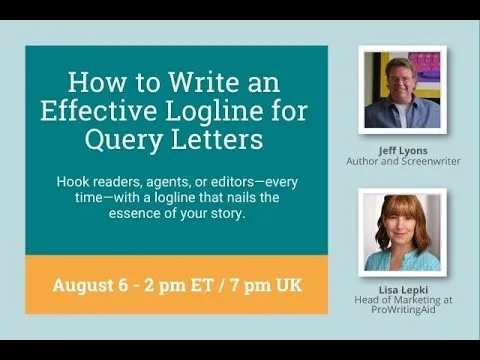
How to Write an Effective Logline for Query Letters, with Story Development Consultant, Jeff Lyons
Based on ProWritingAid's video on YouTube. If you like this content, support the original creators by watching, liking and subscribing to their content.
Treat the logline as a must-have tool for queries and pitching because it creates the first commitment and signals writing focus to editors.
Briefing
A strong logline is treated as a high-stakes, one-time “toe in the door” for agents and editors—and it also functions as a practical development tool that reveals what’s missing in a story before pages get written. Jeff Lyons, a story development consultant, argues that loglines must deliver the narrative essence in one or two sentences: the high concept, the tone, the core premise motion, and the protagonist’s difficult choice. Editors, he says, use loglines to decide quickly whether a writer can focus; weak loglines often trigger immediate “red flags,” because they fail to grab attention or communicate story clarity.
Lyons frames loglines as essential rather than optional. In a workshop-style pitch game at a writers conference, editors “gong” submissions when the logline doesn’t pull them in—usually because it’s unfocused, too vague, or padded with irrelevant explanation. The logline’s job is not to retell the plot or provide backstory; it’s not a hook, tagline, or marketing slogan. Common failures include confusing loglines with hooks (“high concept” alone), using platitudes and genre clichés (“our hero is trying to find his way back”), inserting authorial intrusion (“will our heroine really…”), and over-explaining childhood or context that should belong elsewhere. Another frequent mistake is writing a premise line instead of a logline: premise lines summarize the whole beginning-middle-end structure, while loglines distill the story’s essence and tension.
To fix this, Lyons offers a battle-tested component order for loglines, built from real pitching experience in film and TV. First, establish the world with a few words that imply genre and tone (e.g., dystopia, dysfunctional family, hidden supers). Second, introduce the protagonist without naming them, along with the personal issue they’re grappling with. Third, state the protagonist’s goal or the challenge they face. Fourth, define the opponent as a personified force—ideally another human being—because abstract threats don’t create the same narrative pressure. Finally, end with the protagonist’s decision: an “impossible choice” between two unattractive options that forces action and keeps the reader turning the page. The hook should be implicit once these pieces are correctly assembled.
The workshop portion turns the framework into live diagnosis. Lyons helps volunteers identify missing elements by asking for the world, protagonist, challenge, opponent, and the choice that drives the middle. For example, a Scotland birding story becomes clearer when the “world” is specified (drab London vs. romantic islands), the protagonist’s goal is tied to a time-limited journey, and the opponent is personified (a ship captain who treats her as a liability). A true-story-inspired medical case sharpens when the “world” is defined as legal/medical corruption rather than personal backstory, and the choice is framed as standing up for patients versus protecting a job.
In Q&A, Lyons emphasizes that loglines should not hide the ending in a way that prevents editors from understanding what they’re buying; the tension should come from the protagonist’s impossible decision, not from withholding basic story direction. He also advises against multiple protagonists in a logline for novels, stresses that series require stand-alone loglines per book (plus a series-level one), and confirms the approach works for nonfiction when a clear world, protagonist, and dramatic stakes exist. The overall takeaway: develop the story structure first, then wordsmith the logline by cutting until it reads cleanly—because clarity is what earns the next page, and the logline process exposes structural weaknesses early.
Cornell Notes
A logline is a one- or two-sentence distillation of a story’s narrative essence—high concept, tone, premise motion, and the protagonist’s impossible choice. Jeff Lyons warns that many writers derail by writing hooks, taglines, platitudes, authorial intrusions, or premise summaries instead of a true logline. He recommends a repeatable order: establish the world, introduce the protagonist and personal issue, state the goal/challenge, personify the opponent, then end with the decision that forces action and tension. Used as a development tool, this structure helps writers spot missing components (world, opponent, stakes, choice) before they get lost in drafting.
What makes a logline different from a hook, tagline, or premise line?
Why do editors “gong” weak loglines so quickly?
What is the recommended component order for building a logline?
How does the “impossible choice” function in a logline?
How can logline work reveal structural problems before drafting?
What guidance does Lyons give about endings and what to reveal in a logline?
Review Questions
- Write a logline for a story you’re developing using Lyons’ order. Which component (world, opponent, or choice) is currently weakest, and what specific sentence would you rewrite first?
- Identify one logline you’ve drafted (or a favorite from a book). Mark where it confuses hook vs. logline vs. premise line, and rewrite the final clause to include an impossible choice.
- For a series idea, draft: (a) one stand-alone logline for Book 1 and (b) a series-level logline. What changes when you widen from book-specific stakes to series-wide patterns?
Key Points
- 1
Treat the logline as a must-have tool for queries and pitching because it creates the first commitment and signals writing focus to editors.
- 2
Avoid confusing loglines with hooks, taglines, platitudes, authorial intrusion, or premise-line summaries of the whole plot.
- 3
Build loglines using a repeatable order: world → protagonist/personal issue → goal/challenge → personified opponent → impossible choice/decision.
- 4
End with tension by forcing a difficult decision between two unattractive options, not by promising “cool things” or adding explanations.
- 5
Use logline drafting to diagnose missing story structure early—especially when world, opponent, stakes, or the protagonist’s choice aren’t yet clear.
- 6
For novels, keep the logline centered on one primary protagonist; multiple protagonists can blur reader focus.
- 7
For series, ensure each book has its own stand-alone logline and develop a separate series-level logline to answer “what is the series about?”