How to write daily reflections in your notes
Based on Reflect Notes's video on YouTube. If you like this content, support the original creators by watching, liking and subscribing to their content.
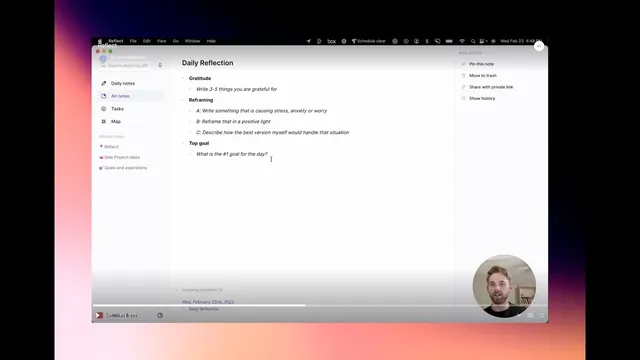
Create a dedicated reflection note and define repeating categories such as gratitude, reframing, and a top goal for the day.
Briefing
Daily reflections become easier—and more useful—when they’re built as a repeatable note template with clear categories for each practice. The approach starts by creating a dedicated note (e.g., “daily reflection”) and defining the sections that should appear every time: gratitude journaling, a reframing exercise, and a single “top goal for the day.” Gratitude is kept concrete (write three to five things being grateful for), while the reframing section follows a structured flow: identify what’s causing stress, anxiety, or worry; rewrite it in a positive way; and describe how the best version of oneself would handle the situation. Adding a “top goal” anchors the reflection to action rather than only emotions.
To make the routine frictionless, the method uses note templates. A “daily reflection” template is created in preferences so that each morning the user can insert the same structure instantly, without rewriting headings or remembering what goes where. The template is set up to include the note itself plus the category layout, with filler text removed so the day’s writing can begin right away. Each morning, the workflow is simple: clear the current note, insert the template via a slash command (or equivalent quick selection), and fill in the sections for that day.
Once this system runs for weeks or months, the payoff shifts from daily clarity to long-term pattern recognition. Because each day’s reflection is stored within the same note, it becomes possible to scroll through past entries and see a chronological list of days completed. Over time—after a year or several years—those entries turn into a personal record of what was happening day to day: how gratitude showed up, what worries recurred, how reframes evolved, and what goals repeatedly mattered. The structure also makes it easier to compare periods, spot trends, and revisit earlier perspectives without starting from scratch each time.
The central idea is that reflection doesn’t have to be vague or reinvented daily. By predefining categories and using a template for fast reuse, daily (or weekly, monthly, yearly) reflections can stay consistent, manageable, and rewarding—both in the moment and in the archive it creates.
Cornell Notes
A practical daily reflection system uses a dedicated note with fixed categories—gratitude (3–5 items), a stress-to-reframe exercise (stress source → positive rewrite → best-self response), and a single top goal for the day. A template makes the routine fast: each morning, the user inserts the same structure so writing starts immediately, with headings remembered and filler removed. As days accumulate, the note becomes a chronological archive of reflections, letting the user review patterns over time. After months or years, scrolling through past entries helps reveal what was happening day to day and how thinking and priorities shifted. The same structure can be adapted to weekly, monthly, or yearly reflections.
How should a daily reflection note be structured to keep entries consistent?
What is the step-by-step flow of the reframing exercise described in the transcript?
Why use a template, and how is it set up for daily use?
What changes after you’ve completed reflections for many days?
Can the same reflection structure be used for more than daily entries?
Review Questions
- What three categories are included in the example daily reflection, and what does each category require you to write?
- Describe the three-part reframing exercise in order.
- How does using a template change the daily reflection workflow compared with recreating the structure manually each day?
Key Points
- 1
Create a dedicated reflection note and define repeating categories such as gratitude, reframing, and a top goal for the day.
- 2
Keep gratitude concrete by writing three to five specific things to be grateful for.
- 3
Use a structured reframing workflow: identify the stressor, rewrite it positively, and describe how your best self would respond.
- 4
Speed up the routine by building a “daily reflection” template in preferences with the correct headings and no filler text.
- 5
Insert the template each morning (e.g., via a slash command) so writing starts immediately.
- 6
Store each day’s reflection in the same note to build a chronological archive for later review.
- 7
Apply the same template-and-category approach to weekly, monthly, or yearly reflections as well.