How to Write Mini Essays (in Obsidian)
Based on Linking Your Thinking with Nick Milo's video on YouTube. If you like this content, support the original creators by watching, liking and subscribing to their content.
Write mini essays as one idea per page, typically 100–300 words, with a beginning, middle, and end.
Briefing
Mini essays are a practical antidote to passive consumption: writing one idea per page (100–300 words) in your own words forces comprehension, surfaces gaps, and turns scattered sparks into a growing body of original thinking—especially when those notes are linked inside Obsidian.
The core case for mini essays rests on three learning benefits. First, they optimize for the generation effect: putting ideas into your own language improves comprehension and recall. Beyond memorization, it also tends to catalyze new meaning—writers often discover insights and develop an intuitive grasp of the topic as they translate “sparks” into “remarks.” Second, mini essays optimize for the “Feynman effect” style of learning-by-teaching: crafting a simple beginning–middle–end story of just over 100 words creates an environment where understanding gets tested, even if the “audience” is future you. Third, they optimize for note making rather than note taking: turning knowledge into your own sentences helps you understand your world while you create something meaningful.
The workflow starts with a spark—something that resonates while walking around, reading, or watching. The habit to break is scrolling past it. The recommended move is to write “because that’s interesting/important to me,” which shifts attention from leaning back to leaning forward. From there comes the remark: a short note capturing why it matters to you. When the question becomes “how do I write a full mini essay with a beginning, middle, and end?” the process uses three quick entry points: experience, opinion, and event.
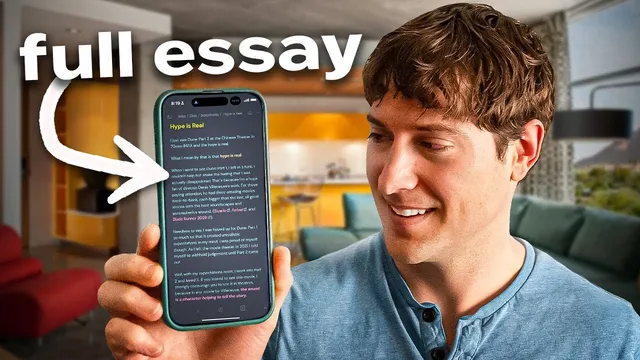
Experience-based essays begin with a personal moment designed to hook attention (for example, watching Dune Part One, then later Dune Part Two). In the transcript’s example, freewriting leads to an insight—“hype itself is real”—which then gets rewritten with a specific audience in mind.
Opinion-based essays start with a strong claim and then build outward using linked ideas from a personal knowledge system. The example centers on AI becoming “mundane,” then connects that theme to “magic to mundane” and Arthur C. Clarke’s idea that advanced technologies can feel indistinguishable from magic. The writing process is described as a cycle: spark → remark → “garden” (drafting and pruning) → link → ignite → rewrite.
Event-based essays anchor on something that happened at a specific time, then use naming to frame the argument. The example uses LeBron James breaking the NBA scoring record in February 2023, contrasted with Kareem Abdul-Jabbar’s 1984 ceremony. Research expands into themes about sports evolution across generations, culminating in a mini thesis titled “LeBron’s a billionaire but Kareem got a sound system,” with supporting claims about how the NBA “builds on the shoulders of giants” and how load management changes the modern game.
Across all three formats, the takeaway is consistent: mini essays are the smallest reliable unit for producing intellectual capital—one idea, one page, 100+ words—then linking those notes over time so the “idea verse” grows with the writer.
Cornell Notes
Mini essays are short, structured writings—one idea per page, typically 100–300 words—with a clear beginning, middle, and end. Writing in your own words leverages the generation effect to improve comprehension and recall, while also revealing gaps in understanding and producing new insights. The format also supports learning-by-teaching (Feynman-style) because the writer must craft something coherent enough to “explain” to an audience, even if that audience is future self. In Obsidian, linking mini essays turns isolated notes into a connected web of ideas that compounds over time. Entry points for drafting are experience, opinion, and event, followed by a rewrite once the core insight or thesis becomes clear.
Why does writing a mini essay improve learning more than just reading or taking notes?
What’s the “spark to remark” step, and how does it prevent getting stuck?
How do experience, opinion, and event help structure a mini essay’s beginning, middle, and end?
What does the “garden master → link → ignite → rewrite” workflow mean in practice?
How does Obsidian linking change what mini essays become over time?
What makes the LeBron/Kareem mini thesis example work as an event-based essay?
Review Questions
- What learning mechanisms are mini essays said to leverage (and how do they show up in the writing process)?
- Choose one of the three entry frameworks—experience, opinion, or event. What would your spark, remark, and likely mini-essay title look like?
- Explain the difference between note taking and note making as described here, and why mini essays are positioned as “the best unit of measurement” for knowledge work.
Key Points
- 1
Write mini essays as one idea per page, typically 100–300 words, with a beginning, middle, and end.
- 2
Use the generation effect: translate ideas into your own words to improve comprehension and recall while uncovering gaps.
- 3
Treat mini essays like teaching (Feynman-style) by crafting a coherent 100+ word narrative that clarifies understanding.
- 4
Capture a “spark” immediately by writing a remark starting with “because that’s interesting/important to me,” then build from there.
- 5
Draft using one of three entry points—experience, opinion, or event—to quickly generate structure and momentum.
- 6
Use a cycle of freewriting/gardening, linking to related notes, and rewriting once an insight reaches “critical mass.”
- 7
Link mini essays in Obsidian so earlier sparks become connected “embers” that can ignite into future work.