How to Write the Background of the Study (Part 1)
Based on Research-Hub's video on YouTube. If you like this content, support the original creators by watching, liking and subscribing to their content.
Treat the background of the study as the foundation of the proposal because it frames the research gap/problem, goal, thesis statement, and justification for the study’s necessity.
Briefing
A strong background of the study is treated as the foundation of a thesis or research paper because it turns a vague topic into a defensible research journey: it frames the research gap/problem, states a clear goal, and presents a thesis statement that justifies why the study must be done. The lecture stresses that this section is not written for style or “aesthetic” reasons. Instead, it establishes context, explains why the problem matters, and signals what readers and thesis committees should expect from the rest of the proposal.
The instructor positions the background as the first major section of the introduction—sometimes also labeled problem articulation, problem formulation, or rationale. Three core elements must appear: (1) the research gap or problem that needs addressing, (2) the research goal (with the reminder that there should be one major goal, not multiple competing ones), and (3) the thesis statement, framed as the main claim/argument and often expressed in an argumentative form. A fifth element is also emphasized: the significance or contribution of the study to the discipline—why the work adds something new to existing knowledge. In experimental studies, the hypothesis may also be included, but the lecture’s sample is qualitative, so hypotheses are not used.
To help students write this section without getting stuck, the lecture lays out a practical “rules of thumb” approach. It begins by warning against a common failure mode: writing the background like a literature review or producing a “conglomeration of random thoughts” by copying and pasting sources without first identifying the gap and goal. Reviewers, advisors, and panel members evaluate whether the narrative is logical, whether claims are grounded, and whether the study’s purpose is unmistakable.
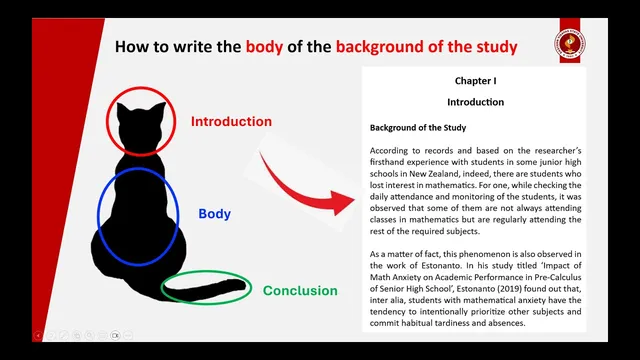
The background is then broken into three parts—opening paragraphs, body, and concluding paragraph—using a “sitting card” analogy: the opening is the head, the body contains the supporting proof, and the conclusion is the tail that closes the loop. In the opening paragraphs, the lecture recommends starting with an overview of the topic and defining key terms when the concept is technical or discipline-specific. The sample topic is “mathematical anxiety,” where the opening defines the term, cites an authority for the definition, and describes its nature and dynamics.
Next comes the body, where the central technique is to write from the vantage point of the research gap/problem and provide “proof” for the big claim. The lecture argues that bold assertions remain assumptions until evidence is offered. That evidence can come from existing literature and, crucially, from preliminary primary data such as interviews and classroom observations. The sample body demonstrates how to use qualifying language like “according to records” and “based on the researcher’s first-hand experience” to show that observations were actually conducted. It also explains why citations matter: they corroborate interpretations and protect the researcher from criticism by grounding claims in established scholars.
Finally, the concluding paragraph rehashes the gap, goal, and thesis statement in a framed way, emphasizing what the study will achieve and why the problem demands attention. The lecture ends by reiterating that a well-structured background provides direction for what comes next—literature to search, methods to choose, and how to maintain a coherent argument throughout the proposal—while also noting that formatting rules should follow university guidelines and that the presented model is one of several possible styles.
Cornell Notes
The lecture treats the background of the study as the thesis proposal’s foundation because it converts a topic into a clear research path. It must include a research gap/problem, a single major research goal, and a thesis statement (main claim/argument), plus the study’s significance or contribution to the discipline. Writing should anticipate committee expectations and avoid common mistakes like turning the background into a literature review or assembling disconnected ideas. The recommended structure is three parts—opening paragraphs (define key concepts and set context), body (provide evidence for the gap using literature plus preliminary interviews/observations), and a concluding paragraph that rehashes the gap, goal, and thesis statement to close the argument.
Why is the background of the study considered the most important part of a research paper or thesis proposal?
What are the core elements that must appear in the background of the study?
How should opening paragraphs be written, especially when the topic uses technical terms?
What does the lecture mean by providing “proof” in the body of the background of the study?
Why are citations emphasized even when the researcher has firsthand observations?
How should the concluding part of the background be handled?
Review Questions
- What specific elements must appear in the background of the study, and how does each one function in guiding the rest of the proposal?
- In what ways can preliminary interviews and classroom observations strengthen the body of the background compared with relying on literature alone?
- How does the lecture’s “head-body-tail” structure change what you write after stating the research gap and thesis statement?
Key Points
- 1
Treat the background of the study as the foundation of the proposal because it frames the research gap/problem, goal, thesis statement, and justification for the study’s necessity.
- 2
Include one major research goal and keep any additional aims as sub-goals/objectives so the proposal stays coherent and defensible.
- 3
Write opening paragraphs to define technical terms and provide an overview that helps readers understand the topic before the gap is introduced.
- 4
In the body, support the central claim with evidence—use literature plus preliminary primary data (e.g., interviews and observations) and use qualifying language like “according to records.”
- 5
Use citations to corroborate interpretations and reduce vulnerability to reviewer criticism when making bold claims.
- 6
Close the background with a concluding paragraph that rehashes the gap, goal, and thesis statement to prevent the argument from feeling incomplete.
- 7
Avoid common mistakes such as turning the background into a literature review or assembling disconnected ideas without first identifying the gap and goal.