How to Write the Background of the Study - Part 2 (Deductive Style)
Based on Research-Hub's video on YouTube. If you like this content, support the original creators by watching, liking and subscribing to their content.
Two structural models guide background writing: inductive (goal/problem/thesis first, then justification, then conclusion) and deductive (context/problem first, then goal/thesis later).
Briefing
A deductive writing structure—starting with the problem context and building toward the research goal—can make a background of the study more logically persuasive, but it demands tighter planning and argument control than the more beginner-friendly inductive approach. The lecture lays out two structural models for writing backgrounds, then demonstrates how a strong deductive version is assembled and revised through multiple drafts.
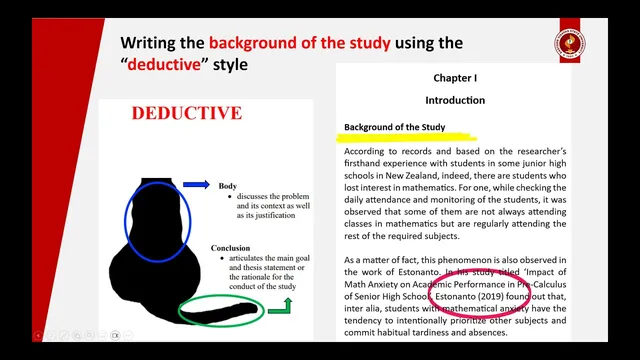
The core distinction is borrowed from logic. Inductive writing moves from particular premises to a general conclusion, which in academic writing translates into an easy-to-follow outline: begin with the “head” (introduction) that states the research goal, research problem, and thesis statements; then write the “body” as justification for the claims; and finish with the “tail” (conclusion) that restates the purpose and rationale. Deductive writing flips the order of emphasis. It starts with the “body” of the argument—context and narrative framing of the issue—then later introduces the main goal, thesis statements, and rationale, ending with a closing that ties the discussion back to the research direction. The lecture warns that deductive writing is harder because it requires sustaining coherent, logical progression from context to problem to research aim.
To make the deductive method concrete, the lecture walks through a sample background of the study for a thesis titled “factors affecting the SBM level of practice in the division of biliran Philippines.” The draft history is used to show that quality comes from revision: the work goes through multiple drafts (described as up to six or seven revisions), with the near-final “draft six” treated as “nearly perfect.”
Early feedback focuses on academic mechanics and ethics. The working title should not be written in all caps, with capitalization aligned to common style conventions (the lecture references APA-style practice). More importantly, the first sentence of the background is flagged for plagiarism because it was lifted directly from a source (Caldwell 2005). The fix is paraphrasing: re-express the idea in new wording while still citing the original source, and adjust subsequent sentences so the argument flows logically.
The lecture then shows how the deductive structure is executed through a planned outline. The background begins by defining “school-based management” (SBM) and explaining its nature and dynamics using policy and assessment frameworks (including references to implementing guidelines and dimensions such as leadership and governance, curriculum and instruction, accountability and continuous improvement, and management of resources). Next comes the “importance of SBM,” supported by citations used strategically to back up bold claims—especially when the writer’s argument is presented as a contention that could be challenged.
Finally, the deductive “problem” section is built with evidence from records and preliminary interviews. The sample claims that only 10% of public high schools in Biliran are validated at SBM level 3 advanced, with further breakdowns (e.g., a small number at level 3, many at level 1 beginning) despite long-standing implementation efforts. The conclusion then transitions to the research goal and argumentative thesis statement: the study aims to determine factors behind why schools with lower SBM practice levels fail to meet level 3 advanced standards, arguing that addressing these challenges is necessary to protect the quality of education and improve responsiveness to programs like K-12.
Overall, the lecture treats a background of the study as a structured argument: define the concept, justify its importance, document the gap with credible evidence, and end with a clear research goal and thesis statement—while revising for ethics, flow, and citation discipline.
Cornell Notes
The lecture distinguishes two structural models for writing a background of the study: inductive and deductive. Inductive writing starts with the research goal, problem, and thesis statements, then builds justification, and ends by restating the purpose. Deductive writing begins with context and the problem narrative, then introduces the research goal and thesis statement later, which makes it harder because the argument must stay coherent and logically connected. A worked example on “school-based management (SBM)” in Biliran shows how a deductive background is built from a planned outline: define SBM, explain its importance, present evidence of the gap (e.g., only 10% at SBM level 3 advanced), then conclude with the research goal and argumentative thesis statement. Revision practices—like avoiding all-caps titles and paraphrasing to prevent plagiarism—are emphasized as part of producing a strong background.
How do inductive and deductive structures change what appears first in a background of the study?
Why does the lecture insist on outlining before writing, especially for deductive backgrounds?
What specific revision guidance is given to avoid plagiarism in the sample background?
How does the sample background handle defining SBM for non-specialist readers?
What evidence is used to establish the research gap in the SBM example?
How does the lecture connect the problem statement to the research goal and thesis statement?
Review Questions
- In a deductive background, what comes first: the research goal/thesis or the problem context—and why does that increase the need for a detailed outline?
- What are the steps for paraphrasing a source-based sentence to avoid plagiarism while maintaining proper citation?
- How does the SBM example use evidence (records, interviews, validation levels) to justify the research gap before stating the research goal?
Key Points
- 1
Two structural models guide background writing: inductive (goal/problem/thesis first, then justification, then conclusion) and deductive (context/problem first, then goal/thesis later).
- 2
Deductive writing is harder because it requires sustained logical coherence; an approved outline reduces the risk of getting stuck or producing disconnected paragraphs.
- 3
Avoid all-caps working titles when style conventions (e.g., APA-style practice) call for standard capitalization.
- 4
Directly copying a definition or description from a source—even with a citation—still counts as plagiarism; paraphrase the idea in new wording and keep the citation.
- 5
A strong deductive background follows a planned sequence: define the key concept, explain why it matters, document the gap with credible evidence, then articulate the research goal and argumentative thesis statement.
- 6
Use citations strategically to support “bold” or “loaded” claims; cite authoritative institutions or authors to reduce vulnerability to critique.
- 7
When drafting conclusions, keep the argument objective: replace assumptions like “they did nothing” with evidence-based phrasing such as “schools face difficulties/challenges” supported by interviews and records.