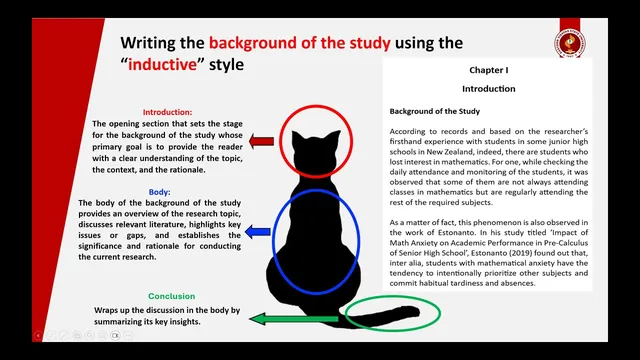
How to Write the Background of the Study – Part 3 (Inductive Style)
Based on Research-Hub's video on YouTube. If you like this content, support the original creators by watching, liking and subscribing to their content.
Use the inductive “head–body–tail” structure: head for research goal/problem/gap/thesis, body for justifications/proofs, tail for a rephrased conclusion and rationale.
Briefing
A clear structure is the difference between a background of the study that reads smoothly and one that stalls or spirals into repetition. Using the inductive “head–body–tail” model, the writing starts by defining the key concept and naming the research gap, then builds credibility through evidence and justifications, and finally closes by rehashing the research goal and explaining why the study matters. The practical payoff is twofold: the draft becomes easier to write step-by-step, and reviewers know what to look for—reducing the risk of major revisions.
The inductive model is laid out as a three-part architecture. The “head” (opening paragraph(s)) should include the main goal of the proposed research, the research problem or gap, and the thesis statement. In the “body,” the writer supports the bold claims introduced in the head with justifications—proofs drawn from observation, interviews, documents, and relevant literature. The “tail” (concluding paragraph) then restates the research goal and the compelling rationale for pursuing the study, but framed differently so it does not sound mechanical.
That structure is contrasted with the deductive style, described as harder because it begins with the problem and context without the guiding introduction. In deductive writing, the main goal and thesis rationale come later, after the problem and justifications have already been presented. Inductive writing, by contrast, front-loads the reader’s orientation: what the study is about, what gap it targets, and why it is worth doing.
Beyond style, the lecture argues that knowing these models prevents common writing failures. With a plan, writers are less likely to get “lost along the way” when staring at a blank screen, because each section has a defined next step. It also improves coherence: instead of random ideas stitched together, the background moves logically from claim to evidence to conclusion. Finally, it aligns with how thesis committees review drafts—members look for specific core elements, and missing them is a signal that the proposal may need substantial revision.
To demonstrate the inductive approach, the lecture walks through a sample background of the study on “lived experiences of Kalinawa National High School grade 10 students with mathematical anxiety.” The opening defines mathematical anxiety using a cited definition, then briefly describes its nature and dynamics. It immediately frames the research problem: if mathematical anxiety is left unaddressed, it can expand into avoidance patterns such as cutting classes and absenteeism, harming math performance and potentially affecting learning and even vocational choices. The research goal and thesis statement follow, aiming to determine students’ lived experiences and identify factors behind their disinterest in mathematics.
The body then supplies “proof” through first-hand and preliminary data: classroom monitoring, interviews, and observations, supported by literature. The sample includes concrete behavioral indicators—tension, fearfulness, low self-esteem, reluctance during recitation, and avoidance of math—along with corroborating claims from scholars (e.g., citations to support emotional symptoms and negative attitudes toward math). The concluding tail reaffirms the presence and impact of mathematical anxiety, argues that the consequences extend beyond grades to future career plans and wellbeing, and positions the study as a basis for later recommendations.
Overall, the lecture treats the background of the study as an argument that must be both logically structured and evidence-backed: claims come first in the head, credibility is built in the body, and the tail closes by restating purpose and stakes in a fresh way.
Cornell Notes
The inductive style for writing a background of the study uses a three-part “head–body–tail” structure. The head opens with the research goal, the research problem/gap, and the thesis statement—often after defining the key concept (e.g., mathematical anxiety). The body then justifies the head’s claims using evidence such as observations, interviews, document/record checks, and supporting literature. The tail concludes by rehashing the research goal and explaining why the study matters, but with different wording to avoid repetition. This structure helps writers stay coherent, avoid getting stuck, and meet what thesis reviewers expect—reducing the likelihood of major revisions.
What belongs in the “head” of the inductive background of the study, and why does it matter?
How does the inductive “body” turn claims into something defensible?
What is the role of the “tail” in inductive writing?
Why does the lecture say deductive writing is harder than inductive writing?
What practical advantages come from using a known structure (inductive or deductive)?
How does the sample background handle credibility and reliability?
Review Questions
- In inductive writing, what specific elements must appear in the head, and how do they shape what the body must prove?
- Using the sample on mathematical anxiety, identify one claim from the head and describe two types of evidence used in the body to justify it.
- Why does the lecture argue that missing core elements in a background can lead to major revisions during committee review?
Key Points
- 1
Use the inductive “head–body–tail” structure: head for research goal/problem/gap/thesis, body for justifications/proofs, tail for a rephrased conclusion and rationale.
- 2
Define the key term early in the head when the topic uses discipline-specific language (e.g., mathematical anxiety) so non-specialist readers can follow.
- 3
Treat bold claims as vulnerable until supported; the body must provide evidence through observations, interviews, record checks, and corroborating literature.
- 4
Write the tail as a rehash of the head’s purpose and stakes, but with different wording to avoid sounding repetitive.
- 5
Knowing a structure prevents getting stuck because each section has a clear next step and a defined function in the argument.
- 6
Deductive writing can be harder because it delays the main goal/thesis rationale, increasing the risk of circular or incoherent flow.
- 7
Thesis reviewers look for core elements in the background; following a known structure reduces the chance of major revision.