How to Write the Conceptual Framework (with Examples)
Based on Research-Hub's video on YouTube. If you like this content, support the original creators by watching, liking and subscribing to their content.
A conceptual framework is a blueprint that specifies how key concepts/variables relate, helping organize ideas and clarify the research problem.
Briefing
A conceptual framework is the study’s blueprint for how key concepts (and, in quantitative work, variables) connect to one another—and it matters because it sets the direction of the entire research process. It organizes ideas, clarifies the research problem, and guides both data collection and analysis by making the relationships among the study’s main elements explicit.
In quantitative research, the conceptual framework typically centers on variables and their measurable relationships. That’s why it often includes independent variables, dependent variables, and sometimes moderating, mediating, or confounding variables—structures that support statistical testing. In qualitative research, variables in the strict quantitative sense are not used; instead, studies rely on key concepts and factors. As a result, a conceptual framework is optional in qualitative work, though it becomes important when the study aims to show how factors or key concepts relate to each other.
The lecture also lays out why this section belongs in a thesis or dissertation beyond the literature review and theoretical framework. Once the researcher identifies the concepts or variables tied to the research problem or gap, the conceptual framework helps maintain coherence and consistency across the proposal and the research journey. It acts like a navigational tool: the clearer the alignment between the research gap and the elements in the framework, the more guided the researcher is in conducting the study.
To write a conceptual framework, the lecture presents six steps. First, clearly identify the research problem or gap; without it, the researcher cannot determine the appropriate variables or key concepts. Second, determine the variables (or key concepts) by listing independent and dependent variables and any moderating/mediating/confounding factors when relevant. Third, review related literature to strengthen scientific rigor—this is where the researcher learns how other studies define and link similar concepts. Fourth, establish the expected relationships among the variables based on theories, prior findings, and assumptions.
The fifth step is the core writing task: explain the conceptual framework in narrative form. After identifying the elements and their relationships, the researcher writes a written account that defines each variable or concept, justifies it using literature, and shows how the relationships guide the study. The lecture emphasizes that reviewers and panel members primarily look for this narrative explanation.
The sixth step—creating a schematic diagram or flowchart—is optional but can help when the narrative relationships are complex or hard to visualize. A key warning is that some students confuse the conceptual framework diagram with the process flow of the study (inputs, outputs, and research procedures). The conceptual framework diagram should depict how the study’s variables or key concepts interconnect, not how the entire research process runs.
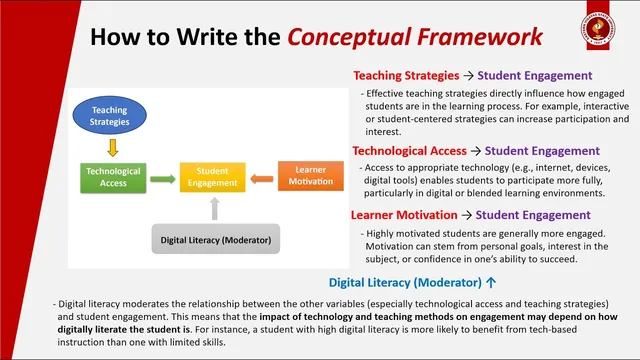
A concrete example ties everything together using the study title “factors influencing student engagements in online learning among college students.” The framework identifies teaching strategies, technological access, and learner motivation as independent influences on student engagement, with digital literacy as a moderating variable. The narrative then links these elements through constructivist learning theory and digital education literature, and the schematic diagram visually represents the same relationships, including how digital literacy can strengthen or weaken the impact of teaching strategies and technology on engagement.
Cornell Notes
A conceptual framework is a structured blueprint showing how key concepts (and in quantitative studies, variables) relate to one another. It matters because it clarifies the research problem, supports coherence across the study, and guides data collection and analysis. The framework is usually built by (1) defining the research problem or gap, (2) identifying variables/key concepts, (3) reviewing related literature, (4) establishing expected relationships, and then (5) writing a narrative explanation that justifies each element. A diagram is optional and helpful for visualization, but it should represent relationships among variables—not the study’s overall process flow.
What is a conceptual framework, and what job does it perform in a thesis or dissertation?
Why is a conceptual framework more common in quantitative research than qualitative research?
What are the six steps for preparing and writing a conceptual framework?
What makes Step 5 (narrative writing) the central part of the conceptual framework?
How should a schematic diagram differ from a process flow diagram?
How does the lecture’s example conceptual framework work?
Review Questions
- In your own study topic, what research problem or gap would you write first to ensure the conceptual framework elements fit the study?
- Which parts of the conceptual framework must be justified with literature, and why is that justification important?
- How would you distinguish a conceptual framework diagram from a process flow diagram when drafting your proposal?
Key Points
- 1
A conceptual framework is a blueprint that specifies how key concepts/variables relate, helping organize ideas and clarify the research problem.
- 2
It provides direction for the study by guiding data collection and analysis and supporting coherence across the research process.
- 3
Quantitative conceptual frameworks typically use variables (independent/dependent and sometimes moderating/mediating/confounding) to measure relationships statistically.
- 4
Qualitative research usually relies on key concepts and factors; a conceptual framework is optional unless the study needs to show how factors relate.
- 5
Writing the conceptual framework should primarily be done through a narrative explanation that defines each element and justifies relationships using literature.
- 6
A schematic diagram is optional and should visualize relationships among variables/key concepts, not the overall research process flow.
- 7
A common error is treating the conceptual framework diagram as the same thing as the study’s process flow (inputs/outputs and procedures).