How to Write the Literature Review (with Examples)
Based on Research-Hub's video on YouTube. If you like this content, support the original creators by watching, liking and subscribing to their content.
A thesis/dissertation literature review must justify the research problem as necessary, timely, and original—not merely summarize sources.
Briefing
A literature review for a thesis or dissertation is not just a list of sources—it’s the mechanism that proves a research problem is necessary, timely, and original, and then sets up everything that follows (theoretical framing and methodology). The core claim is that the literature review earns its place by justifying why a study should exist at all: it contextualizes the gap, positions the researcher within ongoing debates, and prevents duplication of work already done.
The lecture defines a literature review as a comprehensive summary and critical analysis of existing research on a specific topic. Beyond summarizing what scholars have written, it identifies, evaluates, and synthesizes relevant academic work (books, journal articles, and other scholarly sources) to justify a study’s relevance, refine research questions, and avoid repeating prior research. In thesis and dissertation writing, the literature review is also presented as the bridge between the “background/rationale” section and the rest of the proposal, because it supplies the evidence needed to argue for the study’s timeliness, necessity, and originality.
Three major reasons drive the literature review’s role. First, it contextualizes and justifies the research problem or gap. The lecture emphasizes that familiarity with the surrounding literature enables meaningful scholarly engagement—such as contributing to discussions at conferences—because it builds mastery of the field’s debates and context. Second, the literature review supports the study’s theoretical framework by clarifying key concepts, relationships, and assumptions; in quantitative work, it also helps clarify variables and supports research questions or hypotheses. Third, it guides methodological choices: once the research problem is clear, the gap itself influences what methodology, research design, instruments, and data collection/analysis strategies are appropriate.
A key clarification distinguishes this lecture’s focus from a common internet definition. Identifying gaps in knowledge is important during problem formulation and gap spotting, but once a gap has already been identified and the rationale/background has been drafted, the literature review’s primary job shifts. At that stage, the literature review is mainly used to justify the necessity, timeliness, and originality of the already-selected research gap.
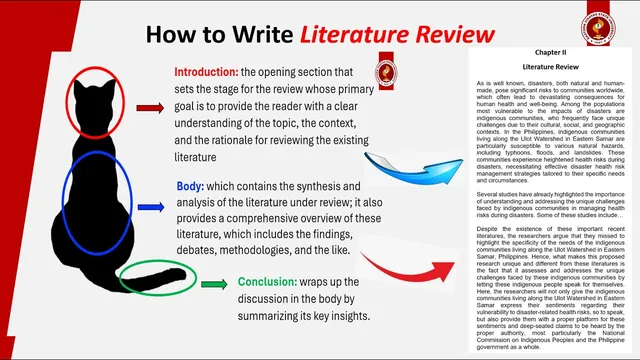
On “how to write” the literature review, the lecture recommends a structured approach using the “head-body-tail” logic: an introduction that defines the topic, significance, scope, and selection criteria; a body that synthesizes and analyzes sources (often organized by themes, chronology, methodology, or theoretical approaches depending on the chosen “attack”); and a conclusion that wraps up the main insights and restates how the study is timely, necessary, and original. The lecture also stresses that organization is flexible—writers can combine organizing principles rather than covering every possible category.
To make the method concrete, the lecture uses a sample literature review from a funded project on Indigenous needs assessment in Panay Island. The sample shows how each cited study is summarized and then “engaged” through an argumentative lens: the review acknowledges contributions while pinpointing what prior work missed—especially the lack of specificity about Indigenous needs from the Indigenous people’s own perspective. The conclusion explicitly rehashes the justification: existing literature highlights marginalization and struggles, but falls short in capturing community needs from the community’s perspective, so the proposed participatory needs assessment is positioned as original and policy-relevant.
Cornell Notes
The lecture frames the literature review as the evidence engine behind a thesis or dissertation: it must justify the research problem as necessary, timely, and original. It also argues that once a gap has already been identified in the rationale/background, the literature review’s main role is no longer “finding gaps,” but proving why the chosen gap matters and why the proposed study won’t duplicate prior work. Three functions are emphasized: contextualizing the problem, supporting the theoretical framework, and guiding methodological decisions (design, instruments, and analysis). For writing, it recommends a structured “head-body-tail” format—introduction, synthesized body, and conclusion that reasserts the study’s contribution. A sample review illustrates how to summarize studies while explicitly identifying what they missed and how the new study addresses it.
What makes a literature review essential in a thesis or dissertation beyond summarizing prior studies?
How does the lecture distinguish “gap spotting” from the literature review’s job once the gap is already chosen?
What are the three major roles of a literature review in thesis/dissertation work?
Why does the lecture emphasize “necessity, timeliness, and originality” as a recurring triad?
How should a literature review be organized, according to the lecture’s writing method?
What does the sample literature review demonstrate about writing the “body” section?
Review Questions
- In your own words, how does the lecture redefine the literature review’s purpose after the research gap has already been identified?
- Which functions of a literature review (contextualization, theoretical framework, methodology guidance) would you prioritize first when drafting a thesis proposal, and why?
- How would you structure the introduction, body, and conclusion of a literature review to explicitly prove necessity, timeliness, and originality?
Key Points
- 1
A thesis/dissertation literature review must justify the research problem as necessary, timely, and original—not merely summarize sources.
- 2
Once a gap is already identified in the rationale/background, the literature review’s main job is justification of that chosen gap rather than continued gap discovery.
- 3
A literature review supports three downstream tasks: contextualizing the problem, establishing the theoretical framework, and guiding methodology (design, instruments, and analysis).
- 4
Writing should follow a structured “head-body-tail” format: introduction (scope/criteria), body (synthesis organized by themes/chronology/method/theory), and conclusion (restate contribution).
- 5
Timeliness is often supported with recent scholarship (commonly within 2–5 years), but humanities/philosophy may rely on primary historical texts as exceptions.
- 6
When synthesizing sources, acknowledge contributions while explicitly identifying what prior studies missed to demonstrate originality and avoid duplication.