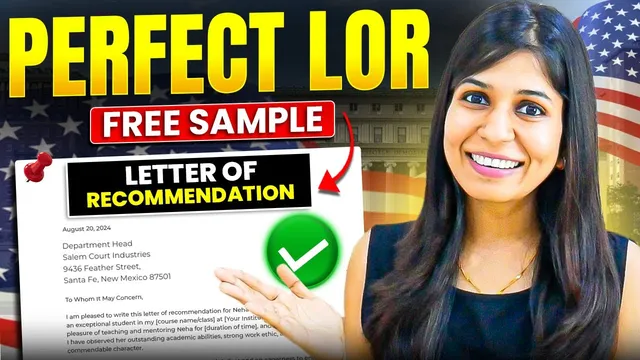
How to write the PERFECT Letter of Recommendation (with FREE SAMPLE) 🤯🔥 for Studying Abroad
Based on WiseUp Communications's video on YouTube. If you like this content, support the original creators by watching, liking and subscribing to their content.
Use a formal greeting and avoid casual openers like “hi” or “hello.”
Briefing
A strong letter of recommendation for studying abroad should be structured, specific, and intentionally varied across multiple recommenders—so admissions officers see a complete, non-repetitive picture of the applicant’s strengths. Most universities ask for two to three letters, and the biggest mistake is letting them read like the same document rewritten. The solution is to keep the core format consistent while changing the style, rearranging key details, and assigning each letter a distinct “major theme” (academic, research, or work experience) that together covers the full range of qualifications.
The recommended structure has five sections: greeting, opening, body, conclusion, and signature. The greeting should be formal—addressing the admissions committee or admissions officer—avoiding casual openers like “hi” or “hello.” In the opening, the recommender must establish the relationship with the candidate by briefly introducing their role and explaining how they know the student (for example, which subjects were taught or which projects were supervised). A typical opening line includes the recommender’s designation and institution, the candidate’s name, and the program being applied for, followed by a sentence or two describing the duration and capacity of the relationship.
The body is the most important section and should outline both professional and personal qualifications. To prevent overlap across multiple letters, each letter should focus on a different theme. One letter can be academic, highlighting subject knowledge, class participation, lab work, and overall course performance. Another can be research-focused, detailing research skills demonstrated during a project and the candidate’s specific contributions. A third can center on internship or work experience, emphasizing corporate responsibilities and how the candidate handled them. Across all themes, every claimed strength should be supported with evidence—an example, a result, or a concrete observation—so the letter feels credible rather than generic. If the applicant has standout qualities that differentiate them from peers, those belong here as well.
The conclusion should tie everything together by summarizing the candidate’s key strengths and, when possible, connecting them to the fit for the specific university and program. The ending should include an explicit endorsement, clearly recommending the candidate “without reservation” and positioning them as an asset to the program. Finally, the signature section should provide the recommender’s full name, designation, institution or company, and contact details (email and phone) in case the university needs to verify or follow up.
To support applicants, the creator also shares a professional sample letter that helped a student gain admission to top U.S. universities, and offers options for additional academic or professional samples through a study abroad course. For students who already drafted their letters, a separate LOR review program provides two rounds of feedback: first on content (what to include, what to omit, and how to make it more compelling), then on grammar, language, and sentence-level polish—though limited review slots are emphasized.
Cornell Notes
A perfect letter of recommendation for studying abroad balances a fixed structure with deliberate variation across multiple letters. It typically uses five sections: formal greeting, an opening that establishes the recommender–candidate relationship, a detailed body with evidence-backed strengths, a conclusion that summarizes and endorses the applicant, and a signature with contact details. To keep two or three letters from sounding identical, each one should use a different style and a distinct major theme—academic, research, or internship/work—so the set collectively covers the applicant’s full profile. Specific examples and proof of skills make claims more believable. The conclusion should explicitly recommend the candidate and, when possible, connect strengths to the target program.
What five-part structure should a letter of recommendation follow, and what belongs in each section?
How can applicants ensure multiple letters don’t overlap or feel like the same letter rewritten?
Why does evidence matter in the body of the letter, and what counts as evidence?
What should the conclusion do beyond restating strengths?
What information must appear in the signature section?
What are the two main ways applicants can get help after drafting letters?
Review Questions
- If a student has three letters, how would you assign themes to each one to minimize overlap while covering academics, research, and professional skills?
- Write a checklist for the opening section: what must be included to establish credibility and the recommender–candidate relationship?
- What elements must be present in the conclusion to both summarize strengths and provide an explicit endorsement?
Key Points
- 1
Use a formal greeting and avoid casual openers like “hi” or “hello.”
- 2
In the opening, clearly establish the recommender’s identity and the exact capacity in which they know the candidate (taught subjects, supervised projects, etc.).
- 3
Make each letter distinct by changing style and assigning a major theme—academic, research, or internship/work—across multiple letters.
- 4
Back every stated strength with evidence such as lab performance, specific research contributions, or internship responsibilities.
- 5
Treat the body as the most important section and spend the most effort there.
- 6
End with a conclusion that summarizes strengths, addresses program fit when possible, and includes an explicit endorsement “without reservation.”
- 7
Include full recommender contact details in the signature so the university can verify if needed.