How to Write the Theoretical Framework (with Examples)
Based on Research-Hub's video on YouTube. If you like this content, support the original creators by watching, liking and subscribing to their content.
A theoretical framework is the “why and how” component of a study’s scientific basis, anchoring research in existing testable theory.
Briefing
A theoretical framework is the part of a study’s scientific basis that anchors research in existing theory—linking concepts and variables, guiding methods, and helping make sense of findings. In practice, it functions as a structured explanation of why the study is credible and how key ideas relate, rather than a collection of unrelated citations. The lecture frames this as a “bigger picture” problem: the scientific basis justifies that the research is valid, reliable, and grounded in established science, while the theoretical framework specifically explains the “why and how” by drawing on one or more testable theories.
The scientific basis of a study includes theoretical framework, previous research, scientific laws, and sound methodology. Methodology, in turn, is tied to research ethics and rigor—especially through ethical clearance and the scientific quality of protocols used to gather data. Within this structure, a theory is described as a systematic explanation of aspects of reality or phenomena that can be tested and used to make predictions, particularly in correlational research. The lecture emphasizes that social sciences and humanities research typically require such anchoring, using established theories to frame arguments and thesis statements. Examples include Albert Bandura’s social learning theory and Lev Vygotsky’s social cultural theory for studies involving learning behavior.
Beyond defining what a theoretical framework is, the lecture lays out why it must appear in theses and dissertations. First, it grounds the research in an existing body of knowledge. Second, it clarifies the presumed relationships among variables or key concepts—making it easier to understand how one factor may influence another. Third, it informs the choice of methods and tools by aligning research design with the theoretical assumptions. Finally, it supports interpretation: the theory helps researchers draw conclusions that are consistent with the logic of the study.
The core “how” is presented as six steps. Step one starts with identifying key concepts by reviewing research questions, objectives, and problem statements, then listing major variables. Step two requires a literature review to find relevant theories used by other scholars, including competing theories that offer different perspectives, and to understand how those theories evolved. Step three selects the most appropriate theory (or theories), with the caveat that one strong theory can be sufficient, though proposal panels may expect multiple theories. Step four defines concepts and explains the chosen theory using academic definitions and authoritative sources, ensuring the theory is widely recognized and supports the study’s variable logic. Step five bridges theory and research by showing how the theory applies to the research problem, including how it informs hypotheses, research design, and data analysis. The lecture warns against a common weakness: listing many theories without actually applying the selected one to the study.
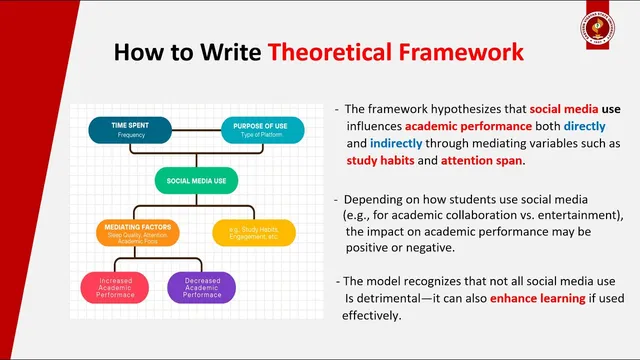
Step six—visualizing the framework—is optional. A schematic diagram can help readers grasp complex relationships, especially in quantitative work where variables and mediating pathways are central. The lecture illustrates this with a sample framework titled “The influence of social media on the academic performance of college students,” using Bandura’s social learning theory. The narrative explains observational learning, self-efficacy, and how different types of social media content can lead to positive or negative academic outcomes, while the schematic diagram summarizes direct and indirect effects through mediating variables like study habits and attention span.
Cornell Notes
A theoretical framework is the “why and how” portion of a study’s scientific basis: it anchors research in existing, testable theory and explains relationships among variables or key concepts. It also guides method and tool selection and helps researchers interpret results and draw conclusions consistent with the study’s logic. Building it starts with identifying key concepts from the research questions and objectives, then reviewing literature to find relevant and competing theories. After selecting an appropriate theory (one may be enough), the framework must define key concepts, explain the theory’s dynamics, and—most importantly—apply the theory directly to the research problem, including hypotheses and analysis. A schematic diagram is optional but useful when relationships are complex.
How does the lecture distinguish a study’s “scientific basis” from its “theoretical framework”?
Why must a theoretical framework be included in a thesis or dissertation, beyond simply citing sources?
What are the six steps for writing a theoretical framework, and what is the most common failure point?
When should researchers use one theory versus multiple theories?
What does “relating the theory to your research” look like in writing?
Why is a schematic diagram optional, and what does it add when included?
Review Questions
- What specific roles does a theoretical framework play in guiding methods, interpreting findings, and explaining variable relationships?
- Which step in the process most directly prevents a theoretical framework from becoming a list of theories, and what must be included in that step?
- Using the lecture’s example, how would you translate a chosen theory into hypotheses and a predicted relationship among variables?
Key Points
- 1
A theoretical framework is the “why and how” component of a study’s scientific basis, anchoring research in existing testable theory.
- 2
Scientific basis justifies credibility through theory, prior research, scientific laws, and rigorous methodology, including ethical clearance and scientific protocols.
- 3
A theoretical framework must do more than define theories; it must explain presumed relationships among variables/key concepts.
- 4
The framework should guide method and tool selection and support interpretation of findings and conclusions.
- 5
Writing should follow a structured process: identify key concepts, review relevant and competing theories, select the best theory(s), define concepts, apply the theory to the research problem, and optionally visualize the model.
- 6
A common weakness is narrating multiple theories’ meanings without bridging the selected theory to the study’s hypotheses, design, and analysis.
- 7
A schematic diagram is optional but useful when relationships are complex, particularly in quantitative studies with mediating variables.