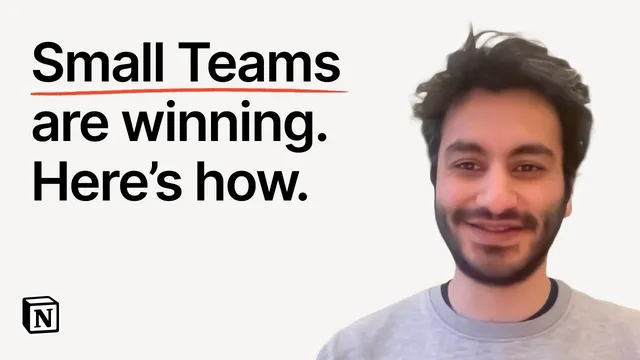
How Twain's Founder Sells Without a Sales Team | Founder Fridays
Based on Notion's video on YouTube. If you like this content, support the original creators by watching, liking and subscribing to their content.
Twain is built around the belief that communication is a learnable skill and that AI should reduce rejection by improving outreach quality at scale.
Briefing
Twain’s founder, Muhammad Shaheen, built a deep-research platform aimed at one stubborn sales bottleneck: getting personalized outreach right without forcing founders and sales teams through “thousands of rejections.” The core belief driving the company is blunt—communication is a learnable skill, and AI should reduce the pain of repeated failure by helping people send outreach that’s more likely to land. The product matters because early-stage teams often can’t afford the time, volume, or emotional cost of trial-and-error messaging, especially when they’re still proving product-market fit.
Shaheen’s origin story traces back to multilingual life and the friction of communicating across cultures. While expanding his first venture, Eat Clever, he had to explain a novel restaurant concept to very different markets—then faced the reality that rejection is amplified when a product isn’t fully validated yet. That combination—difficulty conveying value quickly and the high rejection rate common in sales—became the practical problem behind Twain.
In terms of what works for early-stage founders trying to generate leads, Shaheen recommends starting with a hypothesis about a problem, making an assumption about who has it, and then testing quickly with targeted outreach. He points to LinkedIn as a practical starting point: send a small set of templates to a few ideal customer profiles (ICPs), talk to anyone who shows interest, and look for repeatable problems that suggest we’re onto something. But the messaging guidance is more psychological than technical. Founders should write from the recipient’s mindset—no one is eager to hear from a “no-name” stranger—and should anticipate surface-level objections. He gives a concrete example from his own experience: AI-generated personalized emails “sucked,” so Twain’s approach accounts for the skepticism people have toward AI and preempts the “why should I trust you?” barrier.
A standout product feature is Twain’s qualification agent. After generating outreach and conducting research, it also qualifies the data and the messages themselves—checking whether a generated message sounds good and whether it’s appropriate to reach out to a specific person. If the output doesn’t meet the bar, the system regenerates, turning personalization into a loop that filters for quality rather than just quantity.
Growth and go-to-market themes show up repeatedly. Twain’s rapid scaling is attributed primarily to product-market fit and, later, to usability improvements—especially making the workflow convenient for companies with a few hundred employees. Shaheen also emphasizes that the founder can be the first salesperson; he personally handles demos and top-of-funnel outreach while using Twain himself. Internally, he uses Notion to create clarity through priority batches, avoiding sprawling to-do lists and keeping engineering and data science aligned on what matters most next.
On fundraising, Shaheen credits a pre-seed introduction path tied to Sequoia Capital’s renewed interest in pre-seed investing, and he advises founders to stay authentic—rejection from top-tier firms doesn’t necessarily reflect the idea’s value, just timing and fit. Building Twain differently from his first company, he highlights the speed of solo decision-making, while admitting it’s “brutal and lonely.” The final takeaway is simple: trust yourself, because confidence is hard to outsource—execution still has to be done by the founder.
Cornell Notes
Muhammad Shaheen built Twain to reduce the rejection-heavy grind of personalized sales outreach. His guiding belief is that communication is a skill people can learn, and AI should help teams avoid “thousands of rejections” by generating outreach that better matches what recipients will actually accept. For early-stage founders, he recommends hypothesis-driven outreach: pick an ICP, send a few LinkedIn templates, talk to responders, and look for repeatable problems. Twain’s qualification agent adds a quality-control layer by evaluating research and generated messages and regenerating when outputs don’t sound good or aren’t worth sending. Usability and workflow fit—plus founder-led sales early on—are presented as key drivers of traction and team clarity.
What sales problem pushed Shaheen to build Twain, and why does it matter for early-stage teams?
How should early-stage founders structure outreach experiments before they have certainty?
What mindset should founders adopt when writing messages to strangers?
What exactly does Twain’s qualification agent do, and how does it improve outreach quality?
Why does Shaheen emphasize usability after finding an ICP?
How does Shaheen use Notion to run product development without turning it into a democracy?
Review Questions
- What evidence does Shaheen use to justify that communication quality—not just outreach volume—is the core sales lever?
- Describe the step-by-step outreach experiment Shaheen recommends for early-stage founders using LinkedIn templates and ICP assumptions.
- How does Twain’s qualification agent change the workflow from “generate personalization” to “generate and validate personalization”?
Key Points
- 1
Twain is built around the belief that communication is a learnable skill and that AI should reduce rejection by improving outreach quality at scale.
- 2
Early-stage outreach should follow a hypothesis → ICP assumption → small template test → conversations → identification of repeatable problems loop.
- 3
Effective messaging must account for the recipient’s mindset and preempt surface-level objections, including skepticism toward AI-generated personalization.
- 4
Twain’s qualification agent evaluates both research and generated messages, regenerating outputs when they don’t sound good or shouldn’t be sent.
- 5
Usability becomes the main growth lever after ICP and problem clarity, especially for teams with established processes.
- 6
Founder-led sales early on can work: Shaheen personally runs demos and top-of-funnel outreach while using Twain.
- 7
Notion is used for product clarity through priority batches and feature documentation, avoiding broad opinion-seeking in early-stage execution.