How Was Video Invented?
Based on Veritasium's video on YouTube. If you like this content, support the original creators by watching, liking and subscribing to their content.
Video’s central engineering challenge was converting a 2D image into a 1D electrical signal and then reconstructing it by scanning.
Briefing
Video’s core breakthrough wasn’t “making pictures move” so much as solving a stubborn engineering problem: converting a two-dimensional light scene into a one-dimensional electrical signal that can be scanned, transmitted, and reconstructed. Early inventors attacked the idea of scanning long before electronic cameras existed. In 1843, clockmaker Alexander Bain built a fax-like system that synchronized a transmitter and receiver using pendulums. A stylus moved over paper with non-conducting ink; where iron was present, it conducted electricity, and the receiver used a chemical that darkened under current to reproduce the drawn image. Bain’s system transmitted static images, but it introduced scanning as a concept—breaking an image into parts so it could be sent as a signal.
To get moving images, scanning had to happen far faster. In 1884, German student Paul Nipkow patented the Nipkow disk: a spiral of pinholes that turns a scene into a sequence of light samples as the disk spins. A light source behind the disk scanned across a subject, sensors detected the reflected light, and the resulting electrical signal modulated brightness at the receiver. A synchronized Nipkow disk then recreated the image. The approach reached the edge of what was viewable; mechanical television was broadcast in Britain for a few hours a day over several years, and engineers used it to test improvements—until it became clear it wasn’t the right path. By 1939, mechanical TV was largely replaced by all-electric television.
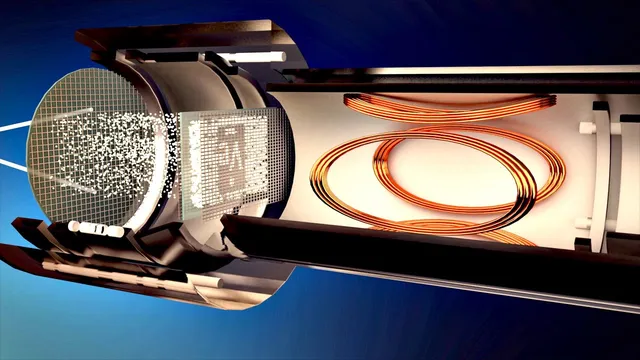
The next leap came with the cathode-ray tube (CRT). An electron gun fired a beam at a phosphor-coated screen, producing light where electrons struck. Magnetic fields swept the beam across the screen in a controlled pattern, while brightness was adjusted by varying the electron output. Color required multiple dead ends before settling on the red-green-blue pixel approach, with phosphors and electron guns tuned to relative brightness. Standard-definition timing relied on interlacing: scanning every other line each sixtieth of a second so two scans formed one frame, and the illusion of motion depended on persistence of vision.
Even with workable cameras and displays, recording lagged behind. Electronic television was designed for transmission—“seeing at a distance”—not replay. Live broadcasting created a practical headache: time zones made “live” schedules impossible. Networks filmed TV screens with cinema cameras, developed the film, and then replayed it through telecine to simulate live viewing. By 1954, this workaround consumed more film than Hollywood’s studios combined, making it expensive and wasteful.
A real fix arrived in 1956 with the first workable video tape recorder: a large, costly machine using two-inch magnetic tape and spinning video heads at about 14,000 RPM. That shift turned video from a one-way transmission system into a storage medium. Over time, tape shrank into formats like VHS and Beta, then into DV and mini DV, and eventually into solid-state storage. The result is that video now delivers images that can outperform film for many uses—changing not just production workflows but how society shares and archives everyday life.
Cornell Notes
Video’s invention hinges on scanning: turning a 2D scene into a 1D electrical signal and then reconstructing it at the other end. Alexander Bain’s 1843 synchronized fax-like system introduced scanning mechanics, while Paul Nipkow’s 1884 Nipkow disk made fast enough sampling possible for early mechanical television broadcasts. CRT-based all-electric TV replaced mechanical scanning by sweeping an electron beam across a phosphor screen and controlling brightness; color later converged on red-green-blue phosphors and interlaced scanning. Recording came much later: networks initially time-delayed broadcasts by filming TV screens, a method so wasteful that it consumed more film than Hollywood by 1954. The 1956 video tape recorder finally enabled practical storage, paving the way for modern video formats and digital capture.
Why did early inventors focus on scanning before “moving pictures” were possible?
How did the Nipkow disk make scanning practical for television?
What technical role did the cathode-ray tube (CRT) play in replacing mechanical TV?
Why did interlacing matter for standard television timing?
What made time-delayed broadcasting so difficult before video tape?
How did the first workable video tape recorder change the economics and purpose of video?
Review Questions
- How do scanning and synchronization connect Bain’s fax-like system to later television systems like the Nipkow disk?
- Explain how CRT scanning and brightness control work together to form an image, and where interlacing fits into the timing.
- Why did recording lag behind display and transmission, and what specific workaround did networks use before video tape?
Key Points
- 1
Video’s central engineering challenge was converting a 2D image into a 1D electrical signal and then reconstructing it by scanning.
- 2
Alexander Bain’s 1843 synchronized transmitter/receiver system introduced scanning mechanics, even though it transmitted static images.
- 3
Paul Nipkow’s 1884 Nipkow disk made scanning fast enough for early mechanical television by sampling a scene through a spiral of pinholes.
- 4
CRT-based television replaced mechanical scanning by sweeping an electron beam across a phosphor screen and controlling brightness electronically.
- 5
Color TV required multiple approaches before converging on red-green-blue phosphors and corresponding electron guns.
- 6
Interlacing (scanning every other line) relied on persistence of vision to make motion look continuous.
- 7
Before video tape, time-delayed broadcasts depended on filming TV screens, which became prohibitively wasteful until recording technology arrived in 1956.