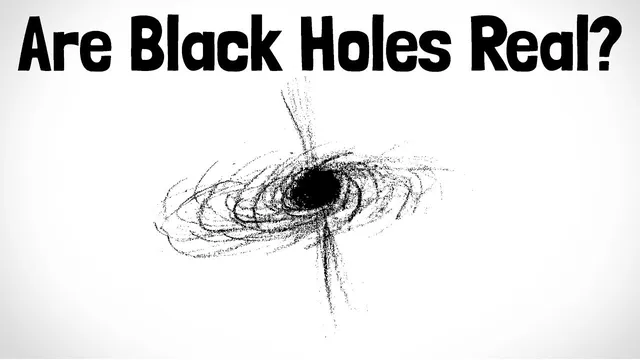
How We Know Black Holes Exist
Based on minutephysics's video on YouTube. If you like this content, support the original creators by watching, liking and subscribing to their content.
Black holes are identified through their gravitational influence on nearby stars and gas, not by light escaping from inside the event horizon.
Briefing
Black holes are observable not because light escapes, but because gravity and infalling matter outside the event horizon betray what’s inside. Once an object is massive and compact enough, its pull reshapes the motion of nearby stars and gas; the resulting orbits and radiation patterns let astronomers infer the object’s mass and rule out alternatives like ordinary stars or neutron stars.
A common method uses binary systems. Many stars form pairs, and when one partner is a dense compact object, gas and dust can spiral in and heat up to emit intense X-rays. By measuring the X-ray source’s orbital motion—along with the visible star’s orbit—astronomers can calculate the unseen partner’s mass. Neutron stars have a theoretical maximum size, corresponding to roughly 2–3 times the Sun’s mass; observed neutron stars fit within that ceiling. Yet some X-ray binaries show companions with inferred masses around 5–10 times the Sun’s mass, too heavy to be neutron stars. With no other plausible category left, the X-ray-emitting companions are identified as black holes.
Sometimes the evidence doesn’t require a companion star at all. The X-rays and radio waves produced by hot material falling onto a solitary compact object can be used to estimate its mass. In some cases the mass matches neutron stars, but when the inferred mass is far above the neutron-star limit, the object can only be a black hole.
At galactic centers, the case becomes even more direct. Many galaxies—including the Milky Way—harbor extremely heavy, compact objects that emit X-rays, radio waves, and infrared light while producing little visible light. The key clue is how nearby stars and glowing dust orbit these centers: the orbits indicate objects that are both extraordinarily massive and confined to such small regions that they cannot be normal stars, star clusters, or distributed invisible matter. The Milky Way’s central source, “Sagittarius A*,” is a prime example. Nearby stars move in tight, fast orbits, implying a mass of about 4 million Suns.
Finally, gravitational-wave observations provide a complementary line of evidence. When two dense objects spiral together and merge, they emit ripples in spacetime. Some detected waveforms match collisions involving neutron stars, but others require objects too heavy to be anything but black holes. In those events, the detailed waveform signatures align with predictions from black hole merger models.
Across these approaches—stellar orbits in X-ray binaries, radiation from accreting gas, star-and-dust dynamics in galactic nuclei, and gravitational-wave signatures—astronomers repeatedly find dense, high-mass objects that are too dark, too compact, and too heavy to fit any non-black-hole explanation. The result is “strong confidence” that black holes, or objects with black-hole features, exist. In practice, astronomers apply a simple rule: if something looks like a black hole and behaves like one, it gets called one. NASA’s James Webb Space Telescope is expected to extend this work by observing early supermassive black holes in primordial galaxies and studying how they influence galaxy evolution, including the jets they can produce.
Cornell Notes
Black holes can be identified even though light can’t escape once inside the event horizon. Their gravity affects nearby stars and gas, and the resulting orbital motions and radiation (especially X-rays) reveal the mass of unseen companions. In X-ray binaries, inferred companion masses above the neutron-star limit (about 2–3 solar masses) point to black holes; in some systems, accretion-powered X-rays and radio waves alone can do the same. At galactic centers, stars and dust orbiting a compact, extremely massive, dim source—like Sagittarius A* at ~4 million solar masses—strongly indicates supermassive black holes. Gravitational waves from mergers further confirm the picture when waveforms match black hole collision predictions rather than neutron-star ones.
Why can astronomers observe black holes if nothing escapes the event horizon?
How do X-ray binaries distinguish neutron stars from black holes?
What evidence can identify a black hole without an orbiting star?
Why are galactic-center objects like Sagittarius A* considered supermassive black holes?
How do gravitational waves confirm black hole mergers?
Review Questions
- What observational measurements allow astronomers to infer the mass of an unseen compact object in an X-ray binary?
- Why does the neutron-star mass limit matter for identifying black holes?
- How do gravitational-wave waveform signatures help separate neutron-star mergers from black hole mergers?
Key Points
- 1
Black holes are identified through their gravitational influence on nearby stars and gas, not by light escaping from inside the event horizon.
- 2
X-ray binaries provide mass estimates by combining the visible star’s orbit with the X-ray-emitting accretion partner’s orbital behavior.
- 3
Neutron stars have an upper mass limit of roughly 2–3 solar masses; companions inferred at about 5–10 solar masses point to black holes.
- 4
Accretion-powered X-rays and radio waves can weigh solitary compact objects even without an orbiting star.
- 5
Galactic-center dynamics—especially tight, fast stellar orbits around a dim, compact source—indicate supermassive black holes, such as Sagittarius A* at ~4 million solar masses.
- 6
Gravitational-wave detections distinguish neutron-star mergers from black hole mergers using waveform signatures consistent with black hole collision models.