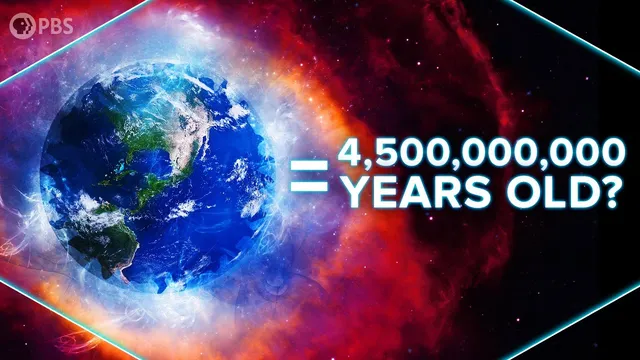
How We Know The Earth Is Ancient
Based on PBS Space Time's video on YouTube. If you like this content, support the original creators by watching, liking and subscribing to their content.
Religious chronologies like James Ussher’s 4004 BC date offered precision but were limited by the historical sources they relied on rather than physical timescales.
Briefing
Dating Earth’s age isn’t a matter of intuition or a single ancient calculation—it’s a chain of evidence that stretches from geology to atomic physics and then back out to the solar system. The core result is that Earth formed about 4.5 billion years ago, and that number holds up across multiple independent methods, including radiometric dating of ancient minerals on Earth, samples from the Moon, and even meteorites.
Early attempts to pin down “deep time” were driven by religious and historical chronologies. In the early 1600s, Irish bishop James Ussher tried to reconcile biblical and other ancient texts and arrived at a precise creation date: 6 pm on Saturday, October 22, 4004 BC. The approach was influential but inevitably limited by the source material’s timescales. A more “scientific” effort came later from Georges-Louis Leclerc, Comte de Buffon, who in 1778 estimated Earth’s age by measuring how quickly a molten sphere would cool. His result—74,832 years—was strikingly specific, but it was far too small because the cooling model ignored the processes that keep Earth hot over geologic time.
Geology then supplied the first big conceptual shift. Scottish geologist James Hutton argued that rocks record slow, ongoing processes: molten material rises to form igneous rocks, erosion builds sedimentary layers, and tectonics can bury and uplift them again. The key insight was uniformitarianism—today’s forces operating in the past—combined with the recognition that these forces act slowly. That meant Earth must be unimaginably old, even if Hutton didn’t try to assign a single starting date.
The next leap came from Charles Lyell’s popularization of deep-time thinking in the 1830s, which helped make “millions of years” feel scientifically plausible. Lyell’s framework also fed directly into Darwin’s evolutionary reasoning: natural selection needs long durations to work with small changes. Darwin himself estimated a minimum Earth age from erosion rates, but his figure (300 million years) was later shown to be too high for the specific chalk formation he used.
The decisive tool for measuring deep time arrived with radioactivity. After Marie Curie’s era of discovery in the 1890s, Ernest Rutherford showed that radioactive decay releases energy at rates that decrease predictably. Those rates are expressed through half-life, allowing scientists to infer how long a sample has been decaying. Carbon-14 dating works for recent history (roughly up to 50,000 years, about 10 half-lives), but Earth-age measurements rely on uranium-lead dating. Uranium isotopes decay into different lead isotopes over hundreds of millions to billions of years, and minerals such as zircon can preserve the necessary starting conditions by incorporating uranium while rejecting lead.
By the 1920s, Arthur Holmes used radiometric methods to estimate Earth at roughly 1.6 to 3 billion years old, and later work pushed the figure higher. The remaining challenge is that very old crust is scarce on Earth because it gets recycled into the mantle. One of the best windows comes from ancient zircon crystals in Western Australia, dated to about 4.4 billion years. To extend the record further, scientists look outward: the Moon’s surface rocks returned by Apollo missions date to about 4.5 billion years, matching the age of the solar system (around 4.6 billion years) inferred from meteorites and models of the Sun.
Taken together, the 4.5-billion-year picture isn’t a single lucky number. It’s a consistency check across Earth materials, lunar samples, and solar-system leftovers—evidence strong enough to replace ancient chronologies with measurements grounded in atomic decay.
Cornell Notes
Deep time became measurable once geology’s need for long ages met atomic physics. Early chronologies (like James Ussher’s 4004 BC date) and cooling-based estimates (like Georges-Louis Leclerc, Comte de Buffon’s 74,832 years) couldn’t reach the scale implied by slow geological processes. Uniformitarianism—forces like erosion and volcanism acting over immense spans—made “millions of years” plausible, and radiometric dating made billions of years measurable. Uranium-lead dating, especially using zircon crystals that retain uranium but exclude lead at formation, provides ages up to billions of years. The resulting Earth age (~4.5 billion years) agrees with Moon samples and solar-system dating from meteorites and the Sun, strengthening confidence in the number.
Why did early “age of Earth” calculations fail to reach billions of years?
What did uniformitarianism add to the age debate beyond “it looks old”?
How did Lyell’s deep-time framework influence evolutionary theory?
What makes radiometric dating different from earlier methods?
Why is uranium-lead dating especially useful for Earth’s age?
How do lunar and solar-system measurements reinforce the ~4.5 billion-year Earth age?
Review Questions
- What assumptions made Buffon’s cooling-based estimate too small, and what later discovery corrected the missing piece?
- Explain how zircon crystals enable uranium-lead dating to infer the time since formation.
- Why does matching Earth, Moon, and meteorite ages increase confidence compared with relying on a single dataset?
Key Points
- 1
Religious chronologies like James Ussher’s 4004 BC date offered precision but were limited by the historical sources they relied on rather than physical timescales.
- 2
Buffon’s molten-rock cooling estimate (74,832 years) underestimated Earth’s age because it ignored internal heat sustained by radioactive decay.
- 3
Hutton’s uniformitarianism linked present-day geological forces to past processes, implying Earth must be far older than human intuition suggests.
- 4
Lyell’s deep-time framework helped make millions of years scientifically plausible and supported Darwin’s need for long timescales in evolution.
- 5
Radiometric dating works by measuring isotope ratios and using half-life to infer elapsed time from nuclear decay rates.
- 6
Uranium-lead dating, especially with zircon crystals, reaches the billions-of-years range needed for Earth-age estimates and can correct for lead loss.
- 7
The ~4.5 billion-year age is reinforced by independent agreement with lunar samples and solar-system dating from meteorites and the Sun.