How Were the Pyramids Built?
Based on Veritasium's video on YouTube. If you like this content, support the original creators by watching, liking and subscribing to their content.
The Great Pyramid required about 2 million blocks, each roughly 1–3 tons, laid at an estimated pace of one block every few minutes over 20–30 years.
Briefing
The Great Pyramid’s construction remains partly mysterious, but recent evidence and engineering constraints point to a clear picture: it was built by organized, skilled labor using practical tools and logistics—not slave labor and not sci-fi technology. The pyramid’s scale is the starting point. Built about 4,500 years ago, it required roughly 2 million limestone blocks, each estimated around 1 to 3 tons, laid at a pace of about one stone every three minutes across decades. That timeline—about 20 to 30 years—makes the work look less like a one-off feat and more like a sustained industrial operation.
A widely repeated myth claims enslaved people built the pyramids. That story clashes with archaeological signals: well-preserved tombs near the pyramid sites suggest workers were honored rather than discarded. If the labor force had been enslaved, the burial record would be expected to look different. The broader implication is that pyramid building depended on workforce management, training, and incentives—people who could reliably quarry, transport, and fit massive blocks.
Engineering details also narrow what was feasible. Egyptians lacked wheels and, based on available evidence, relied on sled transport across desert sand. Experiments with sleds and heavy loads indicate that wetting sand in front of the sled can cut the pulling force by about half, reducing the friction problem that would otherwise make hauling so difficult. Cutting and shaping stone also appears achievable with copper tools. Copper chisels could work limestone, and copper saws—paired with abrasive sand—could wear away rock, though the process would have been slow and labor-intensive.
The logistics of sourcing materials were equally demanding. The pyramid’s core used limestone, while the outer casing used much harder granite. Granite was quarried at Awan, nearly 1,000 kilometers from Giza. The transcript describes using the Nile’s seasonal flooding to move quarried stone: water would carry granite down to the river, where it could be floated on rafts back toward Giza. Granite’s hardness (with quartz contributing to a hardness around 7 on the scale, compared with diamond at 10) makes cutting it a major challenge. The proposed method is repetitive smashing of the surrounding diorite rock to break granite into workable pieces, with an estimated progress of only about 5 millimeters per hour.
Finally, the method for raising blocks up the pyramid likely involved ramps rather than a simple straight incline. Straight ramps would consume too much material, and evidence from incomplete pyramids suggests ramp structures. A wraparound ramp is presented as the most plausible approach, while the top portion—only the upper third of the height—accounts for about 4% of the pyramid’s total material, making it more feasible that levers and other lifting methods finished the highest levels.
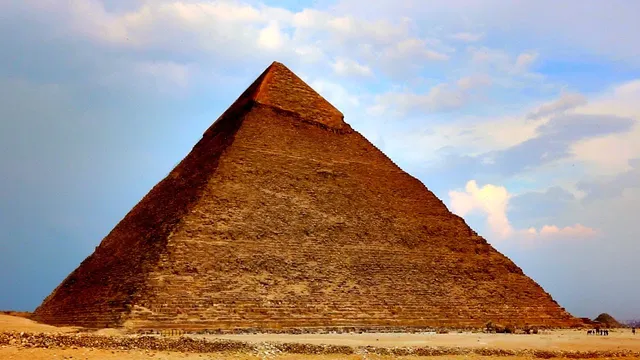
The pyramid’s appearance also mattered. Originally, it would have looked bright and smooth: white limestone casing over the face, with the top possibly covered in electrum (a gold-silver alloy). The geometry—aligned to represent sun rays—would have been visually striking under that metallic cap and reflective finish. In short, the best-supported explanation is a blend of careful planning, labor organization, and engineering workarounds that fit what Egyptians had, even if no complete construction plans survive.
Cornell Notes
The Great Pyramid was built around 4,500 years ago using about 2 million stone blocks, each roughly 1–3 tons, over 20–30 years—at an estimated pace of one block every few minutes. Archaeological evidence near the site points away from slavery and toward organized, skilled workers, supported by the presence of well-preserved tombs. Transport likely relied on sleds across sand, with wet sand reducing friction, and cutting/shaping used copper tools plus abrasives for harder stone. Granite for the outer casing was quarried far away (Awan) and moved using Nile flooding and rafts. Raising blocks probably used ramps that wrap around the pyramid, with levers more likely used for the final top levels.
What evidence challenges the idea that slaves built the pyramids?
How could Egyptians move multi-ton stones without wheels?
What tools could shape limestone and even granite-adjacent materials?
How were granite blocks sourced and transported from Awan to Giza?
Why are ramps the leading explanation for lifting blocks, and why not a simple straight ramp?
What did the pyramids likely look like when new, and why does that matter?
Review Questions
- What logistical and engineering constraints (tools, transport friction, material hardness, ramp geometry) most strongly limit plausible pyramid-building methods?
- How do tomb evidence and site archaeology shift the interpretation from slavery to skilled labor?
- Why does the transcript treat the top portion of the pyramid differently from the lower sections when proposing lifting methods?
Key Points
- 1
The Great Pyramid required about 2 million blocks, each roughly 1–3 tons, laid at an estimated pace of one block every few minutes over 20–30 years.
- 2
Archaeological tomb evidence near pyramid sites supports the idea of organized, skilled workers rather than enslaved labor.
- 3
Sled transport across sand was likely made practical by wetting sand in front of the sled to reduce friction and pulling force.
- 4
Limestone could be shaped with copper chisels, while copper saws with abrasive sand could wear through stone, albeit slowly.
- 5
Granite for the outer casing was quarried at Awan (about 1,000 kilometers away) and moved using Nile flooding and rafts.
- 6
Raising blocks likely relied on ramps that wrap around the pyramid, with levers more plausible for the final top levels.
- 7
The pyramid’s original appearance likely included white limestone casing and a metallic electrum cap, enhancing its sun-ray symbolism.