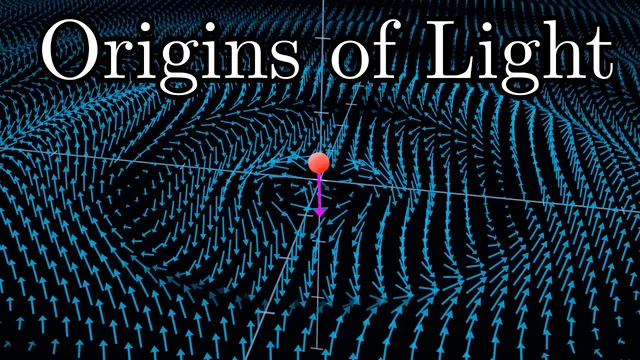
How wiggling charges give rise to light
Based on 3Blue1Brown's video on YouTube. If you like this content, support the original creators by watching, liking and subscribing to their content.
Accelerating charges generate a radiating electric-field component that falls off like 1/r and depends on retarded time, linking charge motion to propagating light.
Briefing
Sugar water twists the polarization of linearly polarized light because its chiral molecules treat left- and right-handed circular polarization differently, giving those two components slightly different phase delays as they propagate. That tiny, cumulative phase mismatch rotates the direction of the resulting linear polarization along the tube—at a rate that depends on light frequency—producing the colored diagonal stripes seen when the tube is viewed from the side.
The explanation starts from a minimal electromagnetic picture: accelerating charges generate a radiating component of the electric field that propagates outward. Coulomb’s law captures the near-field influence that falls off like 1/r², but it cannot account for radiation. When a charge “wiggles,” the dominant long-range effect comes from the acceleration-dependent term that falls off like 1/r and depends on the charge’s acceleration at a retarded time (limited by the speed of light). This radiating field is perpendicular to the line connecting the observer point to the charge’s earlier position, which matches the familiar idea that light’s oscillation direction is transverse to its direction of travel.
A single oscillating charge sends out waves with roughly equal strength in all directions perpendicular to its oscillation, but a collection of many synchronized charges can interfere constructively along a preferred direction. That interference produces beam-like propagation and helps connect the “wiggling charge” model to the wave picture of light. The same framework also explains polarization: if the charge oscillates back and forth along one axis, the field is linearly polarized; if the charge’s acceleration rotates, the field becomes circularly polarized.
With that machinery in place, the diagonal stripes follow from how the twisted polarization affects scattering. In the side-view setup, each point along the tube acts like a source: light reaching a charge induces a secondary oscillation, and that secondary radiation is strongest perpendicular to the local polarization direction. If the polarization at a given slice points straight up and down, then the strongest scattering lands in the observer’s direction; if the polarization rotates toward the line of sight, the strongest scattering shifts away and the observed intensity drops. Scanning along the tube therefore produces alternating bright and dim regions for a chosen color.
The pattern’s diagonal boundaries come from combining two effects: along the tube, the polarization direction rotates; across the tube’s height, perspective changes the angle between the observer’s line of sight and the local oscillation direction. When all colors are present at once, each frequency has its own bright/dim modulation, and the superposition yields the full diagonal stripe pattern.
Finally, the twist itself is traced to chirality. Sucrose molecules are chiral, meaning they are not superimposable on their mirror images. That asymmetry makes the medium’s effective refractive index depend on handedness: left-handed circular polarization and right-handed circular polarization experience slightly different phase velocities. Although the input is linearly polarized, it can be decomposed into equal parts of left- and right-handed circular components. Because those components accumulate different phase delays as they pass successive sugar molecules, their sum—reconstructed as a linear polarization vector—slowly rotates. Higher-frequency light twists more quickly because the phase difference builds up differently with frequency, so the bright-to-dark spacing shrinks for colors toward the blue end of the spectrum.
Cornell Notes
The radiating part of electromagnetism links “wiggling charges” to light: accelerating charges produce a transverse electric field that propagates outward with a 1/r falloff and a retarded-time dependence. Polarization emerges from the motion pattern of the driving charge—linear for back-and-forth oscillation, circular for rotating acceleration. In the sugar-water tube, each slice scatters light most strongly perpendicular to the local polarization direction, so as sucrose twists polarization along the tube, the observed intensity for each color alternates between bright and dark regions. The twist happens because sucrose is chiral, giving left- and right-handed circular polarizations different refractive indices, which creates a cumulative phase mismatch. Since the phase mismatch depends on frequency, the polarization rotation rate—and thus the stripe spacing—varies across the visible spectrum.
Why does the explanation move beyond Coulomb’s law to an acceleration-dependent term?
How does the model connect polarization to the direction of a charge’s motion?
Why is scattering strongest perpendicular to the local polarization direction?
What creates the diagonal boundaries between bright and dark regions in the tube?
How can linearly polarized input produce a polarization twist in a chiral medium?
Why does the twist rate depend on color (frequency)?
Review Questions
- In the “wiggling charge” picture, what determines the direction and distance dependence of the radiating electric-field component?
- Explain how a chiral molecule can produce different refractive indices for left- and right-handed circular polarization, even when the incident light is linearly polarized.
- Using the scattering rule “strongest perpendicular to polarization,” predict what happens to observed intensity if the local polarization becomes aligned with the observer’s line of sight.
Key Points
- 1
Accelerating charges generate a radiating electric-field component that falls off like 1/r and depends on retarded time, linking charge motion to propagating light.
- 2
Polarization follows the motion pattern of the driving charge: single-axis oscillation yields linear polarization, while rotating acceleration yields circular polarization.
- 3
In the tube, each slice acts like a secondary source whose radiation is strongest perpendicular to the local polarization direction, so intensity varies with polarization angle.
- 4
Diagonal stripe boundaries arise from combining polarization rotation along the tube with perspective-driven changes in the observer’s scattering geometry across the tube’s height.
- 5
Sucrose is chiral, so it gives left- and right-handed circular polarizations different phase velocities (effectively two refractive indices).
- 6
Linearly polarized light is the sum of equal left- and right-handed circular components; unequal phase delays rotate the recombined polarization direction as it propagates.
- 7
Frequency controls how quickly the left/right phase mismatch accumulates, so higher-frequency light twists more rapidly and produces tighter stripe spacing.