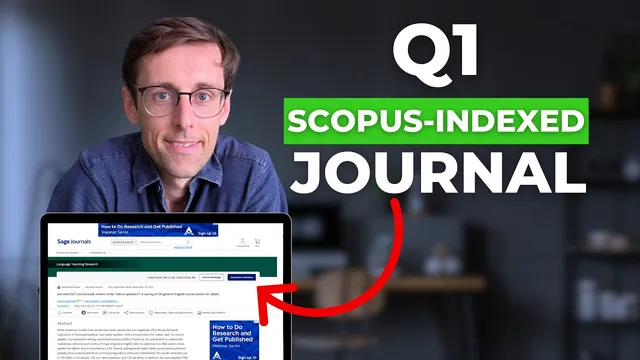
How you can publish your first paper in a Scopus journal (step by step plan)
Based on Academic English Now's video on YouTube. If you like this content, support the original creators by watching, liking and subscribing to their content.
Choose a topic that stands out by importing novel angles and methods rather than repeating the most common themes in the field.
Briefing
Publishing a first Scopus-indexed paper hinges on three linked decisions: picking a topic that’s genuinely distinct, using a study design that’s already been validated elsewhere, and packaging the work so reviewers instantly recognize it as “the kind of paper” their journal publishes. The payoff matters because downloads and citations function as academia’s currency—yet most papers never reach meaningful citation counts.
The topic selection step starts with a warning against following the crowd. In the creator’s field, many studies focused on how students perceive strengths and weaknesses of native versus non-native speakers. That approach, when taken directly, would have been “unpublishable” from the start. Instead, the co-author and the researcher looked outside their discipline for an impactful angle and borrowed a methodology used in other fields. That cross-disciplinary move produced a novel research approach that hadn’t been used in their specific area, and the resulting paper later became their most cited work, reaching 15,636 downloads and over 130 citations.
Once the topic is chosen, the next requirement is not originality for its own sake, but execution. When the methodology was unfamiliar, the researcher reduced risk by reading roughly 10 papers in other disciplines that used the same method. They compared sample sizes, procedures, tools, data collection, analysis, and how results were presented. The goal was to avoid “getting it wrong” by aligning the study with a methodology already validated by other researchers.
Even a strong study can fail if reviewers form a negative first impression. Reviewers develop expectations about what a good paper looks like, and those expectations shape how quickly they judge structure, clarity, and framing. The recommended fix is to match the journal’s established pattern in two ways: (1) mirror the paper structure seen in top-journal articles in that field (including typical section order and approximate section lengths), and (2) use the language patterns common in published work—especially how authors describe research gaps, novelty, comparisons to prior studies, and interpretations.
Choosing the right journal is treated like dressing for the occasion: submitting to a journal that doesn’t fit the study’s “event conditions” can trigger rejection before peer review. The practical method is to scan the paper’s reference list, identify the journals cited most frequently, shortlist three to five that align with the topic and accepted methodologies (qualitative vs. quantitative, experimental vs. observational, and whether review papers are welcome), then compare scope, impact factor, publication time, and open-access status.
The final “secret ingredient” is open access. The argument is that citations depend on accessibility: if a paper sits behind a high paywall, many researchers can’t read it, which limits both readership and citations. A Nature-cited statistic is used to underline the stakes—70% of papers are cited fewer than nine times and 50% receive no citations at all. To avoid that fate, the recommendation is to prioritize open-access journals so more researchers can access, read, and cite the work, strengthening authority and improving prospects for tenure, grants, and broader scientific impact.
Cornell Notes
A first Scopus-indexed paper succeeds by combining a distinct topic, a credible method, and reviewer-friendly presentation. Instead of copying common themes in a field, the approach borrows a methodology from other disciplines to create a novel angle, then validates the method by studying prior studies that used it (including sample sizes, tools, and analysis). Reviewers form fast first impressions based on journal norms, so the paper should match expected structure and scientific phrasing for the research gap, novelty, comparisons, and interpretation. Journal selection should be guided by where similar work is cited and by fit with the journal’s scope and accepted study types. Finally, open access is presented as a major driver of downloads and citations because paywalls restrict who can read and cite the research.
How does the transcript recommend choosing a topic that can actually get published in a Scopus-indexed journal?
What’s the method for handling an unfamiliar methodology without increasing the risk of rejection?
Why does the transcript emphasize “first impressions” in peer review, and how can authors influence them?
What steps are suggested for selecting the right journal to reduce the chance of desk rejection?
What is presented as the “secret ingredient” for higher citations, and what evidence is cited?
How does the transcript connect citations to academic career outcomes?
Review Questions
- What specific actions does the transcript recommend to align a manuscript with a journal’s reviewer expectations (structure and language)?
- How does the transcript justify using cross-disciplinary methodologies, and what steps are recommended to implement them correctly?
- Why does the transcript treat open access as a citation strategy rather than just a publishing preference?
Key Points
- 1
Choose a topic that stands out by importing novel angles and methods rather than repeating the most common themes in the field.
- 2
Validate unfamiliar methodologies by studying multiple prior papers that used the same approach, including sample size, tools, analysis, and results presentation.
- 3
Increase acceptance odds by matching the target journal’s expected structure and by using the common phrasing patterns used for gaps, novelty, comparisons, and interpretations.
- 4
Select journals using a fit-based workflow: mine your reference list for frequently cited journals, shortlist likely matches, and verify scope and accepted study types on each journal’s website.
- 5
Reduce desk-rejection risk by submitting to a journal whose scope matches the study’s methodology and design (qualitative/quantitative; experimental/observational; review acceptance).
- 6
Prioritize open access to expand readership; paywalls can sharply limit downloads and therefore citations.
- 7
Treat citations and downloads as career-relevant metrics tied to authority, tenure prospects, grants, and real-world research impact.