Huge Gravity Anomaly Near Africa
Based on Sabine Hossenfelder's video on YouTube. If you like this content, support the original creators by watching, liking and subscribing to their content.
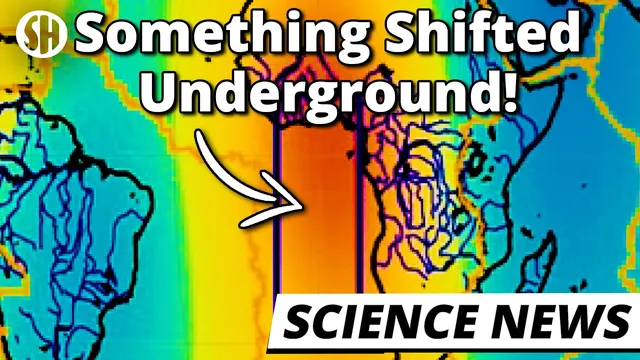
GRACE satellite data detected a gravity anomaly off west Africa that emerged between 2006 and 2008 and then stopped.
Briefing
A major gravitational anomaly off the west coast of Africa appears to have changed on an unusually fast timescale—within about two years (2006–2008)—and it lines up with a simultaneous magnetic-field anomaly. The finding matters because it points to a dynamic process deep inside Earth, not a slow, millions-of-years geological event, and it shows how satellite gravity measurements can detect rapid shifts in the planet’s interior.
Researchers used data from the GRACE satellite mission, a joint effort between NASA and the German Aerospace Centre. GRACE flew two satellites in tandem from 2002 to 2017, separated by a few hundred kilometers, exchanging extremely precise microwave signals. By tracking tiny changes in the distance between the satellites, scientists inferred variations in Earth’s gravitational field with micrometer-level sensitivity over hundreds of kilometers. In the African offshore region, the gravity signal didn’t just get stronger or weaker—it changed faster from one area to the next, then stopped two years later.
The anomaly is also large in geographic extent: it stretches roughly 7,000 kilometers in the north–south direction, comparable to the distance between London and Chicago. That scale, combined with the short duration, makes the event stand out among known gravity anomalies. The transcript notes that geophysicists typically expect gravity-related changes to evolve over far longer periods.
Complicating the picture, the gravity anomaly coincided with an earlier-reported anomaly in Earth’s magnetic field in the same region and time window. Whether the two signals share a cause remains unclear, but the overlap raises the possibility of a common driver. The most widely accepted explanation for magnetic-field changes in general involves processes in Earth’s core, where moving conductive material generates and reshapes the geomagnetic field.
To explain the gravity data, the authors of the new paper considered and rejected a straightforward ocean-current mechanism. Because the anomaly was measured over ocean waters, shifting currents could in principle redistribute mass and alter local gravity. But the proposed current-driven effects didn’t match the observed shape and size.
Instead, the preferred explanation centers on the mantle. Roughly 3,000 kilometers down, a large region of rock may have begun to move upward in an “upwelling.” As the material rose, pressure dropped enough to trigger a phase transition in bridgmanite, a dense mineral in the perovskite family (also associated with materials used in solar panels). The phase change increased density, producing the sudden gravity shift. As the upwelling continued upward and spread out, the density contrast would dilute, allowing the gravity anomaly to fade—consistent with the signal appearing and then disappearing after about two years.
The transcript closes by emphasizing a practical tension: Earth’s gravity can now be measured with extraordinary precision, yet scientists still lack a way to directly “open” the planet and verify what’s happening inside. The event is not described as immediately dangerous, but it underscores how much of Earth’s interior remains observationally indirect—and how quickly it can, at least sometimes, change.
Cornell Notes
Satellite gravity data from the GRACE mission detected a large gravitational anomaly off the west coast of Africa that evolved rapidly—between 2006 and 2008—then stopped. The signal changed in a way that suggests not just a stronger or weaker pull, but a faster spatial change across regions, spanning about 7,000 km north–south. The anomaly coincided with a magnetic-field anomaly reported for the same area and time, though a shared cause is uncertain. Ocean-current explanations don’t fit the anomaly’s shape and scale, pushing researchers toward a deep-mantle upwelling. In this scenario, rising bridgmanite undergoes a pressure-driven phase transition that increases density, creating the gravity change before the effect dilutes as the material spreads upward.
What made the African offshore gravity anomaly unusual compared with typical Earth signals?
How did GRACE measure gravity changes with such sensitivity?
Why didn’t ocean currents fully explain the gravity anomaly?
What deep-Earth mechanism best matched the gravity data in the proposed explanation?
What role does the magnetic-field anomaly play, and what remains uncertain?
Review Questions
- What observational evidence (timescale, size, and measurement method) supports the claim of a rapid gravity anomaly near Africa?
- How does the proposed bridgmanite phase transition during mantle upwelling translate into a gravity signal?
- What arguments rule out ocean-current redistribution as the primary cause of the anomaly?
Key Points
- 1
GRACE satellite data detected a gravity anomaly off west Africa that emerged between 2006 and 2008 and then stopped.
- 2
The anomaly spanned about 7,000 km north–south and reflected rapid spatial changes in gravity rather than a simple uniform shift.
- 3
Ocean-current changes were considered but didn’t reproduce the anomaly’s observed shape and scale.
- 4
A mantle upwelling roughly 3,000 km deep is proposed as the best fit, with rising rock triggering a pressure-driven phase transition in bridgmanite.
- 5
The bridgmanite phase transition increased density, producing the sudden gravity change before the effect diluted as the material spread upward.
- 6
A magnetic-field anomaly coincided in the same region and time, but whether both signals share a common cause remains unresolved.
- 7
Despite micrometer-precision gravity measurements, direct verification of what’s happening inside Earth is still not possible with current tools.