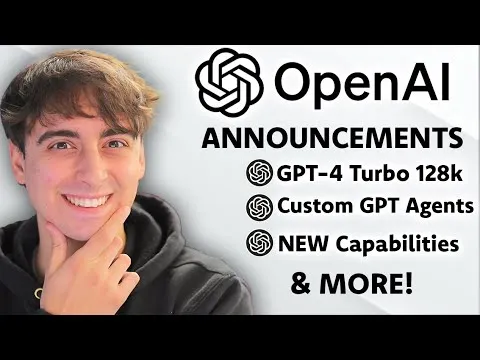
HUGE Open AI Announcements: GPT-4 Turbo, GPTs in ChatGPT, Assistants API, new modalities
Based on MattVidPro's video on YouTube. If you like this content, support the original creators by watching, liking and subscribing to their content.
GPT-4 Turbo adds up to 128,000 tokens of context, aiming for better accuracy over long passages than earlier GPT-4 context limits.
Briefing
OpenAI’s Dev Day announcements put a clear emphasis on scaling what GPT-4 can do—faster, cheaper, and with far longer context—then packaging those upgrades into new ways for developers and everyday users to build custom AI experiences. The centerpiece is GPT-4 Turbo, positioned as a major step up from existing GPT-4 offerings: it supports up to 128,000 tokens of context (with claims of accuracy improvements over long passages), adds “JSON mode” for reliably structured outputs, improves function calling (including the ability to call multiple functions in one go), and introduces consistent seed output so identical prompts can produce repeatable results. OpenAI also pairs the model with retrieval features so applications can pull in knowledge from uploaded documents or external databases, rather than relying only on what fits inside the prompt.
The practical impact is cost and capability. OpenAI says GPT-4 Turbo is dramatically cheaper than GPT-4—about 3x lower for prompt tokens and 2x lower for completion tokens—along with specific pricing examples (1 cent per 1,000 input tokens and 3 cents per 1,000 output tokens). That matters because many real-world products are constrained not by model quality alone, but by inference cost and the engineering overhead of handling long documents, structured outputs, and tool use. OpenAI also updates ChatGPT Plus so GPT-4 Turbo becomes the default model, and it reduces friction in the interface by removing the model picker drop-down.
Beyond the model, OpenAI pushes “GPTs” as a new layer inside ChatGPT: tailored versions of ChatGPT built for specific purposes using instructions, expanded knowledge, and actions. These custom GPTs can be created without coding, configured with uploaded files (leveraging retrieval), and connected to tools such as web browsing, image generation (including Dolly 3), and code interpreter. They can also be published—initially via links and later through a GPT store—opening the door to community-built bots, a leaderboard-style spotlighting system, and potential revenue sharing for popular GPTs.
A major theme is tool-using assistants that feel closer to autonomous agents. Demos show GPTs connecting to services like Google Calendar through Zapier to check schedules, identify conflicts, and even message people when permissions are granted. OpenAI also highlights security controls: GPTs ask for user permission before accessing data or performing actions.
For developers, OpenAI introduces an Assistants API with new “modalities” and a smoother developer experience built around threads and messages. The API is demonstrated with a travel app assistant that can interact with app UI components (including Apple Maps), stream responses, and invoke multiple functions with guaranteed JSON output and no added latency. Retrieval is showcased as a way to ingest long documents—like flight tickets and Airbnb details—without requiring developers to build complex chunking pipelines.
Finally, OpenAI expands its multimodal ecosystem: Dolly 3 gets an API, GPT-4 Turbo includes vision capabilities, text-to-speech is offered via an API with multiple voices, and Whisper V3 is released for speech-to-text. Taken together, the announcements aim to make high-end AI cheaper to run, easier to integrate, and more usable—whether building full applications with the API or creating custom assistants inside ChatGPT without writing code.
Cornell Notes
OpenAI’s Dev Day announcements center on GPT-4 Turbo: a GPT-4 upgrade with up to 128,000 tokens of context, improved long-context accuracy, JSON mode for valid structured outputs, stronger function calling (including multiple functions per turn), and consistent seed output for repeatability. OpenAI pairs the model with retrieval so apps can ground answers in uploaded documents or external databases, not just prompt text. The new “GPTs” feature lets users build tailored ChatGPT versions using instructions, knowledge files, and actions/tools—then share them via links and later a GPT store. For developers, the Assistants API introduces threads/messages and retrieval/tool integration, demonstrated with assistants that can stream responses and invoke app functions (e.g., updating Apple Maps) using guaranteed JSON outputs. The overall goal is to make long-context, tool-using AI cheaper and easier to deploy.
What makes GPT-4 Turbo a step change for real applications, beyond “faster GPT-4” claims?
How does retrieval change what developers can build with GPT-4 Turbo?
What are “GPTs” in ChatGPT, and what components can they combine?
Why does the Assistants API matter for building agent-like experiences?
How do pricing and context length connect to product feasibility?
What multimodal and speech updates were announced alongside GPT-4 Turbo and GPTs?
Review Questions
- Which GPT-4 Turbo features most directly improve API integration reliability and tool use (and why)?
- How do retrieval and uploaded files differ from simply increasing context length?
- What permissions and publishing mechanisms are described for custom GPTs, and how might those affect adoption?
Key Points
- 1
GPT-4 Turbo adds up to 128,000 tokens of context, aiming for better accuracy over long passages than earlier GPT-4 context limits.
- 2
JSON mode and improved function calling (including multiple functions per turn) are designed to make GPT outputs easier to wire into production systems.
- 3
Consistent seed output is presented as a way to make prompt-driven behavior more repeatable for testing and iteration.
- 4
Retrieval is positioned as a core capability: assistants can ground answers in uploaded documents or external databases rather than relying only on prompt text.
- 5
“GPTs” in ChatGPT let users build tailored assistants using instructions, knowledge files, and actions/tools, with permission prompts before data access or actions.
- 6
OpenAI’s Assistants API introduces threads/messages and tool integration, demonstrated with assistants that can update app UI components like Apple Maps using guaranteed JSON function calls.
- 7
OpenAI expanded multimodal and speech offerings with Dolly 3 API access, GPT-4 Turbo vision, text-to-speech APIs, and Whisper V3 speech recognition.